Wednesday, August 23, 2006

Manas Ordo and Besh Tash


August 9, 2006

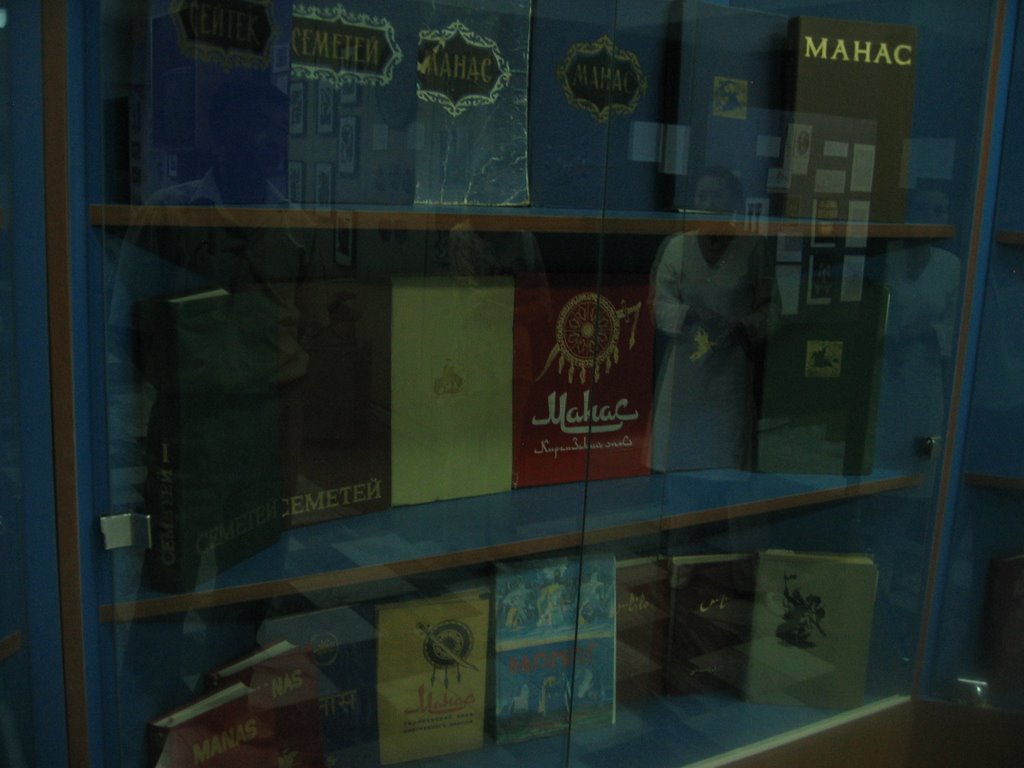
Before leaving Talas, I managed to see the two most popular tourist sites. Manas-Ordo, or the Manas legend complex, is such a part of the local characters that people say if you haven’t been to the Manas complex, you haven’t been to Talas.

Manas is a Kyrgyz legend about a hero, Manas, who searches for a home for his people. Together with his advisors and knights, he battles larger foes, until winning a battle at which he is killed.

Probably based on the experiences of a range of military leaders, their achievements are ascribed to the character Manas.

While books of the Manas legend are available, even in English, the Manas legend is traditionally passed along orally, by storytellers called manaschi.

The complex, including a horse track, a museum, a rose garden surrounded by 40 statues of his soldiers, a sheep-slaughtering site, and a yurt where fortunes can be told, was built in 1995, during the 1000 Years of Manas celebration. The complex makes Manas out to be a real character, saying he weighed 10 kilos at birth, was 2.5 meters tall in adulthood, and lifted a certain large rock (placed outside his grave) before each battle as a sign of luck. If he could lift it, everything would be OK. If he couldn’t, it was a bad sign and he wouldn’t go.

At the museum, they say that Manas was born in Talas, he grew up in Talas, they found the grave of a matching man (2.5 meters tall, 60-70 years old) there. What certainly does give the otherwise undistinguished Talas valley fame is that it was the site of a decisive battle between Arab (Turks, Arabs and Tibetans) and Chinese in 751. The Arabs success in driving out the Tang Chinese army brought Islam into the region and changed the course of Central Asian history.

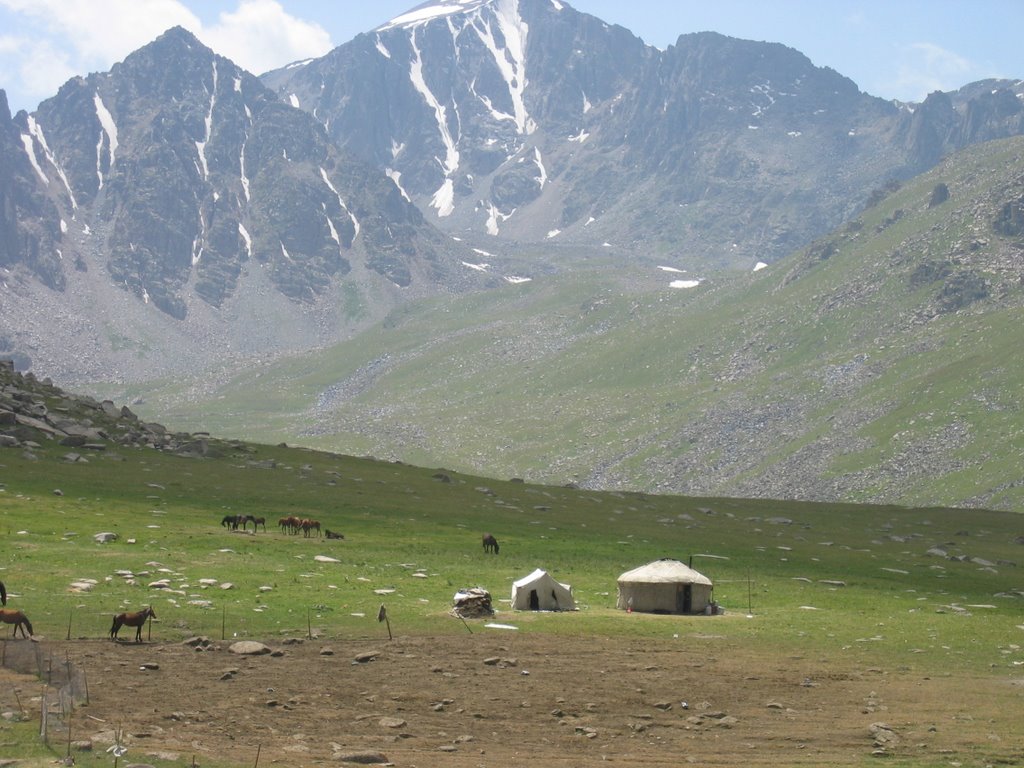
Besh Tash (Five Rocks) is a national park, located just 17 kilometers from the town. It’s a beautiful place. A rapid crystal-clear river moves through the valley, treeless, rocky peaks arising on either side. Yurts dot the pastures, while men on horseback gallop down the rocky dirt road.

Given the lack of rain, it was already dry and brown. But as we ascended, we found some green hills. If I’d wanted to spend my weekend in the most beautiful spot, I probably should have come here. But I instead wanted something a little more unusual, wanted to experience some cultural tourism. At least I got to see what the park looked like.

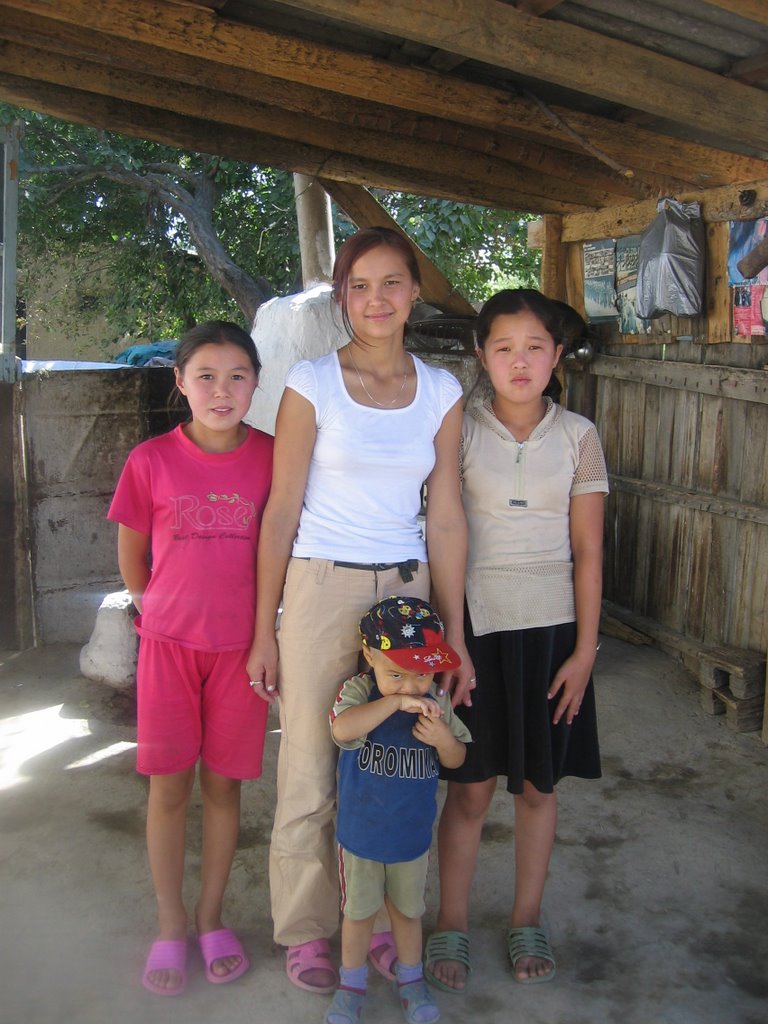
On my final evening in Talas, I moved from my village yurt to a Community Based Tourism guesthouse in town. My host family was quite well-off. Their 22-year-old daughter Elmira had already been to the U.S. three times. She just finished her studies at the American University of Central Asia, which cost her parents a pricey $1700 per year tuition. She was at home, after quitting her job at the Soros Foundation because she considered the $200/month salary too little. She’s planning to work for a phone company on a U.S. military base in Afghanistan for $500 a month.

The family had a yurt in their yard, a car, a computer, internet access, a satellite dish, a washing machine, a refrigerator.

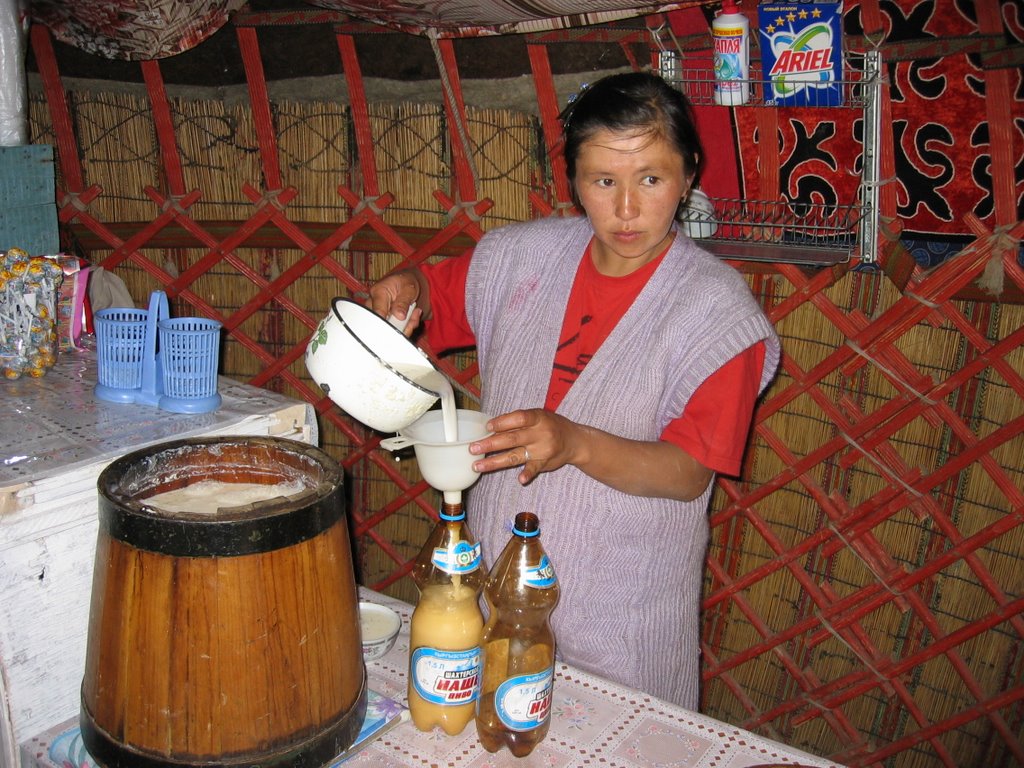
While Bermet sat next to me in the candle-lit yurt, stirring the pot of koumiss (fermented mare’s milk) as I ate my dinner, I asked her if she wasn’t scared Elmira could be stolen during her summer break in Talas.

“No,” she said. “My daughter has a different mindset. She’s been in America and she doesn’t think that way. People here know that and they know she wouldn’t stay if she was stolen.”

“Would you help her to leave?”

“Yes,” she said.

I was interested how Bermet acquired such a modern attitude, how her husband supported her, what led them to challenge the traditions that seemed so perverse in the Talas region.

“My husband stole me,” she whispered, which made the question all the more intriguing. “I was a village girl then and I didn’t know any better.”

I asked how she felt about it. She hesitated.

“I don’t have any regrets now,” she said. But at the time, she hadn’t wanted to marry him. They hadn’t dated before their marriage.

Shortly after she told me about how she supports her daughter’s free decision, she told me that she is urging her daughter to find someone to marry.

“What’s the hurry I asked?” spooning into my spiced rice with carrot, fat and chunks of beef.

“You know,” she whispered. “They still check a girl on her wedding night.” Despite all her modernity, despite Elmira’s education and travels, her private sheet
would be inspected after her first night with her new husband. And Bermet feared that if she waited too long to marry, she’d be tempted into immoral activity, she’d become an impure wife.

I told her what Medina had told me. That if the husband knew his wife wasn’t a virgin and was OK with that, the family would hide the information.

“Yes,” she said. “If the relation was only with him before marriage. But if it was with someone else, he’ll always think of her differently. I don’t think he’ll ever be able to truly love her.”

When I left the next morning, I asked to photograph the couple. Bermet wrapped her arms about her husband’s chest in an unusual sign of open affection. He, embarrassed, pushed her back. She took offense by moving away from him and crossing her arms across her chest. In the photo, he pulled her back to him. His arm is around her shoulder. Her arms remain crossed, but she wears a smile. They seem happy.

Monday, August 21, 2006

Sheker - Chingis Aitmatov's birthplace


August 7, 2006

I had planned to take the bus today to Sheker, Kok-Sai’s neighboring village and the birthplace of Chingis Aitmatov. But Zheksen insisted on finding me a car, seating me a neighbor’s white Mosvich that needed to be pushed by three people to start.

Zheksen and his family had signed up with the tourism development program some time ago, and had even held a seminar at his house. But I was his first international tourist. He was so enthusiastic and so eager to please – going out and buying bottled water, asking if it was OK that he was telling me about the region’s history (his trainers had told him not to bother tourists with information unless they ask for it). In accordance with the official prices, set by the organization, I paid him 640 som for the lodging, food and horse trip, about $15. He earns 700 som a month in his position at the local school. I could see the benefit that attracting more tourists would bring him and I was glad to participate in such a good program.

By 8:30 a.m., I was on Kulipa Kazieva’s doorstop, the coordinator of the program in Sheker. She also lives without a phone and I wasn’t able to phone her in advance. But she had an official Community Based Tourism guesthouse sign on her home and had welcomed tourists several times before. So she got right to business.

Her family had been in the midst of frying bursaki, small squares of bread. They planned to bring them to the memorial ceremony being held today for her daughter-in-law’s deceased father. She quickly changed her clothes, while I waited in the courtyard, where colorful flowers sprouted from the garden.

“This is the guide,” she said, pointing to a younger woman who walked down the street with her. I learned this woman’s name was Medina, she was 30 years old, and was Kulipa’s daughter-in-law. Kulipa brought her along because Medina knew Russian well, Kulipa didn’t.

I planned to stay in Sheker until lunch, then continue onward. I was a bit doubtful how I could stay occupied in the village for half a day and it almost seemed funny to me how these little places are trying so hard to make themselves attractive to visitors. But I ended up enjoying a very nice tour. The theme was Chingis Aitmatov and the time he spent there. But in the end, I got a better picture of general life in the village itself and a detailed glimpse at the life of someone near my age – Medina.

We started out at the house, or the plot, where Chengis Aitmatov was born. That house had been torn down. An elderly woman with a giant chest and a pained walk greeted us and invited us to sit in the shade of a tree, together with her young grandson. She was a distant relative of Aitmatov’s, through her husband, and I was urged to ply her with questions.

Having read only one of Aitmatov’s books, and not fully understanding it since I read it in Russian, I felt ill prepared. However, I asked what I could think of, and found out that his father was shot as a revolutionary in Stalin’s repression of 1937.

“Was he really a revolutionary?” I asked.

They looked at me questioningly.

“Many innocent people were shot at that time,” I said. I just happen to be reading Anne Applebaum’s fantastic volume about the Gulug right now and am well versed in the repression years.

“Oh yes,” Zina seemed to remember. “No, he wasn’t a real revolutionary, he was just caught in their company. He was traveling back here when they were arrested.”

When I asked the relative which book is her favorite, she seemed at a loss for words.

“I haven’t been able to read for two years,” she said. “Problems with my health. So I only know the older books.”

“Which of those do you like best?” I asked, looking for reading suggestions.

“Jamilya,” she said. The one I’ve read. Then she looked at Medina for help and Medina named some of his other books – A Day Lasts a Hundred Years, Face to Face, Cranes Fly Early.

We next visited the Chingis Aitmatov museum, a 3-room collection of photos and documents in the otherwise abandoned cultural house. It was interesting for me to put photos to the names, of Chingis, his parents, and even the characters of his books, several of whom were actual residents of Sheker village. I was shown where one of the characters, still living, lives. And I saw the cave where another character, who received die, hid out after stealing cattle.

It surprised me that Aitmov could have his father shot by the government, grow up the son of an enemy of the state, and then succeed as a writer in the Soviet Union. When I saw his certificate, honoring him as a Worker’s Hero of the Soviet Union, I wondered if he was truly proud of it.

These days Aitmatov lives in Luxembourg. “They admire him a lot there,” a villager told me, when I asked why he was there. But they repeated over and over again that he’d soon be returning to Bishkek. “His health requires it.” “He’s already old and feels it’s time to come home.” As though they’d be offended if he were to spend his final years elsewhere.

The mother-in-law disappeared as she went to find a car. This left Medina and I alone and Medina seemed much more free to talk. She told me she was from Kok-Sai and that she came to Sheker because of marriage. I asked how she and her husband met, knowing what the answer would be.

“We have a tradition here of stealing wives,” she said, and it was clear.

I later asked her how it happened. Her now husband had met her once and decided to steal her. He came with a friend in a car. The wife of Medina’s brother said they just wanted to get acquainted and asked Medina to meet them. When she got in the car, they stole her.

I asked how she felt. “Of course, I was crying and was scared. I didn’t want to get married. But because this family was almost relatives, my parents didn’t even come.” She was sentenced to accept her fate.

“Could you have said no?”

“Yes, but then everyone would have cried and been very upset. We have a saying, ‘A rock should lie where it falls.’”

I asked if she was upset that her sister-in-law had deceived her. This sister-in-law later received a $25 gift from the future husband’s parents during the marriage celebration.

“I don’t know,” she said and paused. She did seem to be. “It’s been twelve years now. I already have four children.”

She told me that a few years ago, she was walking back from a concert in the evening with a friend of hers. They were walking arm-in-arm and when a car approached them slowly from behind, they tightened their grip.

A group of several men jumped out. One of them held Medina while the rest threw Medina’s friend into the car.

“She was grasping my hand, holding me so tight,” Medina said. “She didn’t want to let go.”

“And you were left alone on the road at night?” I asked.

“No, there were some little girls with us.”

“What happened? Did she marry him?”

“Yes, but he ended up dying three years later, from choking on his vomit when drinking. She’s now in Bishkek with her son.”

And she told me about the times when local women feel such desperation they can’t find any way out but death.

“If she doesn’t want to live with the man and her parents refuse to take her back, there is nothing for her to do but kill herself. She’ll either hang herself or drink vinegar to die.”

“Has it happened in this village?” I asked.

“Not here, but it happened in a neighboring village. Luckily she didn’t die. They got her to the hospital in time. Afterwards, her parents took her back and she’s now a successful businesswoman in Bishkek.”

When a neighbor drove by in a rather nice car, I asked what kind of job he had. She said he was a farmer, but his sister lives in Turkey and sends money. “She’s 32 years old and works there, supports the whole family. She’s not married.

“She was also stolen a few years ago,” she added. At the time, she’d been working in Bishkek and had come back to visit her family. A neighbor stole her and she wanted to refuse.

“Her brother, the man now driving the car, showed up, with instructions from his parents that he was not to force her to stay there. He came and said his parents wanted her freed. Everyone got on their knees and cried.”

Medina told me about the wedding night, during which the husband’s sister sits outside the bedroom door and listens to all that happens within.

“What is she supposed to be listening for?” I asked.

“That the husband is pleased that his wife is a virgin.”

The next morning, they show the sheet to the husband’s parents. If there is blood, they announce the goodness of their new daughter-in-law and give money. Then they wash the sheet and hang it outside.

“And if there is not blood?” I asked.

“It depends. If the husband knows about it, knows she’s that type of girl, and is OK with it, then the parents don’t mind. Maybe they already slept together before marriage. But if the husband didn’t know, then it’s a problem.”

“What if he stole a stranger and his new wife was in love with someone else?”

“Sometimes they’ll hide it and forget about it. Other times, they’ll send her home.”

Medina led me down a country road, with bean fields spreading out into the distance, and the snowy peaks of Manas and Chingis rising before us. She took me into the cemetery grounds to see the cave where a character had hidden out. We climbed a fence, waded through a river, and walked through a bean field to Chingis’ old schoolgrounds, where there is now a sculpture garden. She showed me a mineral spring in a farmer’s homestead and pointed out three mosque – one over a century old, another one built more recently, and the central, shiny one, built recently with foreign (probably Saudi Arabian) funds.

She told me that in the past three or four years, people have become noticeably more religious, with small boys now being sent to the mosque.

I asked what she will do if ten years from now, her daughter (now in the 4th grade) were to be stolen.

“Maybe our culture will have changed by then,” she said. “Maybe men will ask women to marry them. It would be a shame though, with her just having finished her studies. Maybe I’ll just have to send her right away to Bishkek.”

She clearly didn’t want her daughter to be stolen as she was and she could tell this to an itinerant foreigner. But should it happen, I think she’d likely have to put on a happy face and accept the tradition. She had, so why shouldn’t her daughter? She couldn’t fight the system on her own. But in the meantime, she could hope that society would change.

A border village


August 6, 2006

The two most popular tourist sites in Talas are the Manas Complex and the Besh-Tash national park. I wanted to spend my weekend going somewhere off the beaten track. So I chose a route that would take me to the border of Kazakhstan, to a village at the end of the road, Kok-Sai.

In Talas, I contacted the Rural Development Service – ELET, an organization that helps to promote rural tourism. They gave me the name of their coordinator in Kok-Sai. There is no telephone service there, they told me, so just show up. I could spend the night at his house.

“And if he’s not there?”

“Don’t worry. Everyone knows him.”

This is the type of travel I loved in my younger days – travel to some remote outpost, knock on some random door, spend a night with a family and get an insider’s glimpse into local life.

I still find it a wonderful way to meet local people and to learn about the culture. But it can also be stressful, dealing with the risk of ending up alone on a roadside. And tiring, knowing that you’ll be the strange foreigner who just showed up and everyone wants to meet.

The owners of my guesthouse helped me to hail a marshrutka to Kirovka, the regional center. At first, the marshrutkas wasn’t overfull, the weather was nice, and I thought how much I loved this inexpensive and convenient form of transportation. Then several families with children came on board and it became less comfortable.

Later, a group of old ladies got on. A particularly mean one, toothless and wearing a white scarf, ordered a teenage girl out of her seat and took her place. Later she ordered a young man to get up, then had her older (but not visibly disabled) male relative sit there.

A spat broke out at the front of the bus, resulting in the driver stopping the vehicle, getting out, and forcing a passenger to get off. I thought it would turn into a fight. A man in a white felt kalpak and his wife got off.

“What happened?” I asked the man next to me.

“He didn’t want to pay. No money.”

It was interesting to see the driver’s strong reaction. There would be no free rides from him in this new capitalistic world.

There has been a shortage of rain this year and the land is dry. We drove past plains of beans, low brown mountains rising up behind them. Except for the green bean plants, the environment was brown, dry and unexceptional.

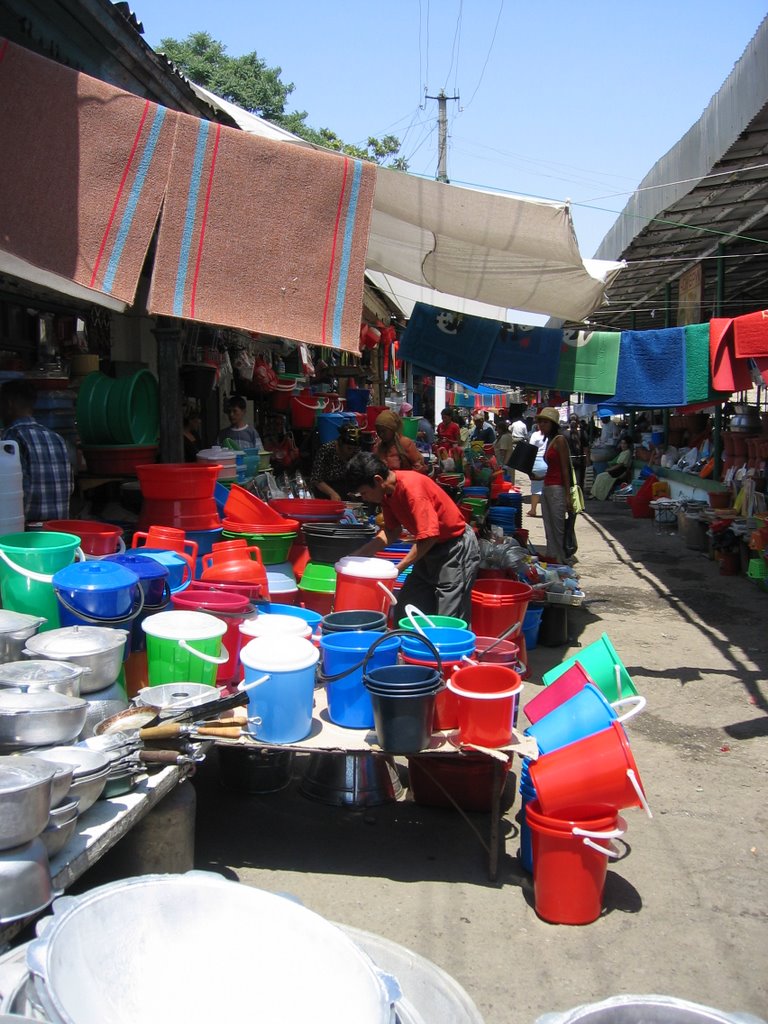
I got off in Kirovka, at a giant bazaar. People actively bought and sold cows, horses, sheep and goats, their droppings falling everywhere. Crowds of people milled past vendors selling clothing and household goods. Only later would I learn that for larger purchases, most people go to Kazakhstan, or even to Bishkek, due to the large markups in price. Spreading out from the bazaar, like legs on a spider, were rows of people selling apricots, eggplant, tomatoes, peppers and strawberries from their gardens.

It felt like a very foreign environment, as though I’d been dropped into another country. I saw only one Russian woman, an old lady selling tomatoes. Her Russian words “local tomatoes!” rang out among the mass of Kyrgyz. Everyone here speaks Kyrgyz and quite a few have trouble with Russian. It was a busy, dusty, noisy place where I couldn’t understand the language and felt out of place in my shorts and sunglasses. Nevertheless, the polite Kyrgyz didn’t give this stranger in their midst any trouble.

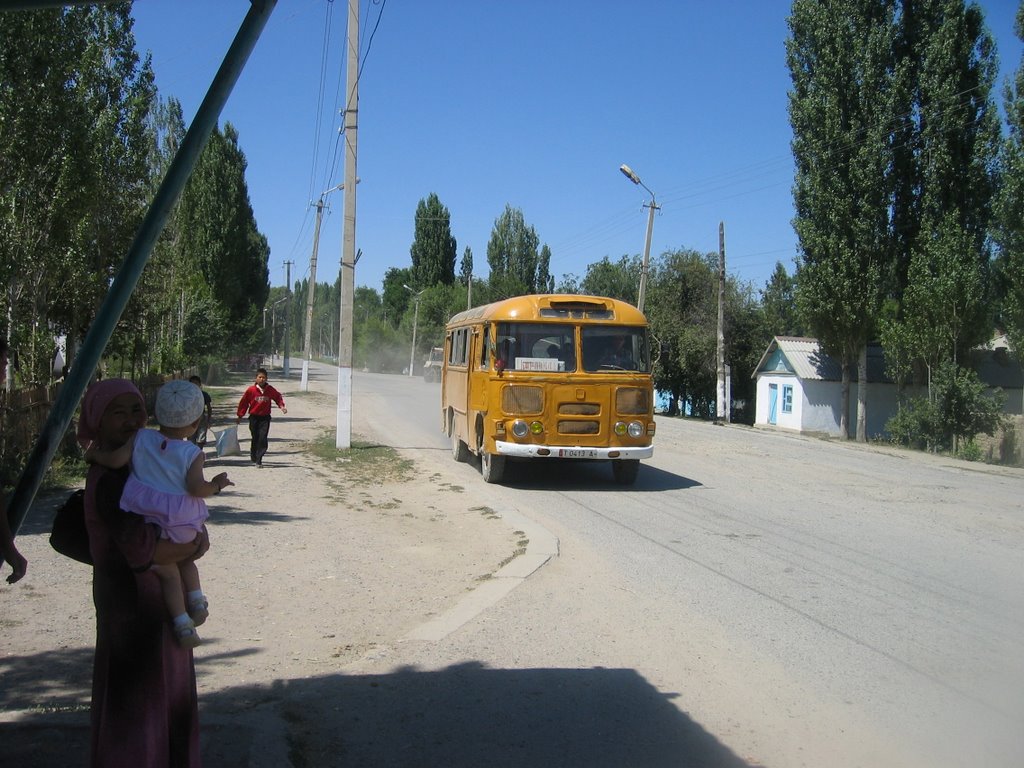
I took a rickety yellow bus to the village of Kok-Sai. The bus was packed and I ended up sitting on the metal thing that goes over the tire. I was lucky to be able to sit at all. Around me, children ate sunflower seeds and dropped the shells right onto the floor. Crunch, flutter, crunch, flutter.

The bus was hot, crowded and uncomfortable and again, I couldn’t understand anything. But what I do enjoy about taking the cheapest form of public transportation is the opportunity to glimpse so many local people in still-life – to catch a small portrait of their dress, their speech, their interactions with their companions, while we are frozen together in the same environment.

One man came on the bus with a bag of ice cream cones. After giving a few of them away, he tied the bag to a metal rung on the bus.

By the time he got off, the ice cream was virtually liquid.

“Don’t they sell ice cream in Kok-Sai?” I asked, as he led me to my destination.

“Yes. But it’s cheaper elsewhere. It costs 5 som in Kok-Sai and only 3 som where I bought it.”

He brought me to the fence of the home I was looking for. A young boy came out, then went in to find his father. Zheksen came out rubbing sleep out of his eyes. He welcomed me in and led me first to where I could sleep, then into the living room, where he had his daughter Zhanna serve me tea. Both he and Zhanna ran around picking up, preparing the bed and preparing the tea. They did a commendable job of welcoming in a stranger from the street on no notice.

I told Zheksen I was interested in taking a half-day horseback ride into the mountains and he asked his sons to set that up. Within an hour and a half, I’d drunk my tea, met the family, and Zheksen and I had mounted our steeds and were ambling down the village road.

My horse had given birth three months ago, and the foal followed us the entire way, taking advantage of any stops to have a drink of milk.

The village of 5,000 was definitely rural.

“This is the center of town,” Zheksen said at one point. I looked around and saw nothing but a few crumbling buildings and a bridge over a river. I thought he was joking under later a woman told me she lived in the village center, and got out right there.

Zheksen pointed out the fast-flowing Kurkuro river, which was mentioned in some of Chingis Aitmatov’s novels. We followed the river out of town and into the mountains, taking the road since Zheksen doubted my horse-riding skills. The hills were brown, scrubby and rocky. Green stretches appeared in the valley, along the riverbanks – copses of poplar, sunflowers, bean plants.

“The Turks came here in 1997 and introduced everyone to planting beans,” Zheksen told me. “They taught us how to do it. The first year they bought them at 3 som per kilo. The next year they paid 10 and people started to live better. After that, they paid 5 and almost everyone went bankrupt. Then they paid 20. Last year we got up to 30, and this year I heard they’ll start at 27.”

“Why was there such a big difference, from 5 to 20?” I asked.

“Because it was done through the government. We don’t know how much the Turks are actually paying. But after the governor, the prosecutor, the police and the others took their shares, there were only 5 som left for the people. I think since then they felt a bit embarrassed at taking so much.”

He told me that people can earn $500 per hectare by planting beans. In comparison, they make $375 for potatoes or $200 for wheat.

“We owe thanks to the Turkish businesspeople,” he said. “Thanks to them, people here are starting to live better.”

In front of us rose the tallest mountain, at 4,482 meters in the Talas oblast. Unsurprisingly, it’s named Peak Manas. A slightly lower peak next to it, is called by local Peak Chingis, after the Kygyz writer. We rode toward these two towering, snow-covered peaks, which provided a beautiful view.

On the way, he told me local legends.

When we passed a bowl-shaped rock, he called it the Dragon Stone. Once, a boy went out, wearing his ring that protected him from harm. He was missing for several days. The girl who loved him went out looking for him. From the opposite mountain, she used an arrow to shoot the dragon who lived in the rock. She cut the dragon open and found his ring inside.

He showed me a rock, with two trees planted on each side, growing towards each other. As the director of a Soviet sanatorium there for 15 years, he planted the trees himself, making a local attraction. He told me that was the spot with Oljobay lived with his love Kashijan, who was his mother’s sister. Oljobay’s uncle was against the union because Oljobay was poor. The fact that they lived together was shameful, as a woman’s virginity was checked by examining the sheets after a wedding night. When the uncle found them, he killed Oljobay and brought his body to Naryn. He removed Oljobay’s heart and dug a grave. Kashijan asked her brother permission to say goodbye to Oljobay for the last time. She went into the grave with him, kissed him and said she couldn’t live without him. While still in the grave, she stabbed herself in the chest. The Uncle declared he wouldn’t allow them to lie together in the same grave. But the two trees growing together in this spot shows that God put them together.

While pointing out a rock shaped like a resting camel, he told me that in the 17th or 18th century, Kalmaks stole a local girl to be the 2nd, 3rd or 10th wife of an old khan. She was only 14 or 15, he was old. She didn’t like him and thought of her family and homeland every day. When she had a chance, she ran away on a camel. They came after her. There was a path in the road and she and the camel fell into the river and drowned. The baby camel that had been with them remained, waiting for its mother, lying by the river’s edge and crying. God turned it into a rock.

He also told me about his family, and some about the local culture. He has 9
children – 6 daughters and 3 sons.

“The reason I have so many children is that my wife kept having daughters,” he said. They had five daughters before they had two sons. “Daughters are yours for 18 years, but then they become someone else’s. If you want to think about your future, you need to have sons, who will stay with you.” That is the Kyrgyz form of social security. Zheken’s 4-year-old son, as the youngest, will be expected to stay home and take care of his parents. In return, he will inherit the house.

He told me that his four older daughters are married.

“Were they stolen or did they marry themselves?” I asked.

“Girls are always stolen,” he said.

“But did they know about it or were they stolen by strangers?”

Two of them had dated their future husbands and agreed to be stolen. Two others were stolen off the street.

“They had just finished their studies,” he said. He told me that the family of the husband traps the stolen girl in a room, not letting her go until her parents arrive.

“Did they want to marry?” I asked.

“No. They were crying and trying to leave.”

“You couldn’t help them?”

“We have a very strong tradition, especially in the village. It’s only in rare cases that a girl leaves.”

I told him about gay marriage and he seemed to be completely in shock at the idea of two men together.

“What would they do together? I can’t even wrap my mind around it. Obviously, a woman’s skin is soft and smooth. It’s a pleasure to stroke it. But a man’s skin?”

I told him that the most of the homosexuals I’ve met are very nice people. Yet he seemed perturbed, not able to understand someone born so different from him.

He had a very clear sense of what a man should be.

“I watch the Brazilian soap operas and I see all these women having trouble getting pregnant. I wonder what is wrong with their men. I think the Brazilian women should come here, where the men are strong and virile!”

He said that men are always considered higher than women.

“Even if a wife is golden and the husband is bad, he’s still considered higher than her.”

He told me that if a woman cheats on her husband, it will result in divorce or death. If a man cheats, the wife will yell or cry, and that’s it. If a girl gets pregnant before marriage, it had no effect on the boy. In the past, it was so shameful for the girl that she couldn’t even go out onto the street for fear of harm.

“Of course the men are guilty. Women can’t get into trouble without a man. But whatever the men do, they are not considered to have done anything wrong.”

“Must be a nice life for a man,” I said.

Despite his village upbringing and the conservative values that engendered, Zheksen was interested in hearing new ideas and seemed willing to consider change. When he told me how the sheet is hung outside after the first night of marriage, to display the virginity of the bride, he said, “Maybe in the future that won’t occur. Maybe the European standard will come to us.”

That evening I spoke to his daughter Zhanna, a pretty girl who just finished her first year of study at the agricultural institute in Bishkek. She is spending her summer vacation at home in the village.

She and her younger sister were showing me photo albums. When she showed me a group of girls from her high school graduation, I asked where they were now. All but one are studying in Bishkek. One was stolen, at age 17, and is now a housewife.

“Aren’t you afraid of being stolen here?” I asked her. I wished her back in Bishkek until she turned 25 (old by Kyrgyz standards) or until she found a husband she liked. Then she could walk outside without fear that she could be grabbed at any moment.

“I was already stolen,” she said. I looked at her, surprised. Her father had just told me he didn’t help two of his daughters, that it was rare to leave after being stolen.

“It was just after high school,” she continued. “I was too young. My parents helped me to leave.”

“What about the other girl? Did her parents not help her?”

“No. Her parents wanted her to get married.”

I looked at her with respect. It must have been a terrifying experience to go through as a 17-year-old. To have seen so many others girls stolen during her childhood and to think she might have to spend the rest of her life with that stranger, to give up her dreams of university studies. Zheksen had been remarkably open with me during our ride. But he didn’t tell me he’d saved his fifth daughter from being stolen. I also respected him.

Life in Talas


August 4, 2006

Day four in Talas and I’m starting to feel at home in this little town. Or I should say, in my yurt in my village 20 kilometers from town. I planned to move to a place closer to the center, but my yurt and the family that runs this complex grew on me and now I’m staying.

I’ve settled into a very comfortable evening routine. Upon coming home, I go to my yurt and change into comfortable clothes. Then, while it’s still light, I sit on a hillside swing and read with a view of the garden, flowers and mountains. I watch Saiagul, a young hostess, picking strawberries for dinner. I see her friend and companion Makpal gather armfuls of round, red tomatoes and long, green cucumbers. These children, probably early or pre-teens, do most of the serving. They are eager, anxious, excited and wanting to please. I already miss Ulkiss, a 2nd year university student who studies traditional Kyrgyz music. She was here my first few days, then returned home to her parents in Talas.

Adil, the white-beared patriarch of the family and Farmer-Hero of the Soviet Union, strolls up and down the cobblestone path, using his cane. “I have a feeling the air is cleaner higher up,” he tells me, then welcomes me to eat apples and strawberries right off the trees and plants.

The girls call me to dinner at 8. The main dish is always accompanied by apples, watermelon, home-baked bread, sliced tomatoes and cucumbers from the garden, homemade raspberry or blackcurrant jam, and cream made from cow’s milk. After dark, I work on my computer in the dining room, make a cross-ocean cell phone call while appreciating the wonders of technology that can connect Urgochkor to another continent, then fall asleep on a pile of mats with a view of the stars through my yurt’s open roof.

A few things I’ve noticed about Talas:

1. Manas, the legendary folk hero, is incredibly important here. Both of the bank directors I visited sit in front of a giant painting of Manas. When a local employee gave me a lift, I saw a Manas placard hanging from his rearview mirror. Talas is home to the Manas Complex and everyone I met asks 1. Have I been to the Manas complex? and 2. Have I been to Besh Tash national park? I haven’t been to either, but hope to reach both before I leave.

2. Almost everyone with a plot of land grows beans, but almost no one eats them. When I tell people that I’d like to buy some of the famous Talas beans, they invariably ask: To eat them? I’m not sure what other purpose there could be. I suppose they think I might like to plant them, as they do. After an unsuccessful search at the market, I finally managed to buy one kilo of beans from a man who buys beans from the locals and exports them to Russia. By special request, my guesthouse cooked me some beans for dinner last night. They didn’t seem to know what to do with them – how to spice them, what to mix with them. They were just boiled red beans, but I still liked them.

3. This is a very Kyrgyz area, probably the most authentically Kyrgyz area I’ve spent time in in Kyrgyzstan. The population is overwhelmingly Kyrgyz, people speak primarily in Kyrgyz, and signs, which are usually bilingual, are sometimes in Kyrgyz only. While most people still use the old Soviet names for streets and villages, the signs only have the new Kyrgyz versions. I hear traditional Kyrgyz names that I haven’t heard before, and koumiss (fermented mare’s milk, usually found in yurts along mountain roads) is sold all over, even in cafes in the center of town.

4. The people seem to be more reserved than in other areas. When I ride my bike into town and wave at the children, they don’t respond, but just stare. The adults have a similar reaction.

5. Family celebrations, called toi or ash are very important and are extremely expensive. It’s considered normal for a family to spend a third of their entire income on tois. Even spending half or more is OK. I asked when a toi is held. “When a baby is born, when a baby turns 40 days, when a baby walks or talks, for a wedding, to mark a new home, for a 40th, 50th, 60th birthday or anniversary. For anything,” a local employee told me. I asked why they were so expensive. “In Osh, they kill and serve a sheep, which cost 3,000 som ($75). Here they kill a cow or horse (costing $250-750). It’s a big difference,” he told me. Obviously, these regular and large expenses make it more difficult for a family to build up capital. I hope they find their tois extremely enjoyable.

Today I met a man who proudly introduced me to his four-year-old son. He kept
prodding his son to ask me questions, reminding him this was a real American, he should appreciate the opportunity. The son shyly slunk away.

“He’s going to be proud of himself now,” his father told me. “He loves to watch American movies on our satellite TV, especially futuristic movies, that show the year 2015 or 2030. He asks me if life is really like that in America and I tell him it’s fantasy, but he doesn’t know what that means. He thinks people really live like that.” And now he’d met a product of that society. I supposed I looked pretty boring in comparison to what he expected.

This same family had a 9-month old daughter. I could see she wasn’t wearing diapers and I asked the parents when they stopped using diapers.

“We barely used them at all,” the mother said. “They are bad for kids.” She looked at me strangely, as though wondering why I would expect diapers to be used. When I told her that people in the U.S. often use them for 2-2.5 years, the whole family laughed.

I saw some statistics recently that showed the increase in the age of potty-training and it’s relation to the diaper-making business. It’s an interesting example of how a commercial industry can affect an entire society’s child-rearing and health habits.

A yurt hotel


August 2, 2006

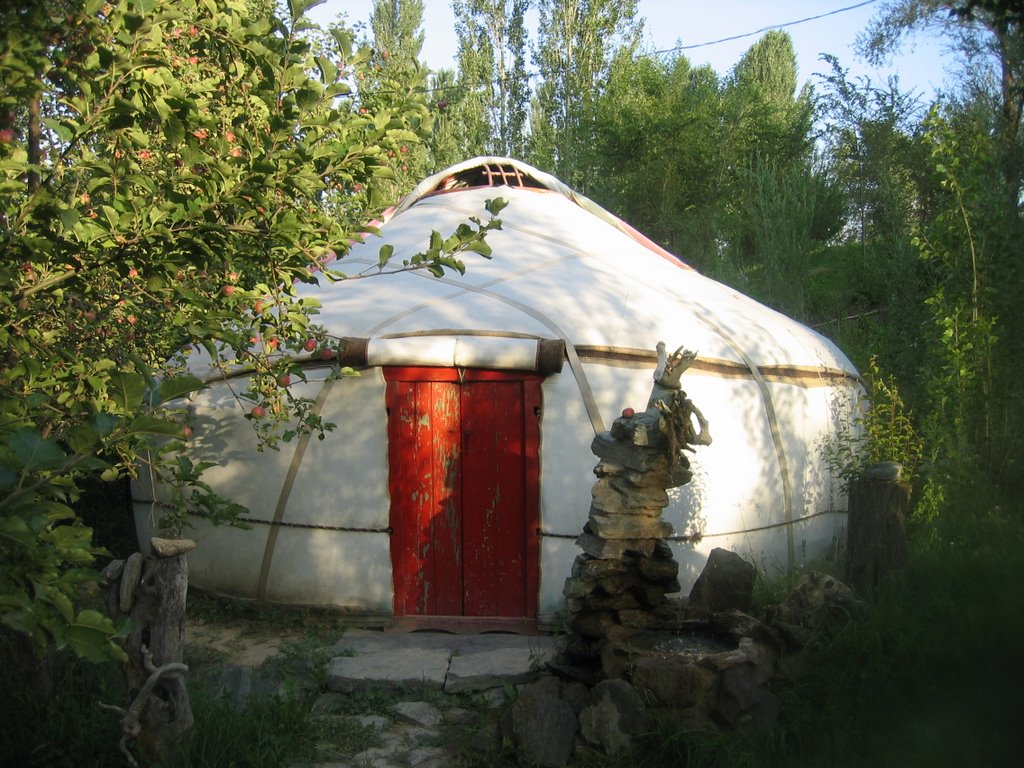
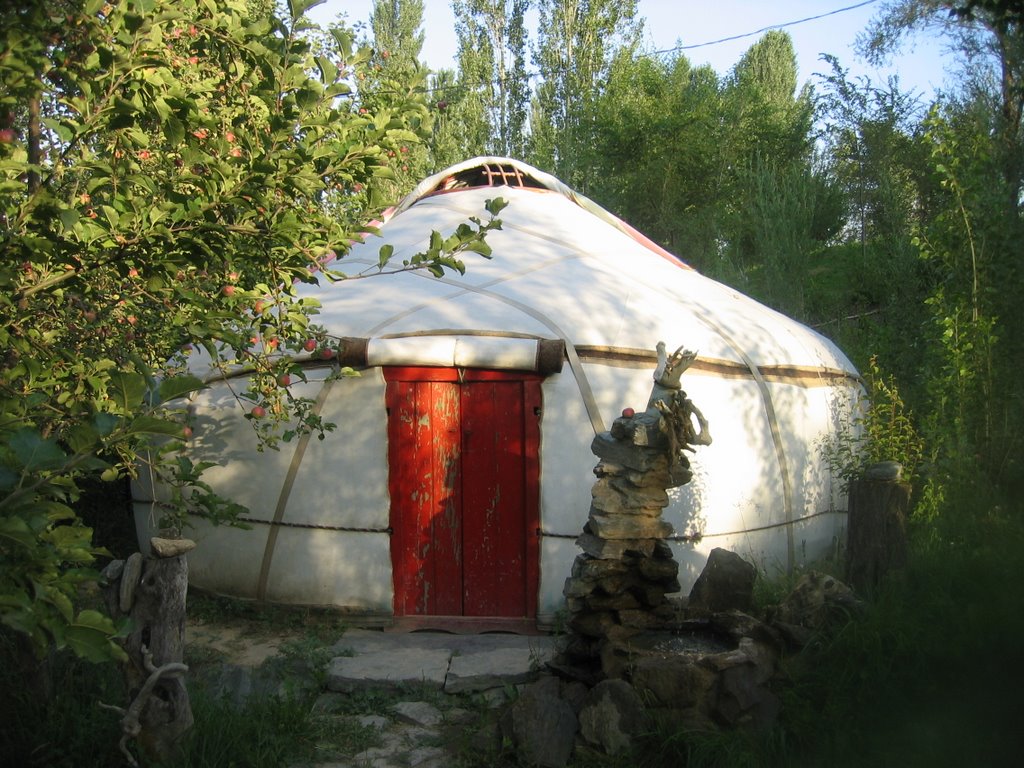
Last night I had an entire yurt to myself. The owners brought stacked up several mats, put a sheet on top, and gave me a blanket covered in a sheet. The upper circle of the yurt, where a stovepipe would usually go, remained half open. So every time I woke up I looked out at the black night sky and breathed in the cool, fresh mountain air.

I’m now typing on my laptop in the yurt, still scrunched under my blanket in the chilly morning air. When my eyes look up, they follow the circular red spokes that hold up the roof, I look at the beautiful red wallhangings, that line the interior, at the red felt mats that cover the floor and release a scent of sheep, at the small red double doors, through which I entered, up at the high branches of popular trees, swaying in the light blue sky. I hear the swish of passing cars (which seems strange in a yurt), and hear cow noises.

This is a tourist complex that opened two years ago, 20 kilometers outside of Talas. Talas is the capital city of the Talas region, the area in the far northwest of Kyrgyzstan. This is my first visit here.

The large and beautiful property is filled with water and vegetation. A stone path leads through a flower garden, with strawberry fields on either side, to my yurt. A bamboo bridge covers a small stream, and near my yurt are three small fountains, providing me with the constant music of running water. Futher on, I can follow the stones to a swing overlooking the gardens, to two traditional Kyrgyz toys – one resembling a seesaw, another a long, flat wooden swing, that two people stand on and row like a boat. There are places to sit in the shade of tall trees. At the top of the hill, the property moves into full-fledged fields, where they grow animal feed.

The friendly family lives in a house on the property. Yesterday I returned to my yurt and passed an elderly Kyrgyz man in the garden, picking fresh strawberries. He wore a kalak and suit jacket, had a long white beard and carried a cane. He told me that he’s lived here since he was a small boy.

It’s a relatively remote region. One paved road leads here, but it involves going through Kazakhstan, which requires a Kazakh visa. The second option follows the same hairpin turns and 3,586 meter ascent as on the way to Osh. Then it turns off and crosses another mountain pass, but this time on a dirt road. The landscape is one of low green mountains, scattered with boulders, white snow stripes covering nearby peaks. Yurts dot the area, the owners making homesteads, with a yurt, a tent, a corral for the horses, and endless green snacks for the herds of cows, goats and sheep.

Talas is a primarily agricultural area and is primarily known for its beans. Bean signs began to appear as soon as we arrived in town. From what I hear, the majority of beans produced are sold overseas, leaving little for the local population to eat. Buyers come from as far away as Bulgaria to buy Talas beans.

The locals don’t seem to be much of bean-eaters, so they don’t mind that their product is sold where it can fetch the highest price. When I tried to order beans at a café last night, I was told they didn’t have any. Instead we had roasted chicken, tomato and cucumber salad, sliced cucumber, crab stick and corn salad, and the everpresent olive, a Russian salad of potatoes, sausage, egg, and pickle.

It’s a long haul from here to town, and I’m planning to try it today on my bike. But since it’s not so convenient to trek back and forth, I’ll probably end up moving to someplace closer tomorrow. Until then, I’ll enjoy the wide, round red space of my own, private yurt.

Monday, July 31, 2006

Biking around Issyk-Kul day 8: Jeti-Oguz Sanatorium to Tyup – and the circle is finished!


July 23, 2006

I had big plans for the last day of my Issyk-Kul loop. I wanted both to hike
through the Jeti-Oguz canyon to the Valley of the Flowers, and to bike another 60 kilometers or so to finish up in Tyup. So I was up and outdoors at 7:20, beginning my hike.

I walked alone for about an hour along a gushing river that roared in my ears. Above me rose pine-covered slopes. As I followed the winding river through the canyon, I’d occasionally cross it on bridges made from tree trunks.

A few cars came by. When three young Dungan men from the Karakol region offered me a ride, I accompanied them to the Valley of the Flowers. They continued on further, to the summit and to a waterfall. I sat in the large meadow, where purple and yellow wildflowers shot up from the grass. I watched horses and cows running free and listened to their moos and whinnies, as though I was in a playground for animals. They seemed so wild and happy and free. And they seemed to belong there. I, as the only human around, was a visitor to their world. Again, Kyrgyzstan amazed me.

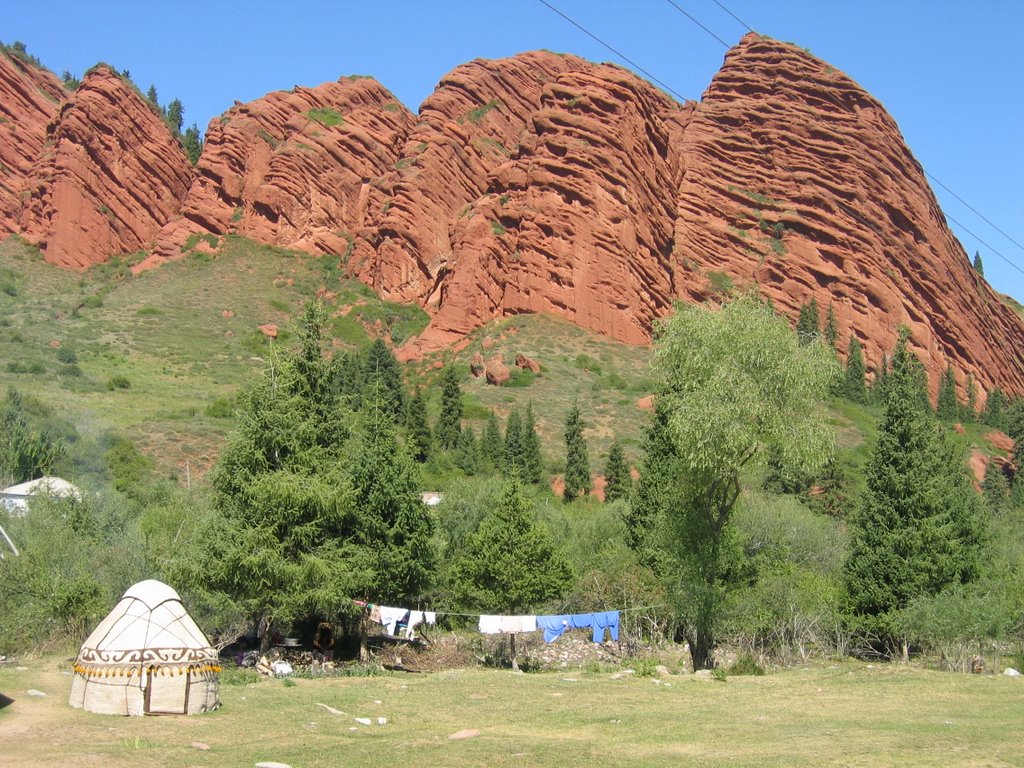
I returned to the sanatorium by foot, crossing a moraine, then walking back through the canyon. At the end of the canyon, the seven red cliffs stood sentinel. The story goes that once a king stole the wife of another king. The king who lost his wife went to see a wise man and asked how to make the king-thief suffer as much as possible. After hesitating, the wise man recommended that he kill his former wife, letting the king-thief have a dead wife, but not a live one. At a funeral feast in the mountains a few days later, the king sat next to his former wife. As the last bulls were slaughtered, he drove a knife into his wife’s heart. Blood flowed from her heart, carrying the seven bull carcasses and the king-murderer with it into the mountains and the valley. The seven bulls turned into seven mountains.

I started off my ride coasting for almost the entire 15 kilometers of dry, scrubby landscape I’d struggled up the night before. One boy on horseback gave me the finger, the first negative interaction I’d during in the entire ride. Another boy had pestered me for money the night before, and the service at the sanatorium was awful. Though I wasn’t in Jeti-Oguz long enough to make much of a fair judgment, I did get the sense that the people in the area were less friendly (or, as the locals say, “civilized”) than other areas I’ve traveled to (with the exception of the remote southern village of Kojo-Kelen, which I felt a similar reception).

I continued along the quiet, calm, green, tree-lined road I’d been on the day before, with fields on either side, mountains rising up behind them. I passed a lot of horse-drawn wagons, with a wooden arch rising over the horse. In one, I saw an entire family packed in the cart with a new, modern baby carriage. Others traveled with a cow on board. And in many of them, either the passenger, or even the driver, lay asleep in the cart, trusting the horse to move ahead and avoid getting hit by passing cars.

After a much anticipated stop in Karakol for a high-quality lunch and some communication at the internet café, I decided to make the final push on to Tyup.

The road to Tyup is a rolling up and down. I had to make one major climb, but was rewarding with two wonderful downhills at 12% grade, some of the best coasts of the trip.

The tree lined road mainly provided views of fields – an array of pastels in green, yellow, blue and white. A woman in a scarf and a young girl climbed up the mountain, running around on either side of the road, looking at the views – of the newly reappeared Issyk-Kul on one side, undulating meadows on the other. The woman gazed over the meadow with her hand on her forehead, then quickly ran back downhill when she saw me looking at her.

I liked the atmosphere in Tyup. Swimmers walked happily to and from the canal, carrying plastic bags and wearing flip-flops. I twice saw men giving women a ride on bikes – both an older and a younger couple. Sunflowers tilted their heads in the gardens behind people’s homes.

And when I approached the area where I’d set off on this adventure four months ago, I hopped into a marshrutka with my bike, tired, burned, dirty and sweaty. But watching the scenery go by, and knowing I’d covered so much territory - all I could see and all that wrapped around the immense body of water - I felt proud and relieved, as well as exhausted.

Biking around Issyk-Kul day 7: Tamga to Jeti-Oguz Sanatorium


July 22, 2006

I began day seven of my bike ride around Issyk-Kul in the village of Tamga, on the southern shore of Issyk-Kul.

Leaving Bishkek on Friday evening, it didn’t take long before cattle, and the children herding them, blocked the roads. Drivers wove through bovine behinds.

Not far outside of the city, a long string of vendors sold fresh fruits and vegetables directly from the adjacent fields to passing motorists. Judging by the cars stopped at these miniature stands, they were doing a brisk business.

It’s now the height of the season at lake Issyk-Kul and quite a bit of traffic headed to the lake on Friday evening. However, once we turned off onto the southern shore, suddenly we were almost alone.

Most visitors go to the northern shore, where there are more developments, more discos, more cafes, and more beach-front entertainment. The southern shore, poorer, more sparsely populated, and less developed than the north, attracts those who seek ecological pristineness, quiet, and simple relaxation.

My driver, Volodya, lives in Khaji-Sai, a village on the southern shore. He loves it there. An ethnic German, his mother emigrated to Germany a decade ago. And 8,000 of the town’s 10,000 former residents have left. But he and his family stay in this village, supporting themselves on his Bishkek-Issyk-Kul taxi service.

I could see why he liked it when our tire went flat on the dark mountain pass. As he put on the spare, I could look up and see a panorama of glittering stars.

Now that I've biked through much of the Issyk-Kul territory, I feel a much closer relationship to the place. I can remember where a particular bread kiosk is located, where the bus stand with the good view is, where were the steps leading up to a hotel. I remember what it felt like to move through a particular area - tired, challenged, exhilarated, awed, and I associated that feeling with what I saw.

I stayed in a guesthouse in the quiet, green village of Tamga, formerly a popular resting place for the military.

The owner told me that several other bikers were guests as well, but already asleep – a couple of French and a couple of Russians. They were headed in the same direction, but were long gone by the time I got up and enjoyed my breakfast near the garden of flowers and fruit trees.

Once I got on the road, I coasted downhill to the lake shore, then followed the road along the coast. It felt wonderful to be on the road and I was lucky to have wonderful weather. The nice breeze cooled the effects of the bright sun.

I passed the village of Barskoon, beyond which lies the giant Kumtor gold mine, a significant contributor to the Kyrgyz GDP. I rode along calm, turquoise bays and deserted beaches lined with flowering purple and yellow bushes. Even from a distance, I could see the rocks below the turquoise water, which then moved out into a deep blue. On the other side of the road, beautiful, snow-peaked mountains lined my path. The smell of herbs filled the air and I listened to the chirping of various birds, the sound of rushing rivers, the occasional swoosh of a car, and the calls of faraway children.

Orange apricots hung from trees. When I’d stop to take a break, I’d hear them fall with a thump, like miniature coconuts. Along the roadside, I passed two men with two buckets of apricots, hoping that a passing marshrutka would stop and buy them. They gave me three and I bit into the sweet flesh with pleasure.

I took my lunch break at a beach near the village of Ak-Telek. After changing in a tunnel, I joined the two families swimming at the remote beach. The water was colored sky blue, smooth and clear. Only the snowy peaks and wispy clouds on the other side separated it from the matching sky.

The families looked at me briefly, then let me be. They were busy calmly swimming, turning black in the sun. No one was there to sell us anything. We sat within a bowl, surrounded by mountains, allowed to enjoy such an immense amount of beauty to ourselves. I loved Kyrgyzstan there.

I watched a father giving his children cannonballs. I laughed as two boys pulled a girl in a bikini into the water, and she turned around and pushed one of the boys in.

“Good for you!” a woman cheered her.

A young local man rode up on a horse and let it drink. When he dismounted, the horse rolled in the stand. After encouraging the horse to roll, the man then stripped off his pants and long-sleeve shirt, jumped back on the horse, and rode it into the lake. As he went out to a depth that reached the horse’s neck, he seemed to show off, as though he was on parade, and drove the other beachgoers out of the water in the process.

While struggling over several kilometers of road layered with additional rocks, I saw passing cars raise a shower of rocks. These flying stones knocked out the entire front window of a truck carrying a family. Women and a baby looked forlornly from the cab as the men peeled out the remaining pieces of glass.

Eventually, the road moved away from the lake and the scenery opened up into a green valley and fields. Tall poplar trees lined the road, making for a cool and pleasant ride. I passed white potato flowers in the fields, watched the laborers hard at work, and listened to water rushing through the many canals.

In the villages, the signs of apricot season clearly showed themselves – families preparing apricots for shipment, boys throwing apricots like baseballs, and large refrigerated rigs collecting crates of apricots for sale elsewhere.

The people along the way were very friendly. Most yelled out “Hello!” Sometimes a child would shout “Tourist!”, alerting his friends to the passing sight. I could feel that it was now tourist season – with more cars and activity than my last visit.

This was the first time I rode with a bike computer and I found the information helpful. In my 10-hour ride, I only spent 6 hours and 20 minutes in motion. The rest was filled by breaks, taking notes or photos, or talking to the children I passed.

By the time I reached the turn-off to Jeti-Oguz, I had already traveled 72 kilometers and was tired.

“The sanatorium is another 15 kilometers,” a shop owner told me. “Uphill.”

I frowned.

“You should hurry. It’s not good to be alone. The Kyrgyz here are wild and while most are good, some aren’t.”

I was taking this detour to see the famous red cliffs that appear on many postcards of Kyrgyzstan. As usual, I didn’t prepare too much in advance though, and I didn’t realize it was quite so far, nor uphill. It was already six p.m., so I needed to hurry before the sanatorium registration might close for the evening.

I slowly plowed my way up the gentle, but continually sloping road. At the end, I was so worn out, I had to take breaks and eat something every two kilometers. I saw the red cliffs ahead, including the broken heart, a giant red rock spliced in two. Several beekeepers worked at their trade along the roadside, selling their products to passersby.

I arrived at a café hungry and caked with sweat. The kind family, who lives in the back of the building, served me lagman and slices of juicy tomatoes and red watermelon.

I made it to the sanatorium just in time to get a room, though the administrator seemed less than pleased to see me. She sat at a desk, busily penning numbers into a ledger. She ignored my request for a room, several times.

“Wait,” she told me.

I watched her as she painstaking wrote a series of number - 33, 34, 35. After making several rows, she then starting adding sub-numbers to each - 3,4, 5. When she finally led me to my room, she’d forgotten both the key and the sheets. There was no shower and she couldn’t tell me how guests washed.

I was able to take a mineral water bath, which was disappointingly cold. Then I had nothing to do but return to my depressing room, with the spider webs around the window, the burned nightstand, and the old, stained mattresses. It cost just over $4, so the quality was in line with the price. But I knew the red cliffs and the raging river were just outside and I looked forward to going out among them the next morning.

Thursday, June 29, 2006

Ala-Archa


June 28, 2006

On Sunday, I joined Boris for one of his fabulous group trips out to nature. This time, he went to Ala Archa, for a hike to the waterfall – a place I hadn’t been before. It was a much needed and appreciated breath of fresh air.

A lot of other people had the same urge. The group filled up two buses. But as the only foreigner in the group, it was still a nice opportunity to practice Russian and to catch up with some of the frequent hikers I knew.

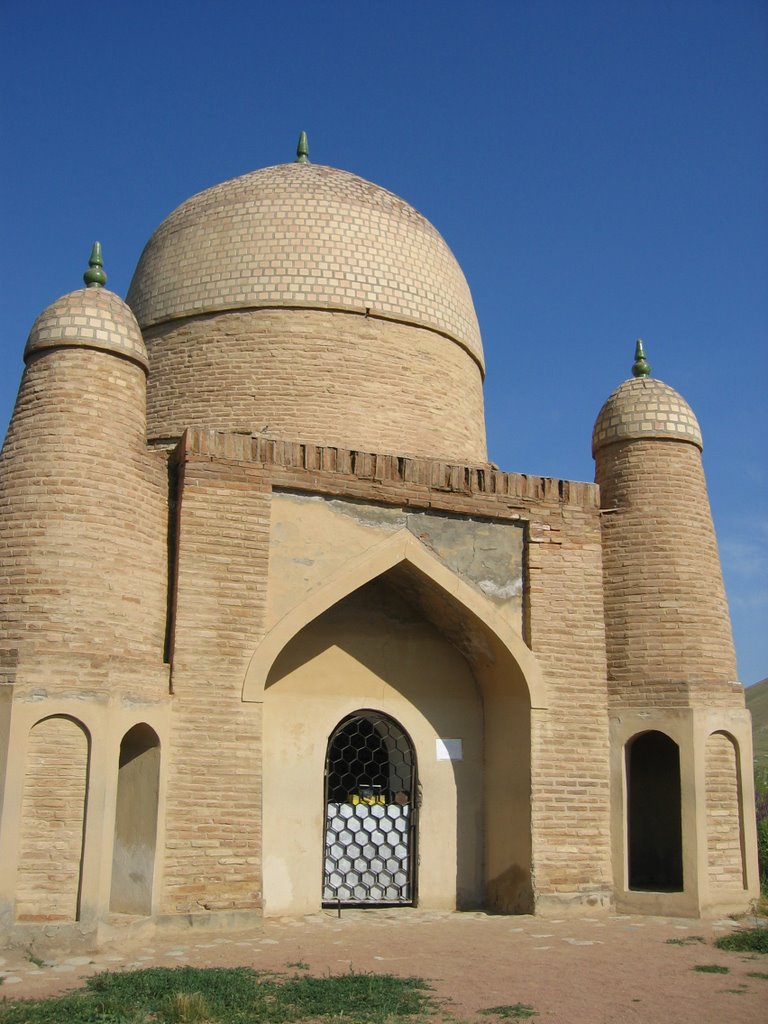
On the way there, we stopped at the Khan’s grave, a monument to Baitik Batir. He lived from 1820 to 1886 and was a leader of a Kyrgyz tribe. He is credited with freeing Kyrgyzstan from Khokand domination and uniting it with Russia.

The sandy brick structure includes arches, minarets, and rounded domes, much like a mosque. A pregnant woman in a sky and cloud-colored dress ran her hands over the bricks as she walked around the structure. She made several rounds, looking reverent, her dyed blond hair covered with a beige headscarf.

Boris told us that the monument is a holy site and is visited by women who can’t give birth or get married.

Some people in the group continued through the cemetery, long weeds and flowers rubbing against their legs, to see the tall, black metal structure honoring Batir’s assistant, Boshkoi Batir Ozber-bai. Others tried their luck at prayers, inserting money into a locked metal box, reaching their hands through the metal grate and holding them outstretched, wishing (presumably for a mate or a child).

An ostrich farm was located near the monument, where people could pay about a dollar to look at the ostriches imported from Australia, or buy an egg for $75.

Ala-Archa is just over twenty miles from Bishkek, but once in the park, it feels like being deep in the Alps. In 1985 it was made into a national park. Due to its glaciers, it is the coldest canyon in the area.

Because of its proximity to the capital and the good roads there, it receives a lot of visitors. The lot is always packed with cars. Not the Moskvichs and rumbling old buses of Sary Chelek, but Maximas, Opels, Audis, BMWs, VWs, Landrovers, and the clearly marked SUV of the International Red Cross.

There are two types of visitor to Ala-Archa – the picnicker and the hiker. Most visitors are picnickers. They find a spot with a view of the rushing river, claim their territory, and sitting there in front a constant supply of food for the entire day. Unfortunately, enough of these people lack environmental awareness that the picnic areas are littered with refuse.

The hikers don’t have to travel far to get away from the crowds. They disappear into the mountains and find remote, clean places to rest and lunch. They find fields of white, purple and yellow wildflowers bursting into bloom in the late morning sunlight. They feel the icy water running over stones as they scamper across streams. They feel the geological past as they cross fields of boulders sprouting moss. They appreciate the power of the mountains as they approach the jagged peaks.

I saw families seated on rocks or among wildflowers, enjoying self-catered picnics. I watched an old couple enthusiastically gathering wild herbs along the way.

The walk to the waterfall was largely uphill and challenging. It took almost two hours. When we got there, I sat with Feruza, an analyst at the electrical company, and her 12-year-old daughter sasha. I was also semi-supervising Bagdan, my friend’s 10-year-old son, who she’d sent on the trip alone.

We sat near the waterfall, where we could watch the water splashing from the rocks 50 meters up in a sunlit spray. It hit the shaded black rock mid-waterfall, then ran down in streams of white rivulets. Young people approached and stood against the falls, getting soaked for the sake of a memory or a photo. The numerous rapids that emerged from the falls extended their sound around us, like a song that we could stand in the middle of.

Everyone else was returning on the bus. But I’d brought my bike and planned to bike back to the city. So I walked back down ahead of schedule and began my 2.5 hour ride back home.

It was the first longer trip my new bike had taken. It handled the distance and the roughness pretty well. But I don’t feel like I got much exercise. It was almost all downhill. I never really thought it possible to coast almost nonstop for about 20 miles, but from Ala-Archa to Bishkek, it can be done. It felt more like a motorcycle ride, which wasn’t bad either.

Wednesday, June 28, 2006

reading recommendations?

June 23, 2006

Lately I’ve been reading too many mediocre books and am longing for some books that will wow and inspire me, the kinds that one finishes with a sense of awe. I’m looking for books like those written by Wallace Stegner, TC Boyle, Jhumpa Lahiri, the Russian masters, Junichiro Tanizaki and Theodore Dreiser. If anyone has recommendations of fantastic, well-written and moving books, fiction or non-fiction, I’d appreciate the suggestions.

Since I am planning a visit to Nicaragua in the future, I’d also appreciate recommendations of books written in Spanish and/or about Nicaragua.

Bishkek


June 23, 2006

Last week, I got a new bike to replace the bike that got stolen, a red and black 21-speed with disc brakes. It’s wonderful to have wheels again and the ability to cycle around town raises my happiness index by several points. I had thought about continuing my Issyk-Kul journey this weekend but decided to take it easy since I’m heading to the States next weekend.

It’s nice to have some time to sit in front of the fan, to read, to write and to cook. I plan to attend water aerobics this afternoon and tomorrow will go on a hike and a bike ride to a nearby national park.

Last night I spoke to Zhenya and she was in a bad mood. She had wanted to go hiking on Sunday, but the $4.25 price was too much to allow both her and her son to go. The owner of the shop she rents is demanding she pay $120 that her deceased partner owed her.

“Hussein’s relatives sent me $500 to cover his debts,” she said. “But I already gave that away. It wasn’t enough. And I feel bad going back to his family, after they’ve already lost him, and saying that his debts were more than that. Maybe they will think I am deceiving them.”

At the same time, she risks losing her Chinese long-term tenants in the apartment she rents out because they are being constantly harassed by the police. A police officer came by, apparently to check passports, and saw that they had goods for their business stored in the apartment. He demanded money and they paid him $180. From that point, he hasn’t left them alone.

“Why don’t they just not open the door?” I asked.

“They don’t open the door any more. But they live on the first floor. And this offer comes and taps on the windows, pulls at the bars. They are afraid and they say they may have to leave the apartment because their nerves can’t take it anymore.”

When the officer is harassing them, they call Zhenya. Several times she has run over there and confronted the officer.

“He’s a young guy from the mountains, probably Talas or Naryn, and looks so evil. I think he would kill me if he could,” she said.

She went to the police department to complain.

“I told the officers at the intake center that an officer was harassing my tenants and was extorting money from them. They just looked at me and smiled, asked me how much money he was getting, as if they wanted to come get some themselves. At just about the same time, someone handed me a long article from the Evening Bishkek newspaper, in which it said that this was a racket and these officers, who are supposed to be controlling foreigners, take money and send portions of the money all the way up the management.”

For the first time, Zhenya brought up the possibility of leaving Kyrgyzstan. “All of this makes me think that this place is just a mess,” she said. “And it’s not getting better. It makes me want to not live here anymore. I know that Russia has its problems too, but the people there must be more civilized.”

That same day, our former Osh officer manager got onto on Osh-Moscow plane with her daughter and left her country of birth behind to build a new life in Russia. Singly or in pairs or as families, the exodus from Kyrgyzstan continues. Those who go alone usually send back money and may return. Those who take their families or children are usually gone for good. Their ambition and work ethic stifled in Kyrgyzstan, they take their skills out of this country, where they think they can put them to better use.

Lunch with a stolen colleague

June 22, 2006

This afternoon I met Ainara, a staff member I worked with in Osh, for lunch. Ainara is a smart, bright, energetic and hard-working person. Since I left, she had risen into a management role. One of her subordinates, Kenche, a man in his late twenties, trained as a surgeon, named his new-born daughter after her.

“I hope that she will be like you,” he told her.

In early January, less than two months after I’d left Osh, she was stolen and got married. I was especially surprised to hear it happened to her. Not only was she smart and modern, but she’d told me she had no interest in getting married. I asked her how it came about.

Her now husband, Kanatbek, had been her friend for the past five years. She said he’d asked her repeatedly to marry him, but she didn’t love him and she refused. At the time, she had been dating two other people.

One of the men she was seeing had offered to give her earrings, which is the sign of engagement. She refused, but agreed that in the spring, she might be ready.

On the evening she was stolen, she’d gotten together with Kanatbek and other mutual friends at a café. They asked her to go to the disco afterwards, then realized that they forgot money. So they proposed taking a taxi and stopping by Kanatbek’s home on the way to get money.

When they arrived at his house, the driver said he had another client and couldn’t wait. So he drove off, and they all accompanied Kanatbek to his door. When Ainara got to the threshold, she was then taken by force into the house, where his family was gathered, and they tried to put the scarf on her.

It turned out that not only Kanatbek, his family and friends, but also the taxi driver had known about this in advance.

“How did you react?” I asked.

“I cried,” she said. “You can’t imagine what it’s like to be taken in by force and to suddenly be in that situation. We were friends and I didn’t expect that from him at all.”

She told me that at first she refused. They put her in a room, by herself, for three or four hours, so she could think. I imagine she could hear all of the relatives through the wall.

“My brother and his wife and they told me I should make the decision myself.”

“Would they have supported you if you wanted to leave?” I asked.

“Yes.” She really does come from a comparatively modern, urban family.

Then her mother arrived, very upset, and wanted to take Ainara home.

“My mother likes Kanatbek and she’s told me in the past that he’s a good man and asked why I didn’t want to marry him. But she didn’t want me to be married in this way.”

“Why did you decide to agree?” I asked.

“If it had been a stranger, I definitely would have left, right away. Women didn’t used to have that choice. But now it’s possible to refuse, and even to go to court. But what kept me there was the thought of what his grandmothers would think about me getting up and walking out. They would say I was bad. And because we had been friends for so long, I knew his mother and his grandmothers. When my mother came and tried to take me back, I saw his mother cry.”

It was hard for me to understand why she considered the pain Kanatbek’s mother and grandmothers would feel due to his kidnapping victim refusing to dedicate her life to him more serious than her own pain of marrying a man she didn’t love.

“Did you think about your boyfriend at the time?” I asked.

“Yes, I thought about everyone. I knew I didn’t love Kanatbek, but I also knew that he was a good person, that he cared about me, and that he’d take good care of me. And seeing his mother crying had a strong impact on me.”

I think more than anything else, the role that older generations of women play in bride stealing appalls me. Why would a middle-aged woman, educated in a large city under the Soviet system (in a time in which bride stealing was banned) believe that her son has the right to kidnap a person and make her his bride? Why would she want a daughter-in-law brought into the family by force rather than by choice? Does she not realize that in her support of her son, she is supporting a tradition that puts her daughter at risk?

I actually spoke to a middle-aged Kyrgyz woman in Osh who had helped her son steal a wife by convincing the girl’s mother to have her stay. And then later, when her own daughter was stolen and the mother was devastated, it was her guilt at doing the same thing that made her give into the kidnapper’s mother. In effect, by helping their sons, they are sacrificing their daughters.

Apparently, Kanatbek must have been confident of his ability to convince Ainara, because they had already planned the wedding.

I asked Ainara what her life was like now. She said that Kanatbek moved back from Kazakhstan, where he’d been working, to live with her. His mother is in Kazakhstan, so they have the apartment to themselves. She had to adjust to doing household chores, which she never did before, but said that her husband helps sometimes.

“Before, my brother’s wife did everything. I would just help sometimes with the laundry on Sundays. But otherwise, after work, I was free. Now I have to cook and clean, but I’ve already gotten used to it.”

She said that her boyfriend, who she expected to marry, was very upset. But emotionally, she seemed to be doing OK. She looked the same as she’d always looked, dressed in trendy, tight-fitting clothing with matching accessories.

“Kanatbek isn’t at all jealous, which is good,” she said. “I can dress how I want to and go out with my friends.”

She’ll soon be entering her third month of pregnancy. I asked if she wanted to know the sex.

“No,” she said. “And Kanatbek doesn’t either. He just says he wants it to be as easy as possible for me.”

That’s surprisingly considerate, compared to many local men, who expect their wives to reproduce and demand sons.

Ainara is as energetic and hardworking as always, planning to work as long as she can before the birth.

I find it fascinating to think that as a result of this crime, six months from now, a person will be born who never would have existed otherwise, as well as succeeding generations of people who never would have come into being. At the same time, the child that would have been born, had Ainara married her boyfriend, and all of his or her descendants, are now erased from possible existence. From one invitation to a disco on a cold, January evening.

Another day in the heat


June 22, 2006

Today, for the third day in a row, the sun beat down, heating our surroundings like a clay oven.

“I looked at the thermometer, in the shade, before the sun had fullen risen, and it already said 35 degrees,” Shavkat said.

“My dishes were in the shade and they were hot to the touch,” Nigora said.

I made it to the central market today and was stuck by the scent of ripe melons, rotting garbage, and sweat. I saw a cow’s head, with a bloody neck, lying on the ground near a butcher’s stand. A little later, a cart, piled with three cows’ heads passed me, the appendages shaking from the moment.

Basil, peppers, green onions, eggplant and cauliflower piled high on tables into a row of greenery. Apricots, cherries and peaches lined the fruit aisle. Raspberries were sold at the end, from large alumimum vats, the vendors with red hands, dyed from the juices.

In the afternoon, we ate peaches and apricots in the office. In the evening, our departing office manager fried strips of eggplant in egg, then used them to wrap slices of tomato and garlic. Nigora had made me this oily, but delicious creation, for breakfast this morning.

We had to hire a few new staff members today. We chose three people out of 23, one of whom came from a rural area outside of Nookat. Her family paid her tuition with the potato harvest, an especially productive Holland potato.

In the evening, I rested with the family on the porch. Over plov and our season’s first watermelon, we heard the stories Shavkat repeats over and over again – about his love of nature and the simple life (Nigora threatens to marry him off to a Kyrgyz women in a pasture during his retirement), about how he used to work non-stop during the summer, followed by almost nine months of playing cards, about how he wanted to start a tour company, but never felt that the situation in the country was secure enough.

“Sometimes I’m not very decisive,” he said. “If I was alone, I could be decisive, but I feel responsible for my family and for all the people who would work with me.”

“And in the time that you think about something, the opportunity goes by and we age,” Nigora said.

The soccer game between the U.S. and Ghana playing in the corner of the patio, slowly garnered our attention. Ghana scored its first goal, the U.S. followed suit, then the Ghanaians pulled ahead 2-1.

“The Americans have a bad trainer,” Habib said.

“No, it’s because of their psychology,” Shavkat said. “They are lazy and don’t run enough.”

“The Africans play so well because they know how to move. They are such good dancers,” Nigora said, as she wiggled her shoulders forward while seated.

I miss the idle evening talk, the way that dinner flowed into evening which flowed into bedtime, the evening breeze that lifts the lace curtain, the wind that knocks sweet, round, firm apricots, like grape tomatoes, from a neighbor’s tree onto Nigora and Shavkat’s roof for consumption.

The call of the muezzin


June 21, 2006

I’m back in Osh, where I find the most welcoming sound to be the call of the muezzin. It rang out so clearly in the early evening that I could hear the timbre of the singer’s voice. It sounded as though he were calling from a neighborhood rooftop. Now, again, in the evening, as I prepare for bed, I hear the call again, marking the phases of the day, allowing residents to set their life to a rhythm.

I flew down in a Yak-40, with an airline I try to avoid. Usually I travel on Altyn Air and while the planes are small, I’m generally not focused on the plane’s ability to stay in flight during the journey. But on this little thing, which passengers entered by crawling into the plane’s belly, I constantly worried about the plane’s capacity to stay above the mountain peaks. I tried to distract myself by listening to my ipod. But when we suddenly dropped and began to shudder from side to side, I paused the ipod and reached out for the seat in front of me.

Our driver, Malan, met me at the airport. He was thrilled to have received a 60 percent raise recently and was in very good humor. He’d been thinking of going to Russia to work, though his wife hadn’t wanted to let him go.

“My wife is very content now that I’m not going anywhere,” he said. “And my son is very happy as well. When he heard that I might go to Russia, tears welled in his eyes.”

As we entered town, we saw a giant truck with standing men packed into the open-air back, many of them wearing Uzbek caps. They looked stoically at the road ahead.

“What’s that?” I asked Malan.

“They are going to the cemetery to bury someone. The casket is lying on the floor, among them.”

He told me that Muslims use caskets only to take someone to the cemetery. They don’t bury people in boxes.

“When a man gets old and is preparing to die, he’s supposed to buy a nice white material, that will be used to wrap his body. And the money used to buy that material should come only from honest, hard work. One shouldn’t use money that they got by deceitful means.”

I’ve never paid much attention to cemeteries in the south. They somehow remain much more inconspicuous than northern cemeteries.

“In Kazakhstan and in northern Kyrgyzstan, people build memorials from brick, they make them almost like homes,” Shavkat told me. “In the south, we basically just put people in the ground, maybe with a headstone.”

I came home to Nigora and Shavkat’s. We spent the evening looking at the photos of Nigora’s Issyk-Kul journey I’d brought them on a disk and eating their second-to-last duck, which they’d killed for my arrival.

The boys are all finished with exams and trying to figure out what to do for the summer. Habib got a job as the administrator of an internet club, until he showed up late the first two days and the owner gave the job away to a girl.

“I was tired after my exams and wanted to rest before going right to work,” he explained.

Nigora is continuing her work selling dishes at the market, and Shavkat is preparing for the tourists he expects in the coming month or two.

I’m back in my old room, that I lived in for ten months. The two beds that made up the double bed have been separated and I’ll be sleeping at an angle perpendicular to how I always slept before. I look up at the top of the wardrobe, where my stacks of books gathered dust, at the deep windowsill, emptied of my scattered belongings, at the stovetop, where my TV once stood.

I lived in a significant portion of my life in this room in Osh, Kyrgyzstan, but all the signs of me have been erased. It’s as though I’m sneaking in as a ghost, to see how I may have lived in a former life.

Outside on the patio, I can hear Nigora describing the photos to Shavkat and Faruh, as they appear on the computer screen. For once, she’s the source of knowledge and the adventurer. She’s seen something none of them have. And a quiet pride fills her voice as to listens to and responds to her family’s interest.

In Memory of the Dead

June 20, 2006

Today I paid a short visit to a pominka, a memorial held 40-days after a death. Zhenya organized it in memory of her Turkish business partner, who died unexpectedly of an untreated ulcer.

She asked me to come to the store she shared with him sometime between 2 and 8 today. The shop, called Galaxy during Soviet times, still looked the same as when Hussein had been alive. On one side was the grocery section that he owned and managed, and has since been taken over by someone else. On the other side, Zhenya runs a shop selling dishes, cosmetics, toiletries and school supplies.

Behind the counter, in her section, Zhenya had set up a small table and chairs. She’d placed an order from a Turkish café near her house for lentil soup, rice rolled in grape leaves, yogurt, a dip made with sour cream, garlic and herbs, sesame-seed bread, and beet salad.

There were several visitors there besides myself – two middle aged men, a couple that lives across from Zhenya, and a younger couple. I never know how to act at such gatherings, so I started out quiet and sober, feeling a bit uncomfortable that I never actually met Hussein, though I heard a lot about him through Zhenya and I know he was important to her.

Zhenya had placed two photos of Hussein within view of us – as though he was looking at the people who had come to the meal in his honor. In one of the pictures, he stood in front of shelves of vodka and juice in his shop. He was wide-shouldered and serious, his lips pressed together.

I looked over at the shelves where vodka still stood. Did he know that the business wouldn’t work out? Or would he have been able to make it work? Was that uncertainty part of the stress that killed him?

“It’s not profitable enough here,” Zhenya told her guests. “This is a poor region with not many buyers, but a lot of competition. We are going to look for another place to move to.”

She told us that the store owner would rent out the premises to a sewing factory. “That will be profitable,” she told us. “They will have regular orders from Dordoi and this is a large and well-lighted space. And there is no competition around here, plus plenty of available workers.”

Zhenya is waiting for her assistant to return from Naryn to free her up so that she’ll have some time to look for a new space.

On Sunday, I celebrated Zhenya’s 34th birthday with her, her son, her neighbor, a friend, and two other children at Karisma, a Turkish restaurant. Because her birthday fell so close to Hussein’s pominka, she said she didn’t want any loud celebration.

“I wouldn’t have done anything at all if you hadn’t called me and asked about my birthday,” she told me.

She chose the café because of its quiet, park-side location and the fact that it didn’t usually play music. She was upset that I brought her a homemade chocolate cake and her neighbor brought her flowers. “I didn’t want a big celebration!” she insisted, and unsuccessfully tried to send the cake and the flowers home.

We had a quiet, but pleasant dinner, with lentil soup, iskander kebab, grilled meat skewers and Turkish bread.

Two weeks from now, the owners of the Turkish restaurant where Zhenya ordered the pominka food are packing up and returning to Turkey.

“They’ve been here three years and don’t see how one can earn a living in Kyrgyzstan,” Zhenya said.

But Zhenya just marked 34 years of making a life and a living in Kyrgyzstan. Hopefully her spirit and entrepreneurism will bring her many more.

Monday, June 19, 2006

Lost History

June 18, 2006

I actually have prepared blog entries since May 23rd. But unfortunately, I lost them all in a computer glitch. So to sum up the past several weeks in very abbreviated form: my bicycle got stolen, my mother came for an enjoyable one-week visit, I showed Salima Bishkek and Osh for the first time, I visited Sary-Chelek, a remote lake in the south of Kyrgyzstan, and I spent a few days in Osh, where I had a chance to spend time with the family and to catch up with some of our wonderful staff members there.

One of the most interesting events of this week is that one of my colleagues, Olesia, gave birth. She is an ethnic Ukrainian and was posted in the south of the country. I heard secondhand that she neglected to use protection when she thought a sexual partner might have good genes. And I also heard secondhand that the baby’s father is an already married man from the south – either Kyrgyz or Uzbek. She’s planning to raise the child on her own.

She was at work until just days before the deliver. On Wednesday morning, our office manager called her at the birthing house, the name for government-run maternity hospitals.

“She sounds like she’s in a lot of pain,” Kasiet told us. “She asked me if it was supposed to be so painful.”

“Can she get some medicine?” I asked.

“I told her to ask for some,” Kasiet said. “They certainly won’t offer it to her.”

I later found out that she went to the hospital alone. She doesn’t have a partner and even so, men have mixed views about attending births here. And she and her mother seem to be estranged.

A few hours later, another colleague, Janna, tried to called Olesia on her cell phone, but it was turned off. It was disturbing to be thinking of Olesia alone and in pain, and to not be able to do anything.

Finally, at 3 in the afternoon, Olesia called Janna and told her she’d given birth to a boy. We planned to visit the next morning.

I talked to some of my colleagues about support during childbirth. Our office manager, Kasiet, said she was alone. Her husband refused to go with her.

I told her I’d be offended if my partner refused me that support during a difficult time.

“They wait outside,” she said. “And it’s different here. Eastern men have a different mentality. And until just recently, hospitals didn’t let anyone at all in while women were giving birth.”

It seems to me to be too easy to stand outside and to just smile at the result. It doesn’t allow men the knowledge of what it really takes to produce a human being. And it leads their decisions on whether or not to have more offspring to be based on incomplete information.

“Some people say that when a man attends a childbirth, he can marvel at what his wife has gone through and will have even more respect for her,” my coworker, Aizhana, said, who gave birth six months ago. “But other times, they are so grossed out that they aren’t attracted to their wife anymore.”

“If that were the case, wouldn’t they then be unattracted to any woman, knowing that if they got her pregnant, they’d see the same thing?” I asked.

A male Uzbek colleague said that he’d refuse to support a future wife in childbirth.

“I heard of a guy who had served in Chechnya and had seen a lot of blood. His wife talked him into coming into the delivery room with her. And when he saw all that blood, something clicked in his brain and he went crazy. Men just can’t handle that much stress.”

I told him it was common in the States for men to be there and I’d never heard of anyone going crazy.

“And what would you prefer if you were in great pain,” I asked Damir. “To see the supportive faces of people you love and who can ensure you get the care you need, or to be alone with a doctor who wants bribes?”

“But none of our ancestors did that,” Kasiet said. “It’s not something they’ve been trained to do.”

“It’s not a genetic pre-conditioning,” I said. “Whether or not one’s grandfather was in the delivery room has no influence on how a modern man can handle the situation.”

I have a Russian co-worker, Denis, whose wife is expecting their child within the next few weeks. He plans to be in the delivery room with her, as he was for their first child. And he plans to take leave to help care for the new child. His Kyrgyz wife was lucky to find someone evidently much more caring and supportive than the average local man.

The next morning, we went to the 4th birthing house. There are 6 government run birthing houses in Bishkek, as well as a couple of private clinics. I asked Denis how people chose between them.

“Generally, people go to where they have acquaintances or where they can make a deal to ensure they’ll receive good care.”

“Is there a significant difference in quality at the private clinics?”

“My wife gave birth to our first child at a private clinic. What’s nice there is the level of service. There is more privacy, the food is better and the staff really attend to you. But the problem is that they often lack the equipment needed for problems and emergencies. So if something goes wrong, they end up transporting the patient to a government hospital anyway.”

The Fourth Birthing House was a massive, run-down, Soviet-era building. We went through an unmarked door and climbed the stairs up several floors. It smelled of cigarette smoke and overcooked cabbage and buckwheat. At the appropriate landing, we found two doors bolted shut. A small window, like a take-out counter, was open in one of them. Above the window was a handwritten list of the patients located there. We found Olesia Ovseenko there, next to her roommate’s name. Above that, a bright pink piece of paper announced that as of January 2006, by law, all services related to birth were provided free of charge.

Janna stuck her head through the window and asked someone to call Olesia. Olesia walked to the window in a blue, green, red and yellow robe. Her face was pallid, but she was good-spirited as usual. She greeted the group of 11 colleagues, then went to get her baby to show us.

She held the 3.7 kilogram, one-day old baby up through the window to show us. He was swaddled tightly, like a straightjacket covered with a cocoon. He couldn’t move his arms or legs. Only his tiny face was visible. Everyone reached into their pockets and stuffed 50 and 200 som bills into the swaddling.

There is a tradition here in which people give money or gifts to those who give them good news or show them something new. It seems to be practiced most frequently with the news of a birth. Even if someone orally tells you about a birth, you are supposed to offer a small gift to that bearer of information. Similarly, when we went to Issyk-Kul with Nigora, the taxi driver asked her for a gift since he was showing her the national treasure for the first time (regardless that we were paying him to do so). She gave him a chocolate-covered wafer.

After a while, the men left, leaving Olesia to speak to her female colleagues through the window. In the meantime, other visitors arrived and stuck their faces through the window, blocking our view of Olesia, as they searched for their loved ones.

While Olesia seems to be alone in terms of family, she’s surrounded by people who care about her. She told us that many colleagues came almost immediately after the birth and that the word had already spread as far as Jalalabat, in southern Kyrgyzstan. One group of colleagues plans to buy her a stroller. We will be buying her a baby bed.

The mothers on our team worry about Olesia living alone with a small baby. They offered to come by and show her how to give the baby a bath.

Olesia told us how she tried to change a diaper for the first time.

“I have no idea how to do anything,” she said. “It got all over the place. To be honest, he scares me a bit.”

“Don’t worry, you’ll get used to it and you’ll learn everything,” the mothers assured her.

They handed her yogurt, a banana and cottage cheese and urged her to eat.

“Drink lots of broth,” they told her. “It’s warm and it gets your milk going.”

Aizhana told her to stay warm and to keep her mouth closed to protect her teeth.

“What was that about the teeth?” I asked her, as we were leaving.

“A mother loses a lot of vitamins and Calcium and that makes the teeth weak. It’s important to not drink cold things and to try to keep the teeth protected so they don’t get damaged.”

“For how long?” I asked, surprised at this new theory.

“I tried to keep my lips closed for a month after delivery,” she said.

I remembered when she came to the office to show her new arrival, that she wore a mask over her mouth. I figured she might have had a cold. But perhaps, really, she was just protecting her teeth.

Lake Sary Chelek

Koumiss (fermented mare's milk) vendor, selling her goods from inside a yurt


Lake at end of Grigorovsky canyon

Getting a mud treatment at an Issyk-Kul Sanatorium

A Family Praying on Souleymane Mountain - Osh