Tuesday, December 12, 2006

Kara-Suu traders


Today I made a trip to Kara-Suu, the most important southern bazaar, on the border with Uzbekistan. It’s a place of contrasts. While it is an incredible generator of wealth and many average people have made their fortunes there, it’s also a very drab and depressing place.

When heading in that direction, the air becomes dusty, the fog clouds the sky and covers the land. A woman in a black headscarf and a long black coat crossed the road, in between snow-dusted fields. The fog, the emptiness, the long woman in black created a lonely sight.

Today was wholesale day, and car after car passed us loaded beyond imagination with boxes, panes of glass, rolls of blankets or fabric, tied bundles of clothing. The tires looked like they’d collapse under the weight, not to mention the roofs of the old Soviet cars.

“The fog and the bad weather don’t bother them,” our driver, Malan, said. “Business continues.”

He told me they were Uzbek traders who come to Kyrgyzstan to buy Chinese goods. They are cheaper here because of the high tariffs Uzbekistan puts on imports.

“And there are women inside those cars too. Imagine how they can fit!” He said that woman dominated the trade business because they can fight with border guards more effectively than men.

“It’s all illegal, but they find a way to get it in. They’ve been sitting there since 3 a.m. this morning. And then they have to sell it secretly in Uzbekistan. I talk to them sometimes and they tell me it’s not like here where people can sell openly.”

“Good thing you ended up on this side of the border,” I said.

“If I ended up there, I’d leave. I couldn’t live like that. People in Uzbekistan used to live better than us. But not now.”

He told me most of these traders used what’s called a black entrance – a house that is located right on the border. “The front door can be in Kyrgyzstan and the back gate opens into Uzbekistan. The owner of the house pays the border guards a certain amount so they look the other way. They act like they don’t see anything. Then the owner offers traders to allow them to transport their goods through his property for 200 som ($5).”


In the past few months, now that more promising banks are working in Kyrgyzstan, I’ve been encouraging my local friends and colleagues to think about their futures and save, even if a little. This goes very much against the mentality generated by the bank failure and the devalued currency of the 1990s – spend all you have or at least buy some of value.

Investments, especially in real estate and cattle, are a common and good way of saving money here. But plenty of people don’t have enough to buy real estate, and don’t have the time or space to raise cattle. For them, it’s a shame to have money sitting under the mattress when banks are offering 10 to 11 percent annual interest on deposits.

Also, with the very low levels of pensions offered, which are virtually impossible to live on, young people need to start thinking of their futures in a way their predecessors didn’t have to.

Today I brought some brochures about savings products to the office. Malan, our driver, Baktigul, our office manager, and Valentina, the guard and cleaner, looked at them with interest. Then they began a spirited discussion amongst themselves about what was the best way to save. The previous day, after we’d discussed savings over our chicken dinner, Baktigul calculated how much she’d have if she saved with interest over 20 days.

“It was quite a large sum,” she said, raising her hand to her neck to indicate it would be more than enough to meet her needs.

Malan put 70,000 som he’d saved into a piece of land where he hopes to eventually build a home for his retirement. “Within a few months of buying it, it wouldn’t go for less than 100,000 som. That was my good investment!”

Baktigul wondered if she’d do better than a deposit if she were to buy a calf on credit and have her parents raise it into a cow, then sell it at a profit.

I listened from a distance and thought it was great to hear three people, of three different nationalities, and three different decades, talking openly about how to best invest and prepare for the future. They all have dreams and I hope they are able to reach them.


Tonight is my seventh night in Osh. It’s been wonderful to catch up with the family, with staff, to see the city again, to feel its vibrant current. But in these kind of accommodations, it’s much tougher in the winter than the summer. I’ve actually been longing for my apartment, wishing I could have the Osh city and company with my Bishkek living standards.

I’m tired of going to sleep worried that I’m drugging myself with carbon monoxide, with timing my activities based on the availability of heating, electricity, or an indoor toilet, of sleeping till the very last minute because it’s just too cold to get up and do anything in the morning. I’m looking forward to a hot shower, to my washing machine, to the temperature-controlled climate, to the indoor toilet.

Sunday, December 10, 2006

A Surprise Chicken Dinner


On Friday morning, Baktigul, our office manager, asked if I wanted her kill a chicken for dinner.

“We still have 12 and the feed isn’t worth the cost of keeping them,” she said. “We could kill one and have a soup in the office tonight.”

“Fine,” I said. I didn’t care too much either way.

When I returned to the office after the meeting, she opened the door holding a goosebumped, defeathered chicken corpse in her hand. The neighbor, Valentina, a middle-aged woman who works part-time as the cleaner and security guard, was helping her.

“The problem is that the electricity is still out and it takes a lot of gas to boil water with the generator,” Baktigul said. “So we’re waiting for the electricity to come back on, though it means dinner might be late.”

“OK, whatever,” I said, feeling this was definitely not an area for me to intervene.

When I took Malan to a meeting, Baktigul made arrangements with him to pick up some vegetables on the way back. A while later she called me.

“Do you want to invite your family to the office to eat?” she asked.

“Sure,” I said, continuing to go along with the plan. If she thought there would be enough for an extra five people, fine.

When I returned in the evening, I brought some salads, fruit and pastries I’d picked up on the way. I found a large table set with a white lace tablecloth. A warm aroma of boiling broth filled the air. Malan diced dill and cilantro while Valentina and Baktigul completed the finishing touches, setting out the boxes of juice and round, yeasty lepushkas Malan brought.

By the time the family filed in the door, it looked as nice as a restaurant banquet. Baktigul set a plate of boiled potatoes and carrots in the center. Another plate held the chicken, cut into small pieces. We each received a steaming bowl of broth, into which we could put whatever we wanted. There was grated carrot salad, a red bean and onion salad, a cabbage salad, and a salad with grated beets, walnuts and mayonnaise. We had a chocolate-covered wafer cake, a selection of chocolate cookies, and bow-shaped pastries filled with cottage cheese and apples.

After all that work, the chicken turned out a little rubbery. But everything else was delicious. And best of all was the conversation. Me, Malan, Baktigul, Valentina, Nigora, Shavkat, Lutfulo, Habib and Faruh sat at the table for three hours laughing and chatting.

Valentina, who appears Russian, has a son, daughter-in-law and grandson in Moscow. She and her husband would like to move to Moscow, but can’t sell their house for enough money to buy a flat in Russia. Her son’s wife is Kyrgyz and the girl’s parents had been against the marriage because they wanted her to marry a Kyrgyz.

Baktigul, a Kyrgyz, is facing the same problem. She has a Tatar boyfriend whom she hopes to marry next year. But her parents are against it because of his ethnicity.

In the U.S., attention is usually focused on racism, overt or subconscious, among Caucasians. But I don’t hear much about racism coming from other ethnic groups, though it can be just as common and virulent.

“The Kyrgyz don’t think of it as racism,” Baktigul told me, “but tradition.”

Valentina agreed. “Whatever ethnic group a woman marries into, that becomes her group and she’s expected to adopt their customs and traditions, losing her own.”

She said it got so bad with her son that the girl’s relatives beat him up. I don’t know how they eventually went through with the wedding.

“Maybe our children will be free to choose their own spouses and for their ethnicity not to matter,” Baktigul said. “But today, it’s still the parents who make the decision.” I couldn’t help crossing my fingers that she’d find a way to marry the person she loved, and not give him up because of the group he was born in to.

“The Uzbeks are even worse than the Kyrgyz in trying to keep their children within their ethnic group,” Nigora, an Uzbek, said. “But all of us, if we look far enough back, are all mixed to a certain extent. My family is mixed with the Uighurs.”

“And I’m Arab!” Malan, an Uzbek, said, pointing to his chest with pride.

We talked about the people we knew, the news we’d heard, about the development and future of the city. We gossiped, debated and laughed until 9:30, which tends to feel like midnight in winter Osh.

I returned home with the family in their little white Tico, which feels like riding in a tiny plastic model car. They gave me the front seat. Nigora and the three boys somehow squeezed into the back, which comfortably seats two. We puttered along the bumpy, dark streets to home. Laying in bed, near the warmth of my coal fire, I looked forward to a calm, quiet, weekend.

Thursday, December 07, 2006

Coming Back to Osh


It’s both good and hard to be home. The company can’t be beat and the evening conversations around the dinner table are enlightening and missed. In the past two nights, we’ve had plov, boiled duck, homemade raspberry jam, home-baked round loaves of bread, and fried apple pastries. We’ve talked about tourism, about the political situation, about the educational system, about Uzbekistan, about Kyrgyz/Uzbek relations. They are all kind, energetic, thoughtful and insightful.

But I’ve definitely gotten unused to the simple living conditions. Last night I ate dinner, indoors, with a blanket over my shoulders and another over my head. It was so cold walking out, across the icy pathway, to the bathroom, that it’s easy to skip on teeth-brushing or other evening rituals, with the goal of just getting back inside where it’s warm. Knowing that the bathroom was available to me until morning made it seem that much more desirable.

My paper-hoarding habits returned, with my seeing any possible piece of unneeded paper as a potential source of heat.

The stove and heavy blankets kept me warm at night, but by morning the fire had already died. And I needed to go back out in the cold to take a shower. Hot water poured from the spigot, but the tiles below, on which I went barefoot, were frigid.

I stayed under the spray for a long time, dreading the thought of having to drip in the unheated bathhouse, then walk back outside across the courtyard to my now unheated room.

As soon as I got back to my room, I crawled under the covers, finding bed the warmest place. Nigora came in to bring me tea and soon after carried in the small space heater. I felt bad causing her to worry.

For the first time I went into the regional administration building today, the hulking white square structure across from the Lenin statue. A long strip of cloth, which looked like a rag, ran down the front steps. A similarly ragged cloth lay across the four flights of steps leading upstairs. I suppose it was to protect the carpets from wet feet. But it looked tacky.

The building itself was nice, with high ceilings, red carpets under the rags, and large golden nameplates on the doors. But it smelled like a stolovaya, with the scent of cabbage and lamb fat wafting through the halls.

I saw many of our staff. And it was especially rewarding to see the people I’d hired myself in the past 1-2 years, as well as other inexperienced staff I’d worked with and trained, now in positions of responsibility.

“The results increased by three times since I’ve been in charge,” one man in his mid-20s said with evident pride.

Another young woman from a rural area, who looked quiet and modest in a headscarf, I know is actually extremely intelligent. She got a scholarship to a high-quality Turkish university in Bishkek, speaks fluent English, and is now in charge of a team of one.

“I’ve selected another person who is now in training and we’ll soon get one more employee,” she said, her eyes glowing at her team’s growth.

I could see their confidence, their leadership, and their professional development in their appearance and demeanor, not to mention their dialogue. Best of all, a market for such people, with experience, knowledge and skills, is starting to develop. While before, only connections mattered. Now, some employers are clearly willing to pay for the people who can do the job, whether they have connections or not. This trend ensures a promising future, professionally and financially, for our staff and I’m happy to see them gain such opportunities.

It’s cold in Osh now and there is not much to enjoy in terms of the scenery. Like usual, it’s the people who really make Osh the welcoming and colorful place it is.

Sunday, December 03, 2006

The Ski Season Opens


December 3, 2006

For some reason, I haven’t had much motivation to write lately. Maybe it’s a lack of time, maybe a lack of exciting events, maybe I’m losing the eye for detail that happens with prolonged time in one place. But I’m feeling like I don’t have much to say.

Today I welcomed in the ski season with a trip to Tuguz Bulak, a ski base about an hour outside Bishkek.

“Is there enough snow?” I asked Boris, the trip organizer.

“Of course, there is lots!” he said.

He was lying. While the chairlift was running, the lower slopes were brown with the earth showing through the snow. I went down once - to inaugurate my brand new skis, to make sure I remembered how to ski (I made it down with no poles and no falls!), and to not make it a completely wasted day.

I spent the rest of the day in the chalet, reading The Great Game, one of the best historical books I’ve ever come across and a very insightful look at the great power intrigues played across Central Asia.

The ski business is clearly developing in Kyrgyzstan. Work on two new cottages was underway, the parking lot was full and customers packed the chalet. But customer service has lagged far behind the progress in chairlifts and buildings. The waiter yelled at me and others in turn for bringing our skis inside, saying they’d be fine outside but refusing to take any responsibility for them. They won’t allow people to leave their belongings indoors, forcing most people to base themselves either out of their cars or outdoor picnic tables. And this same waiter made me feel guilty for taking up space (one seat on a bench for 4 or 5), despite the fact that I welcomed any customers who wanted to sit at my table.

He made me move in order to make room for a party of eight. So I ended up in a corner, where another party of 8 or so soon came. He saved this table for them, refusing to allow others to sit there, even though these people brought their own food and bought only drinks and a few bowls of soup from the café. Somehow they’d been deemed important though.

Though I tried to focus on my book, as my table-mates drank more and more, I ended up getting pulled into conversation with them. While I love the nature and the sport of skiing in Kyrgyzstan, it’s a strange experience for me to suddenly be surrounded by so many privileged people – people I generally have little interaction with and don’t always feel comfortable around.

The guy next to me, let’s call him Rysbek, was focused on flirting with me. But in between pick-up lines, he told me he’s finishing his Ph.D. at the end of this month and is the Chairman of the Board of a rural credit union, with $50,000 in personal capital. He couldn’t have been more than 30 years old, making me wonder where he got so much money. This credit union charges 30% interest per year, paid on the original amount borrowed.

I found his friend, Nurbek, more interesting. He was an assistant to Akaev and works as a procurement consultant for several international organizations. In his spare time he breeds rare dogs and horses at his country home. He seemed cultured and intelligent and wants to get together and talk sometime, saying he felt I had an analytical mind.

He told the group how he had an American girlfriend, Carrie, when he was a student in Moscow. “We lived together, and we almost married,” he said. “She was such a strong feminist. Sometimes I’d do something like offer my hand when she was getting out of the car and she’d say no, she could do it herself. But she was something else, very capable and self-reliant.”

“Why didn’t you marry her?” I asked.

“Because of my mother,” he said. “She was strongly against it. She said that as the oldest son, I had the duty to come back and live in Kyrgyzstan. I needed to have a Kyrgyz wife and Kyrgyz children. She wouldn’t even consider it.”

I marveled that he’d listen to his mother and succumb to her pressure from the distance he had in Moscow. And I found it tragic that he threw away his love and his opportunity for an international life because of the pressures of tradition.

“It sounds like the movie, Sunduk Predkov,” I said, referring to a locally popular recent movie about a Kyrgyz man and a French woman in love. “But he was able to convince his family.”

I asked if he found himself a Kyrgyz woman.

“Seven years later I did,” he said.

“And did Carrie marry?”

“Yes. But we still keep in touch sometimes, and write each other letters.”

He said that he’s spent about two months in Washington, D.C. on trainings and what surprised him most was the strict rules regarding interactions between men and women.

“It can take a month to get to the point of where you can ask someone out,” he said. “The sexual revolution and the quick relationships that characterized it have past. This made a positive impression on me.”

It was good to hear something positive about the U.S. Because earlier this week, I attended a classical music concert with one of our employees, Natalia, an intelligent and motivated 24-year-old. I handed her a summary of the news I’d picked up in English, thinking she’d like the practice. Iraq and Afghanistan led the headlines.

“Do you want to live in America?” she asked me.

I didn’t know how to answer her. I told her that my friends and family are there and they provide the main draw. And there are some good things. But the political situation is disheartening and I get bored there when I stay too long.

“I used to want to live in America,” she said. “But not anymore.”

I asked why.

“I’d rather go to Europe, because I think the societies there have values closer to ours. I’d still like to travel to America, but just not live there.”

To me, America falling from the place of Natalia’s dreams was more serious than any military or political loss. It means that a bright, motivated, talented young person no longer sees the U.S. as a place to fulfill her dreams. Instead, Europe shines brighter.


In Bishkek, the maniac seems to have disappeared from the scene. I don’t hear much about him, other than someone occasionally dissuading another from walking at night. My co-worker, Aizhana, said he was caught.

“The police spoke on the TV and said they’d got him.”

“Did they show a picture of him?”

“No.”

“Did they say his name? Anything about him? Where he’s from? What might have motivated him?”

“No, just that he was crazy.”

“Did they ever name the victims? Did any of their relatives talk on TV?”

“No.”

I didn’t think I’d heard any of those details, but I wanted to check. Based on her answers to my questions, I think I have to join my friend’s theory that there never was a maniac, that it was a scare conveniently thought up by those in power to keep people off the streets and to make Bishkek residents afraid of young Kyrgyz-speaking men from the south.

Given that it gets dark early now, I take taxis more frequently than I used to. But I’m starting to regain my comfort level.

Sunday, November 26, 2006

The First Week of Winter


November 26, 2006

I’d intended to be in Portugal this week. But instead, I ended up staying here and experienced the first week of winter in Bishkek.

Cold air has settled down upon the city, making it unattractive to go outside or spend much time outdoors. And already, the streets and sidewalks have iced up, and they are never shoveled, plowed, sanded, or salted, making walking slow and difficult.

I’ve pulled out all my winter gear, have to bundle up when heading out, and seek to spend time where the heating works and it’s warm.

Along with winter comes the frequent sound of cars sputtering with the effort to overcome the cold. The call to prayer has become a sound of life, the same way it was in Osh. I heard it last night as I walked home in the evening, and found the rhythm soothing and haunting. When I heard it again upon waking at 6:30, it bothered me. In the darkness of early morning, it felt strange to have the Muslim music float through my apartment, an uninvited guest in my home.

The benefit of staying in town was that I got to celebrate Thanksgiving, not only once, but twice. An elegant buffet dinner at the Hyatt was followed two days later by a succulent meal home-cooked by a talented Texan. I had turkey and chicken, potatoes, stuffing, gravy, salads, and dessert. But best of all, cranberry sauce.

A Short Trip to Osh


November 26, 2006

I made a one-day trip down to Osh, the first time I’d been there in months. Enroute, I paid a bribe for the first time in my life.

The flight to Osh was sold out and I didn’t have a ticket. But I figured I’d go to the airport and see if someone didn’t show up. The guard told me yes, they had a seat available, but I would have to pay extra. He asked if I knew how much a ticket cost. I did. He said it would cost more than that price.

“But I’ll need a receipt,” I said.

“There won’t be a receipt.”

“But my office requires one,” I said.

“There won’t be one,” he repeated.

“OK, then I’ll have to get in touch with our office manager.”

So, in front of the several officers and the passengers seated nearby, I called our office manager and asked what to do.

“He wants extra money,” I told her.

“What do you mean?”

“A bribe.”

I then handed my cell phone to the officer so that our office manager could negotiate the bribe directly with him. He handed it back to me and she told me how much to give him.

“Where do I pay?” I asked.

“Put the money, all of it, in your passport,” he said.

I was supposed to hand my passport to him to check, and putting the money in there was supposed to be discreet. But I was far from discreet. After I’d already made a public discussion and phone call, I handed him my passport with the wad of money clearly sticking out. I almost felt sorry for him. He’d probably not had to deal with this much trouble to get his cut before.

I am usually very strongly anti-corruption and anti-bribe. But in this case, I didn’t feel so bad about it. The people who bought their seats in the usual manner didn’t pay anything extra. The staff could have just told me the plane was full, as it was. But instead they were selling the seats reserved for crew. If the employees had an agreement amongst themselves that they’d stand for the one-hour flight in exchange for some extra pay (I expect their salaries aren’t very high), and I’d get to my destination, I was OK with that.

I would have had to sit scrunched in a little dark place at the back of the plane. But a man went back there instead, leaving me with his standard seat.

Despite the falling snow and the icy roads, the plane took off. One hour later, I was in Osh.

Our driver, Malan, met me at the airport, dressed in a fur cap. A new shiny green mosque glimmered off the airport parking lot. A thin layer of snow covered the surrounding mountains. But the ground was clear. On the way into the city, I asked Malan for news.

He said the city had been quiet during the protests. There were only pro-Bakiyev protests, and even they were mostly just people who had been forced to participate.

“They rounded up all the government employees and the students and told them they had to go protest,” he said. “My seventh grade son came home and told me they only had two lessons at school one day. When I asked why he said it was because the teachers took all the older students to the protest.”

At first glance, Osh seemed more run down than I remembered, the houses plain and sagging, the scenery bleak, the people dressed in dull, dark colors. But it didn’t take long before the soul of Osh, its people, showed me the spirit that I love.

I attended an opening of a new business. And there, people filed into the premises – old men in beards and ankle-length robes, old women wrapped in kerchiefs of grey, pilled wool and colorful scarves. They sat out in the cold, without complaint, to watch young women in red dance, to listen to music and to speeches. Children blew pink bubbles with gum and bounced on their heels. Passengers stopped and peered through the gate at the festivities. They filed inside and the babushkas offered up a prayer to bless the premises.

A colleague told me about attending the opening of a car dealership in Bishkek. “Only in Kyrgyzstan could you get 250 people to attend such an event,” he said.

I was impressed by the professionalism of the event. A business was opening in Osh and this was a good thing for the people and the city. They’d have another service available to them, competition increased, and several more decent-paying jobs were made available. It was heartening, a signal of hope and development in often difficult conditions.

After the ceremony, after all that time in the cold, people filed in to look at the new premises. This would have been the time to give people information, to open accounts, to capture new customers. But after allowing people a brief look at the premises, the staff all went off for a celebratory lunch at a nearby café. If people wanted to initiate services with this business, they’d have to come back. In that sense, customer orientation was still missing. However, as competition grows, the customer comes closer and closer to being valued.

During lunch, the housekeeper, a friendly and hardworking woman, approached me. She wanted to know if I could approach the director on her behalf. She was widowed, her father dead, her two brothers poor like her, and she couldn’t support her three children on her $70/month salary.

Unfortunately, low wages continue to exist in Osh. Many people earn $25 a month for full-time work. I was recently talking to some employees and asking about development in Osh. They assured me that the city is developing, that things are getting better.

“But are people still making $25-30 a month?” I asked.

“Yes.”

“If an owner of a large business can earn several thousand dollars a month profit, why would he not raise those wages?”

“Because there isn’t a point in doing so as long as there are still people willing to work for that amount.”

“Wouldn’t it be in his interest for his employees to be healthy, to be able to fully dedicate themselves to the job, and not have to worry about how to survive?”

“Maybe. But that type is thinking is still new in this area.”

So this particular housekeeper is doing well by market standards. But with the market rates for goods and services, she finds she can’t support her family. And she was unable to send her first grade daughter to school this year.

So, like usual, I found Osh to be a melding of color and blackness, of hope and despair, of struggle and success, of promise and shame. It’s still the city that captivated me once and captivates me still. I hope to be able to spend some more time there in the coming weeks.

Wednesday, November 22, 2006

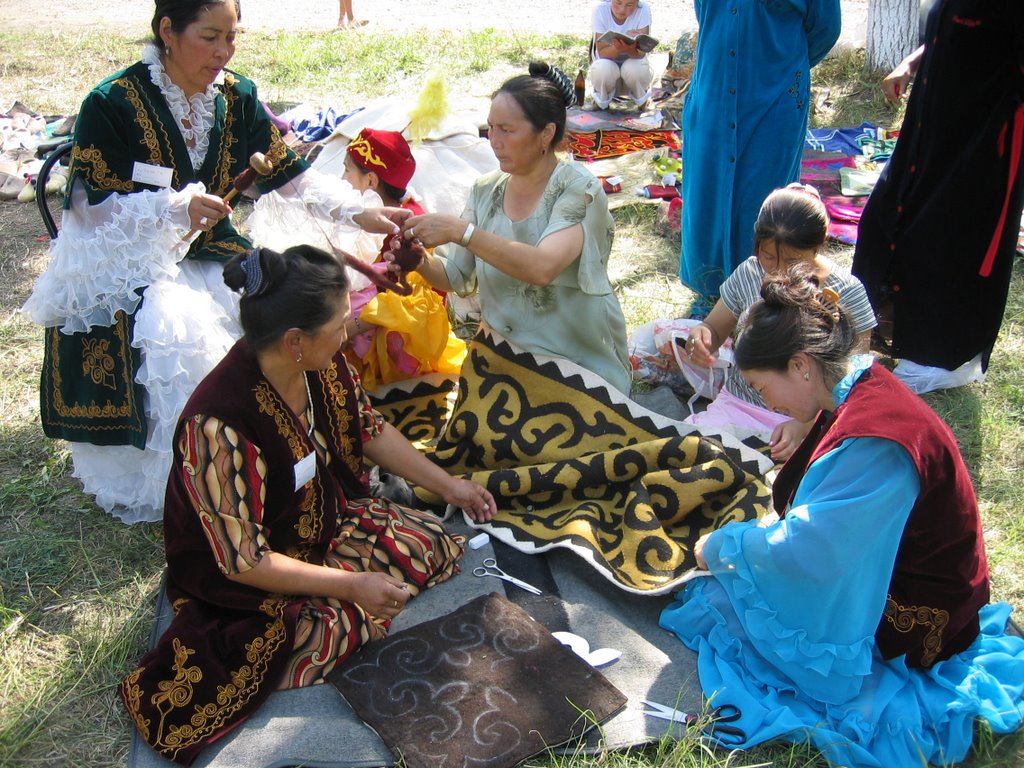
Kyrgyz felt photos

A reader requestedd some photos of Kyrgyz feltwork. Here there are!

In order: Golden Thimble souvenir shop (Bokonbaevo), artisan at work at Golden Thimble, making a shyrdak (Osh), natural dye (Osh), the finished product (Osh).


The little things that count


November 19, 2006

I spent the majority of this beautiful fall day indoors, taking advantage of a free day to catch up on some reading, writing and resting. In the late afternoon, I went to a Lebanese restaurant to pick up some take-out, then stopped by the supermarket. On my way out, I saw a man curled up along the side of the road. His head lay face down on the pavement and he was motionless. He looked like a drunk, but he also looked as though he might be dead.

I continued walking, shocked, feeling helpless, and not knowing what to do. I certainly couldn’t move him. Wouldn’t someone who could help him? I looked behind me. Two young men had left shortly after me. They’d also passed the man and had ignored him. So would everyone else. Were they not bothered? What would it take for someone to intervene?

A family walked toward me and I knew they’d pass the man on their evening stroll. The father pushed a child in a stroller. The mother wore a veil. What kind of sight was that for a religious family to come across?

I wished there was an emergency service I could call. Night was falling and I was sure a car would run over him on the narrow road. I imagined him dying and my not having done anything about it. I imagined how the driver would feel who accidentally ran over a human on his way home.

I decided I had to try to do something. Otherwise, I was no better than the callousness in the society I was criticizing.

“We just have a practice of doing nothing,” my co-worker Aizhana told me.

I went back into the supermarket and asked the guard to help. He gave me a strange look, but followed me out and let me point out the man. I asked if he’d please move up him to curb. There, in the street itself, he’d certainly be hit and die.

“Later,” he said in English, and turned back to the store. “He won’t die,” he said in Russian.

“No, now,” I insisted. “The cars will not see him in the dark.” The light was already fading. Within 20 minutes, his dark, crumpled body would be invisible.

He said he’d call for someone to help and I made clear that I’d wait until I saw the man off the street. He did call and two tough-looking Kyrgyz men in black came out shortly, snapping gum and looking annoyed.

“Where are we supposed to move him?” they asked me.

“Just up to the curb, so he won’t get hit.”

The three of them were able to pick the man up with no problem. And in the process of moving him, the man woke up, so I knew he was alive.

“They probably only helped because you are a foreigner and they didn’t want you to look down on their country,” my friend Zhenya later told me.

Regardless, I thanked the guards and went home, feeling much better. I wasn’t able to provide the man with clean clothes, food, or the psychological and drug treatment he needs. He’ll continue on with his difficult existence, for another day at least. But I wouldn’t have to live with the thought that maybe someone would be killed tonight and I could have, but didn’t prevent it.

A city under the spell of a maniac


November 19, 2006

Yesterday, while meeting two friends for tea in posh surroundings, we discussed the situation on the street. They also agreed that the atmosphere had changed. Cathy had several acquaintances who were leaving Kyrgyzstan because they didn’t feel comfortable any more. Her friend, a foreigner, had been mugged at 5:30 p.m. a few days before, and was traumatized after her attacker punched her in the chest.

Earlier in the day, I’d been in a neighborhood on the outer edge of the city with a local employee, Nurgul. I liked the streets we were walking down. They were narrow, devoid of cars, filled with pedestrians and dogs, various houses divided by fences and gates on either side. It felt more like a small town or a village than part of the capital. I commented to Nurgul that while I liked the area a lot in the day, I imagined it would be hard to walk home there at night.

“Yes, it’s completely black,” she said. “Scary.” And with darkness falling at 6 p.m., people who live in those outer regions can have a tough time getting home.

Nurgul told me that since the maniac has been at large, her brother picks her up directly from work. He then makes the rounds to pick up his other sisters and they all head home together.

My Dutch friend Joke told me that for this reason, at least one international organization has changed their hours. Formerly 9 to 6, they now work from 8:30 to 5:30, so that people can get home before dark. This change was made just a few days ago, also a result of the maniac.

Rumors were that they caught him, but now they say it’s the wrong person. Joke theorizes that it may not be as simple as it’s presented.

“You know, having this maniac about is very convenient for the government right now,” she said. “It works well for them to not have anybody on the streets at night and to raise suspicions about those from outside Bishkek.”

She was right, though I hadn’t thought about that. The streets have certainly been most unappealing after dark in the last few days. And the description of the maniac – a Kyrgyz
man, aged 25 to 30, speaking poor Russian, fits the typical protestor to the tee.

In the news, they described the victims of all seven attacks, and they gave the features of the wanted man. But there was no composite. At the time, I asked my co-workers why they didn’t publish a drawing of the wanted man. They didn’t know, but seemed to think it would be a good idea. Maybe there is no wanted man?

Clearly, people are heading for their homes at nightfall, feeling that once they reach the security of their homes, they will be safe. And for the most part, they are correct. The level of violent crime against average citizens is very low.

However, the consequence is that almost overnight, the disappearance of the average people and the families from the evening streets takes away the public eye that keeps order. It’s a disappearance that happened long ago in the US, when people stopped walking. And it would be a shame to lose it here.

“People feel they are safe as long as they are home. But what’s going to happen when break and enter robbers and murderers appear here?” I asked my friends.

They laughed. “That’s too advanced,” they said.

I can only hope the maniac will be announced as caught soon, and that people will return to the streets before their extra-cautious manners become routinized, that they don’t lose the cohesion that makes this such a nice place to live.

Bad vibes


November 17, 2006

For the first time, I’m having bad vibes in Bishkek. As I wrote earlier, I was so uncomfortable walking home last night that I called Mark as soon as I got home and told him I didn’t feel safe.

Tonight, I left work around 8. I rode my bike down a less trafficked road, in order to reduce my chances of getting hit by a car. But it was pitch-black dark, drizzling, cold, and barren. Again, I felt very uncomfortable. I couldn’t move very fast in the darkness, but it was only the fact that I was on a bike that gave me a little security.

I met my friend Zhenya outside an internet café. She wants to emigrate to the U.S. and I helped her out by taking her picture and submitting the application for her and her son online. She wanted to give me some bread she said was especially good.

When I submitted her application, I listed her as legally separated. The definition said there needs to be a court document proving separation. Zhenya hasn’t had any contact with her husband for years and he takes no responsibility for their son. In all manners, she’s divorced. Only she never went to file the papers because she didn’t want to have the pay the fees.

I suggested she begin the process now. “What if you win the lottery?” I asked her, “and then you aren’t allowed to take Algubek with you because you can’t take a child to another country without the father’s permission? You should get things ready now so you are prepared.”

She took my advice and went to the court already this afternoon. “I filed the paperwork and it only cost me 20 som (50 cents)!” she said, excitedly. “I didn’t know it was so cheap!”

She said the court would mail her husband a letter asking him to appear in court. If he came and signed the papers, everything would be fine. If they send him three letters and he doesn’t show up, they’ll process the divorce automatically.

I shared my discomfort with Zhenya. “Do you think my bike will get stolen here?” I asked her, as I locked it to a waterpipe. Recently, someone stole the bike computer that had been attached to the handlebar. I think it happened when I left my bike inside the internet café.

“No, it will be fine,” she said.

“Aren’t you nervous walking your dog alone at dark?” I asked.

“No, I was just with my son,” she said.

We said goodbye and I went into the café to use the internet phone connection.

After making a few calls, my sense of foreboding was so strong that I went outside to check on my bicycle, something I never do. It was where I left it and no one was around.

I then went back in and made a long call to my mother. When I went outside this time, the bike was gone.

After a futile argument with the guard, in which he claimed he’s not responsible, I called Zhenya, just because I needed to tell someone that I’d lost yet another bike (that’s two bikes and two cameras in a span of months). She offered to come walk me home.

While I waited for her, two tipsy Russian men, who looked rather like criminals themselves, came out to talk to me.

“You know, it’s the atmosphere after the Revolution,” one of them said. He bent over and whispered. “The Kyrgyz are sometimes a little crazy. You know there is a maniac on the streets now.” Everyone is talking about the maniac, and it might be people’s fear that keeps people inside and empties the streets to the point where I find them frightening. Although, the police announced today that they’d arrested a suspect.

Zhenya arrived, together with Algubek and the dog. “You see what this place has become, why people want to leave?” she asked.

As much as I’m temporarily not feeling comfortable here, I couldn’t blame it on Kyrgyzstan. I know people all across the U.S. who are unable to keep a bicycle of decent quality because they get stolen so quickly. I was more shocked at losing another possession, tired of contact with criminals, and upset by this strange feeling I’ve had for the past 24 hours of something not being right.

“Just remember that people lose their children, their apartments, and their jobs,” Zhenya said. “And be glad that you were inside on the phone and nothing happened to you.” She was right.

I was glad to have her with me as we walked through the dark alley leading toward my home. My neighborhood looked awful. The garbage that has been piling toward the sky had been blown about and refuse stuck to the cold, wet streets. We maneuvered through the darkness, through the garbage and through puddles.

“Our garbage isn’t getting picked up either,” Zhenya said. “One of the garbage trucks is broken.”

When we passed the dark, empty playground, most of the metal stolen, I thought back to the evenings, not so long ago, when children were out playing late in the lighted street, their screams and laughter rang throughout the neighborhood. It’s such a contrast.

Then, upon reaching the relative comfort of my apartment, I heard banging and yelling upstairs, then the sound of crying through the heating vents. A couple having a violent, physical argument. The disorder continues.

And I dream about the white walls and the rose garden of my Uzbek home, the open greenery of the jailoo, the kind taxi driver who took me to his Kochkor home in August. I know there is so much goodness here. I’m just not feeling it at the moment.

The heat is on


November 17, 2006

Last night, for the first time, I didn’t turn on my electric heater when I got home. This morning, it was strange to step out of the shower and not be shivering. This led me to go check the heat vents, where voila, heat was coming out!

The city decides each year when to turn on the central heating based on how cold it’s been. I read that the heating season began on November 10th. But hospitals and schools get first priority. It took a week to get to a simple apartment like mine.

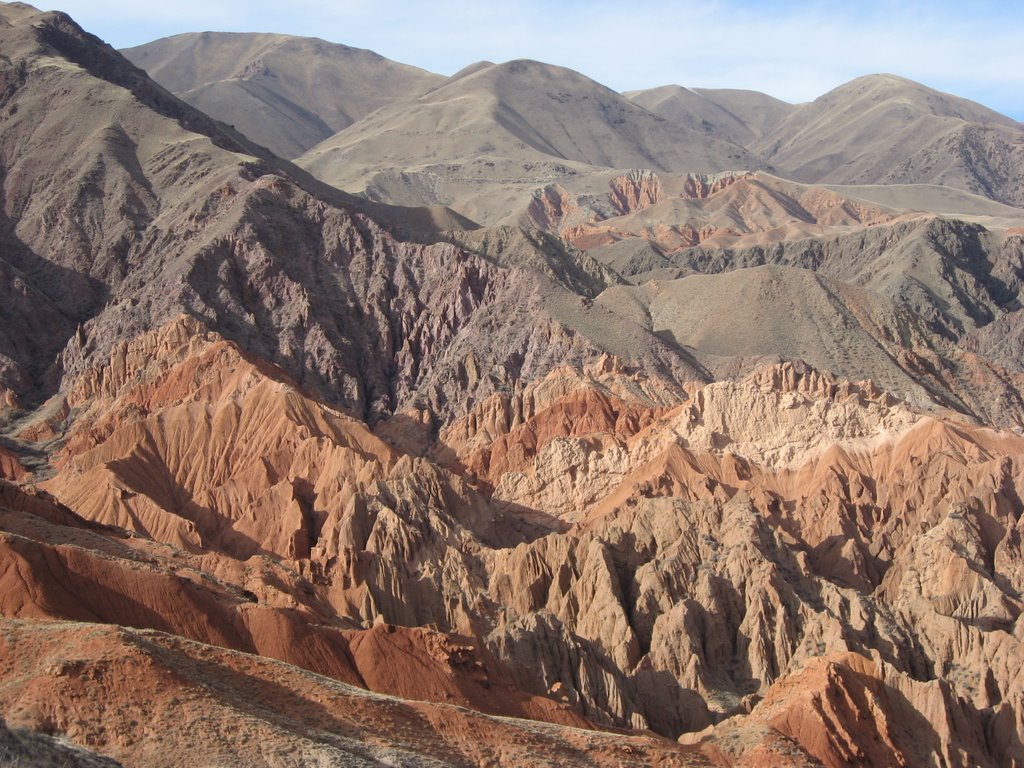
I haven’t been too good about writing in the past week. Last Sunday I visited the canyons and enjoyed what might be one of my last opportunities to spend time in the Kyrgyz mountains. I ended up separated from the group, walking with a middle-aged mountain enthusiast who was visiting the canyons for the sixth time this season. His daughter married a Dane and he got a videocamera shortly after the wedding in April. Making videos of nature and people in nature has become his passion and we frequently had to stop for him to film. Worse, he expected me to be the star of his film and asked me to do things like eat wild berries, look around pensively, or walk slowly through nature while he filmed. I’ve never had any talent for acting and I think I may have disappointed him.

He gave me a great tour though, bringing me up to the ridge of the canyons where we could walk along and enjoy the aerial view of the clay and sandstone, the red, white, beige and brown stripes, the whimsical shapes created by wind, and white snails and other signs of life buried within 1.5 million years of history.

Another news item from the week is that there is a maniac loose in Bishkek. He has so far attacked seven people in the 7th microdistrict. The attacks are random. In one case, he asked a man, “Do you know where the 7th microdistrict is?” then stabbed him in the face. He doesn’t rob and he doesn’t rape. But he has killed three of his victims.

Between 250 and 500 police are combing the area looking for the man, a 25-30 year old Kyrgyz who speaks poor Russian and lives in the area. Everyone is talking about the maniac and being cautious at night.

Perhaps for that reason, when I walked home last night at 11, the streets seemed deserted, even on the central main roads. Or maybe I just hadn’t walked home so late in a long time. But in any case, it was freaky. The streets were devoid of the usual families and couples that bring public scrutiny and safety to the streets. Only questionable young men, prostitutes and drunks seemed to be about. I found myself frequently looking over my shoulder and felt I stood out in my brightly colored coat.

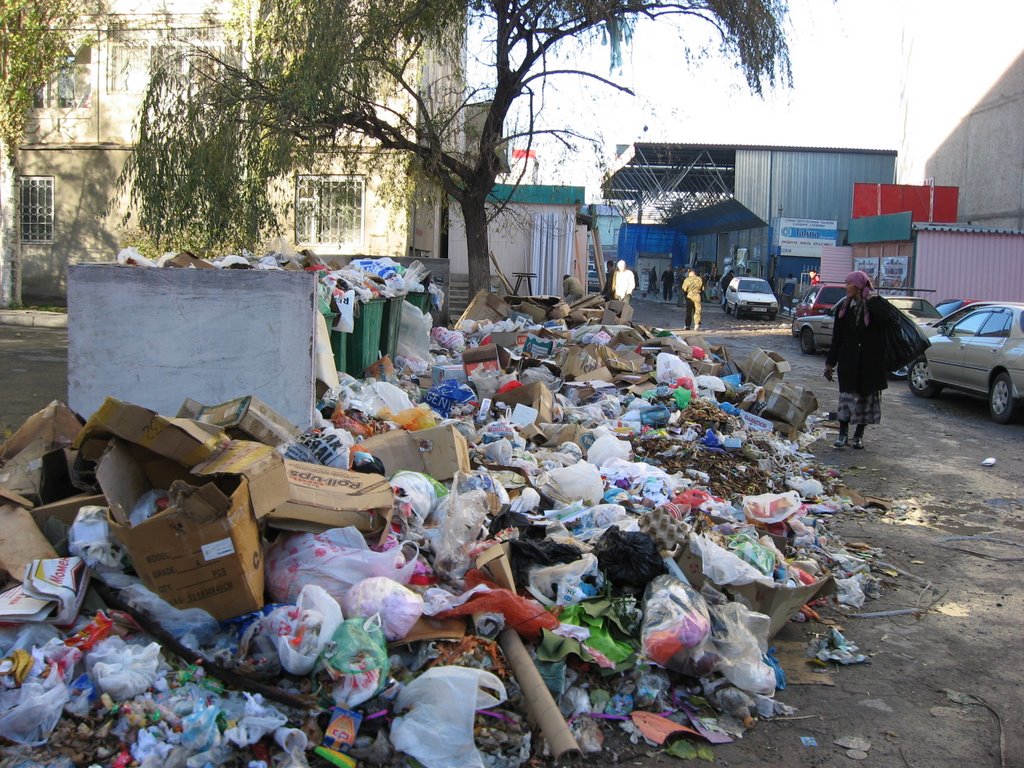
Then, as I neared my apartment, I passed the trash area. The other night, coming home from work, acrid smoke burned from just about every trash bin enroute. But for some reason, no one is setting fire to or collecting our trash. It already overflowed the bins several days ago and is now a mountainous island of garbage.

Walking past it should normally speed up one’s pace. But a weird looking guy in front of me – a tall, slender Arab in a long coat over what looked like pajamas and stockings - slowed down and then stopped, pretending to look at a cat. Was he nervous by my footsteps behind him? Did he want me to pass? Or was he himself the questionable one?

I almost flipped around and went the other way, but I would have had to come back at some point to get home. So instead, I quickly passed him and took rapid steps to my entrance. I shut the newly-installed iron door with a password opening and gratefully entered my apartment, promising myself to take a taxi next time.

The Kazakhs refuse to come


November 7, 2006

We had a speaker from Kazakhstan scheduled to speak at a seminar who refused to come to Kyrgyzstan due to the protests. She demanded a bodyguard, and a 100% guarantee that nothing would happen to her at the border. We agreed to give her a bodyguard during the day, but we couldn’t give her a 100% guarantee of anything, especially not at the border. And she wanted a bodyguard at her hotel at night as well.

“Who does she think she is?” our driver, Sergei, asked. “The President?”

I could only imagine what they were showing on the news in Kazakhstan, under a regime deathly afraid of such protests taking place on their territory. The next day, a different Kazakh woman did come and I asked her.

“The news doesn’t show it as something limited to the central square,” she said. “They make it seem like it’s taking place all throughout the city.”

Tuesday, November 21, 2006

November 8, 2006

Guards keeping the two groups apart

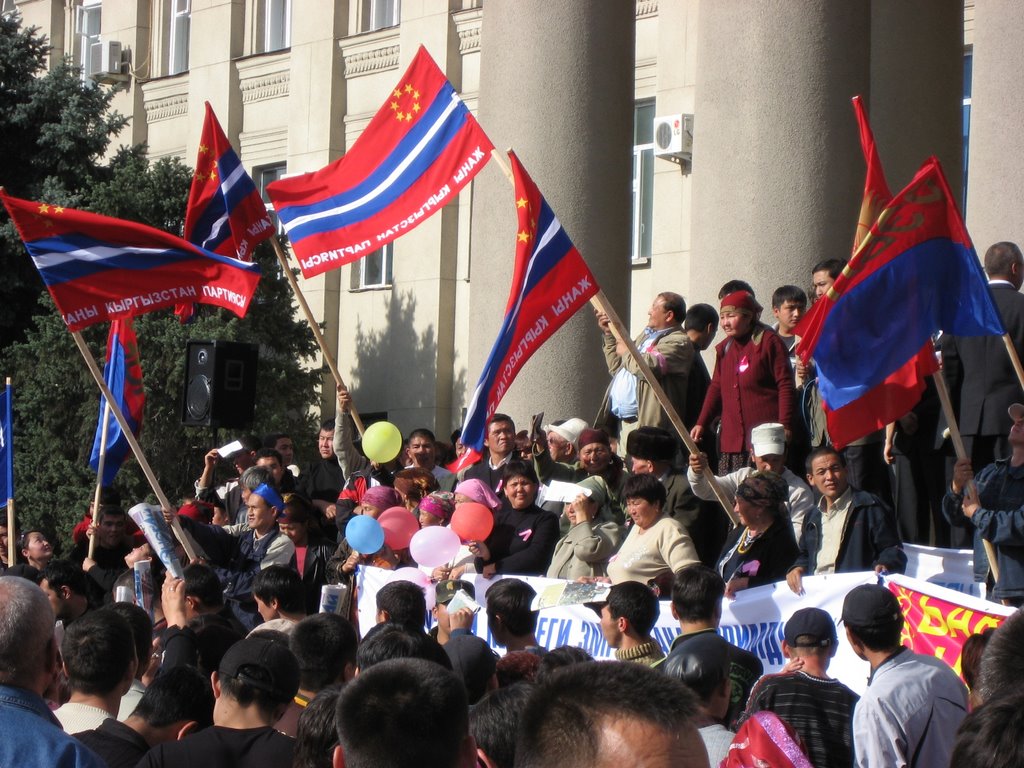
pro-Bakiyev supporters on old square


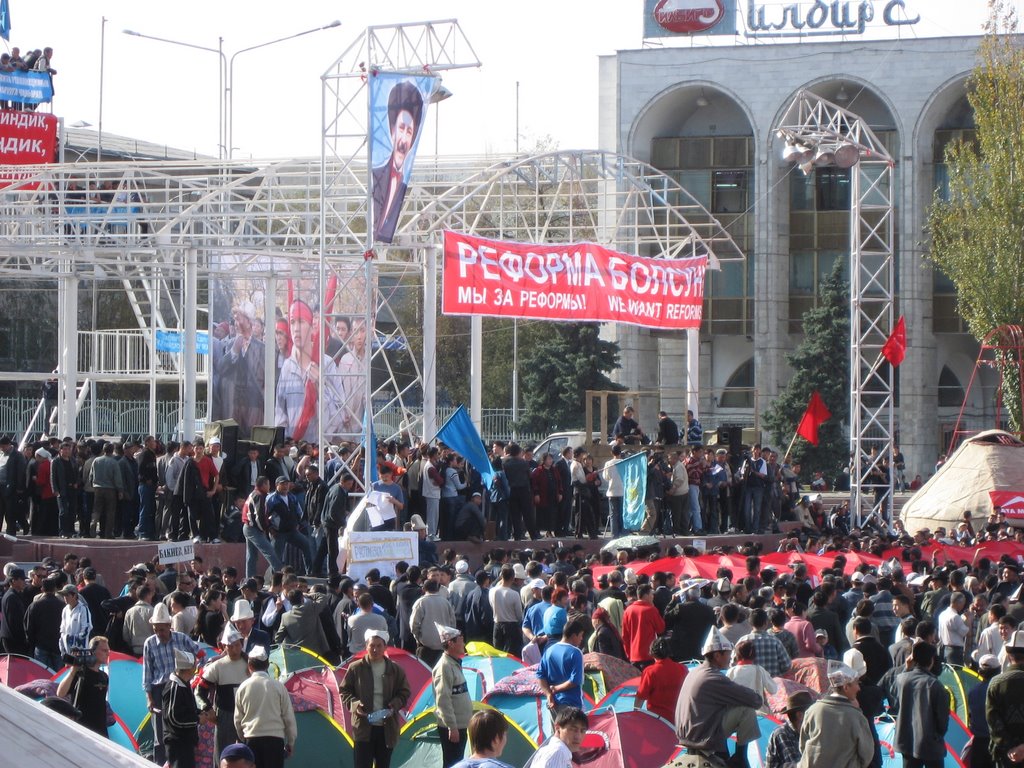
Opposition protestors on central square

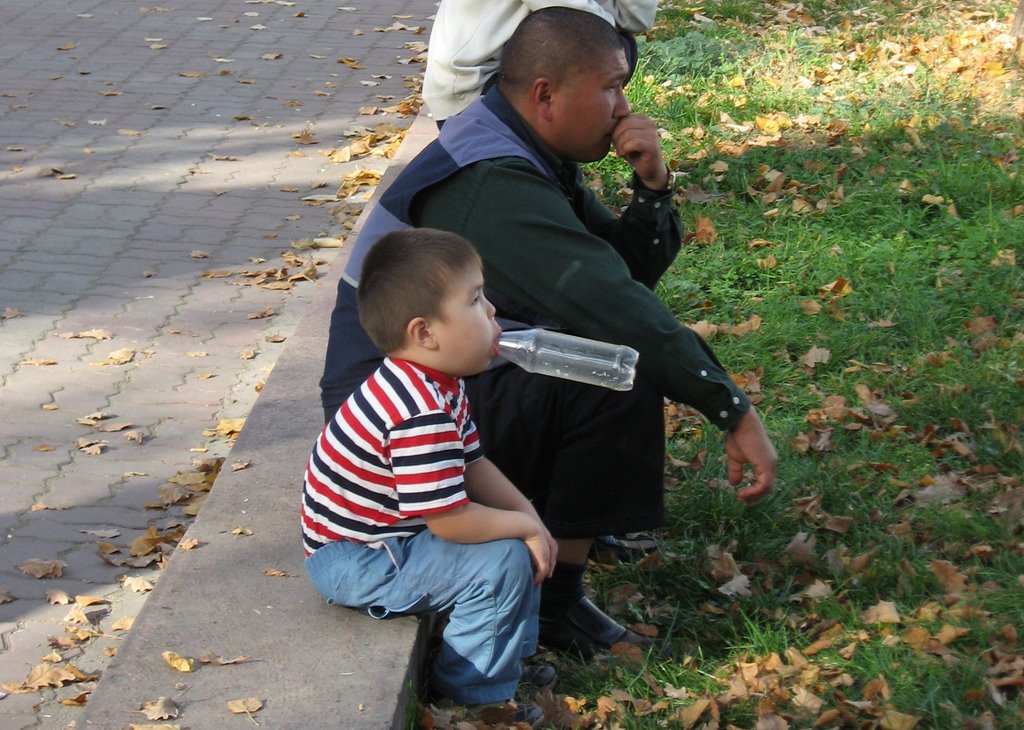
Father and son watching protests

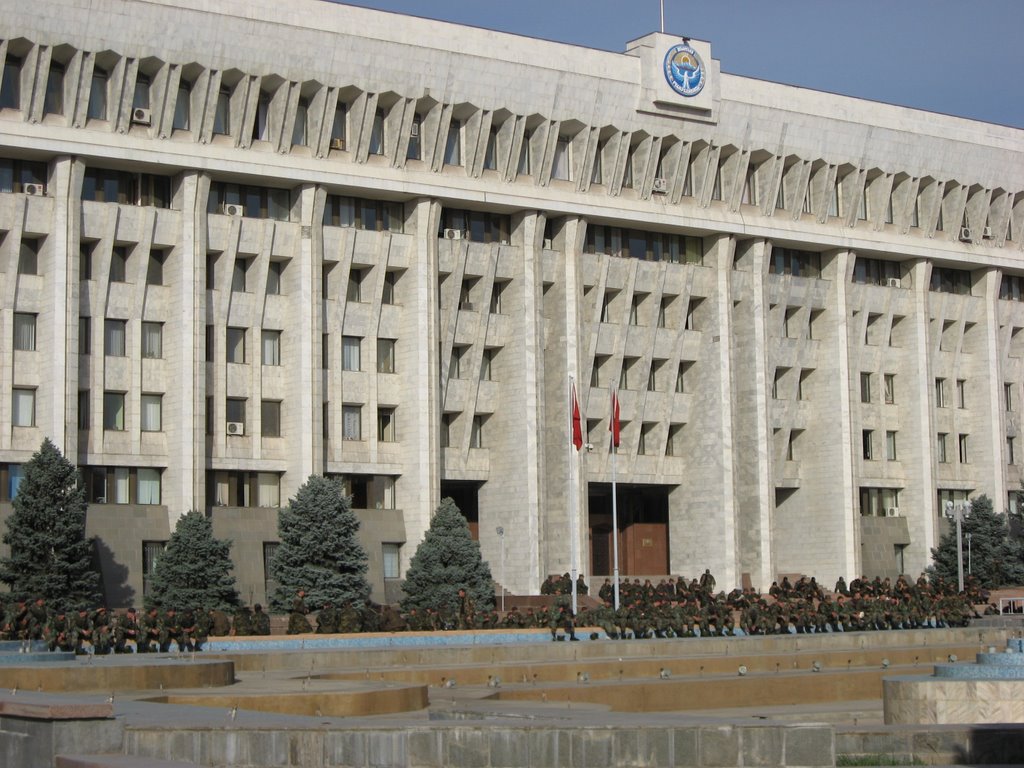
White house under guard

Six Days of Protests

November 6, 2006

On the seventh day of protests, people started to get worn out. I had lunch with an American friend who showed up pale, with bags under her eyes.

“I’m tired of the uncertainty,” she said, “Of having to pay attention every hour to what’s going on, to constantly checking the internet and not knowing what’s coming next. I can hear the shouting from my apartment. It never stops.”

After lunch, she and I walked to the square to see what was going on. Bakiyev had collected more people since the day before, including 3rd, 4th and 5th year students from the Kyrgyz Medical Academy, who claimed that classes were canceled and they were forced to come stand up for Bakiyev.

There was also a large group of opposition protestors, who had moved from in front of the White House to the Central Square. What was more disturbing were the rows of National Guard in riot gear, holding rectangular metal shields in front of them, forming rows on either side of the street, keeping the two rows of protestors apart. Plenty of soldiers still slept or lounged in the grass, drinking bottles of Tan, however those in the row seemed more alert than what I’d seen the day before.

It was very strange to walk in between the two protests, to be within the confines of these soldiers in riot gear and to see that despite the tension, free movement was still allowed. Plenty of people came down with the sole purpose of checking things out, since there is no other way of getting reliable news.

Reading the news on the internet, it seems like the President and the politicians are getting closer to a compromise on the new constitution. But to the protestors, it seems to be just an opportunity to try to get Bakiyev out of power. His supporters shouted – “Ba-ki-yev! Ku-lov!” repeatedly, as though at a high-school pep rally. A more impressive speaker spoke in Russian about the fact that Kyrgyz are united, and they will not be divided and thrown into conflict by the opposition.

One Western visitor, who came in town earlier this week, thinks the protests are great, that Kyrgyzstan is the only place in Central Asia where people are allowed to go on the street and say what they want, regardless of how stupid it might be.

But the locals, including our driver, Sergei, were getting tired.

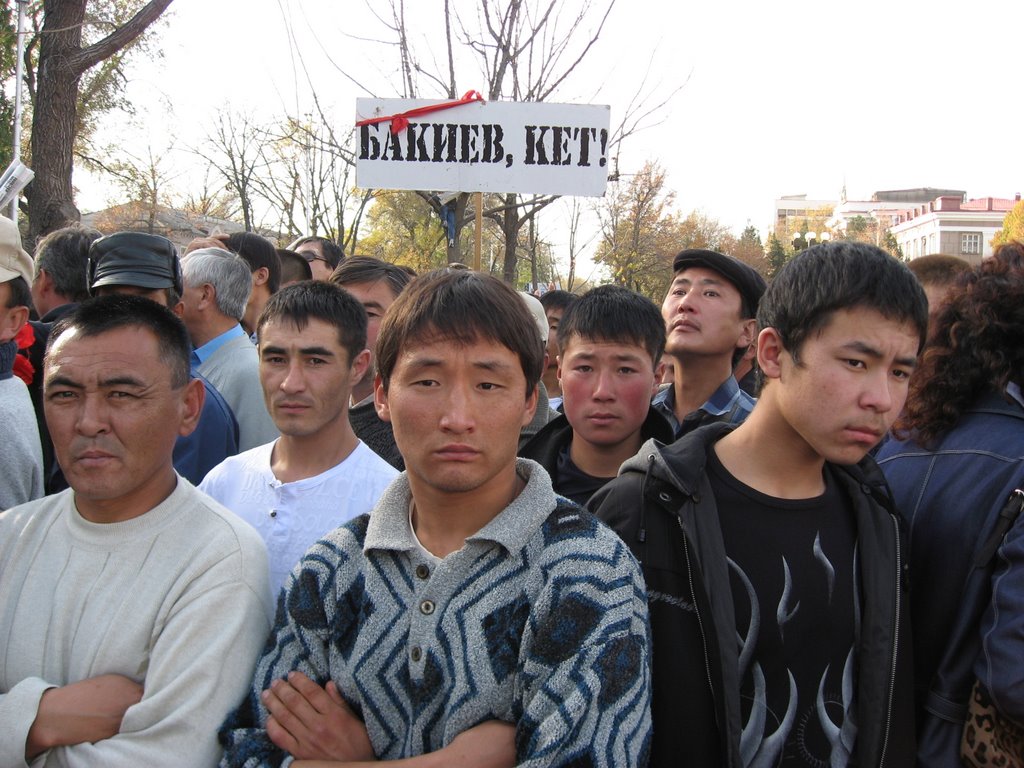
“On the first days, I had some interest in what is going on,” he said. “But seven days is too much. And when I go down there, I see all these young people, under age 25. It would be a different story if there were mature people my age saying something intelligent. But these rural youth don’t even have anything in their heads to think with. They don’t even know how to say the word Constitution. They’ve never said it before in their lives. They have no idea what the difference is between a Presidential system and a Parliamentary democracy. But they are down there yelling this word, Constitution, that they don’t understand.”

He also said he could see a lot of potential criminals in the group – maybe such as the hard-faced men pictured below. “They are just waiting for when disorder will begin and they can have the opportunity to freely steal things.”

Several people I work with left their cars at home, not wanting to take a risk in case something happens. But more and more people are returning to their normal routines and the roads filled with cars yesterday.

“People just get used to things,” Sergei said. “This has now become a part of life.”

That’s true. Last week, we closed our office with lesser gatherings. Now no one questions working the whole day.

The fact that is that outside an area of a few blocks, there is no sound, indication of, or effect of the protests. Should one choose to, it’s possible to enter a cocoon and just pretend nothing is happening. I’ve been tempted to do that for a while, but the intrigue of what might happen and the recognition of a unique moment in Kyrgyz history draws me to the news sites and to the square.

However, for the first time yesterday, I did go to aerobics class. I had figured they’d be disrupted by the protests, but they weren’t. A sizeable class showed up, woman who were going to get their exercise no matter what was going on outside.

I emerged into the dark evening and could hear the speakers’ voices over the loudspeaker. Do they never get tired of talking? Can people remain riled up for so long? Don’t the people down there have headaches by now? Not to mention the poor people with apartments located there.

Luckily, my apartment is out of the sound range. So I returned home to quiet, no news, and the ability to unwind. Only to wake up once again wondering if anything fundamental had changed in my surroundings.

Let it Snow


November 21, 2006

Winter is here. The first snow fell today, covering the tree branches in a light layer of frost. The air became nippy, the streets slushy. It’s barely light before the workday begins and is already dark when it’s over. People have had to accept that it’s now winter. Several months to go before streets will be light and warm and full again.

Maybe the cold weather will keep some of the bad guys off the street. Some say they are people from the regions who came for the protests and didn’t go back home. I heard of three muggings in the past week alone – more than I’ve heard about in my whole time in Kyrgyzstan. One of them was one of our employees – a young man who was leaving a disco with a friend on Sunday night when they were jumped by six strangers who took their cell phones and wallets. Manas had a tooth knocked out (but was able to get it replaced). His friend is now OK, but spent some time in the hospital. I’m now going home every evening with our driver.

Saturday, November 04, 2006

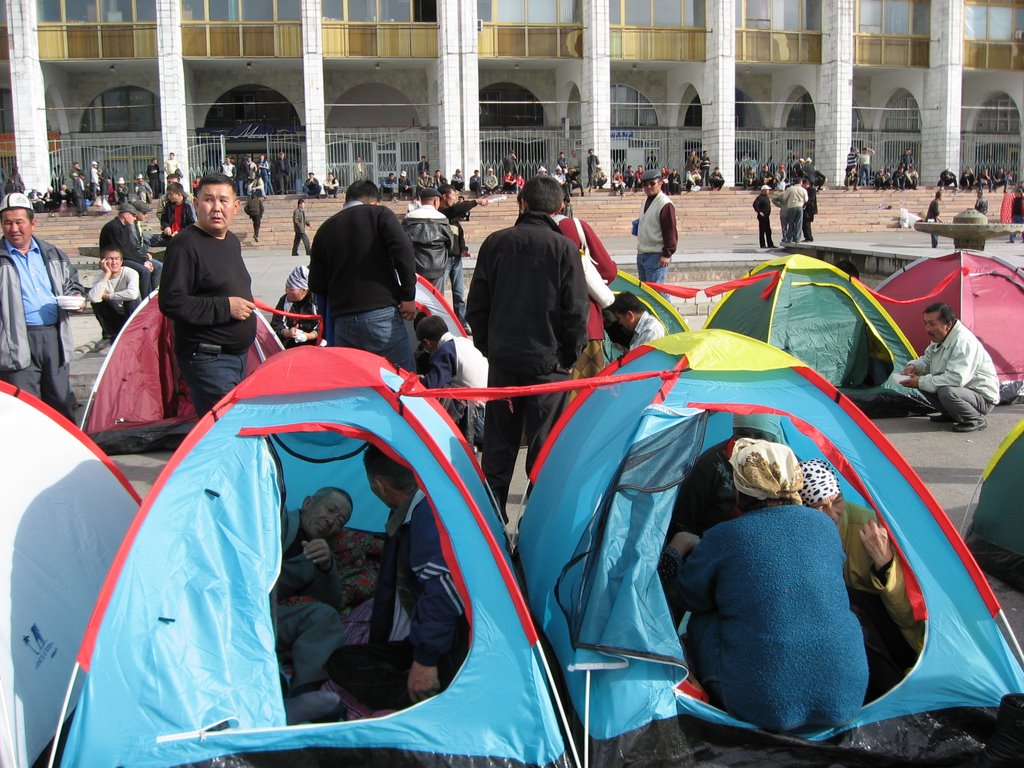
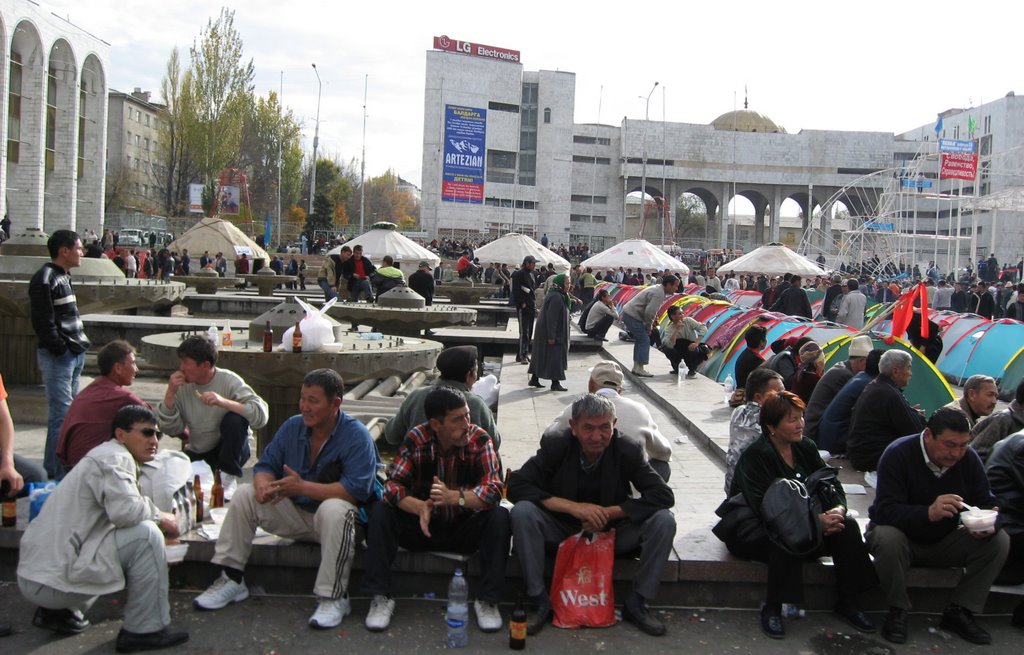
eating lunch

tent dwellers

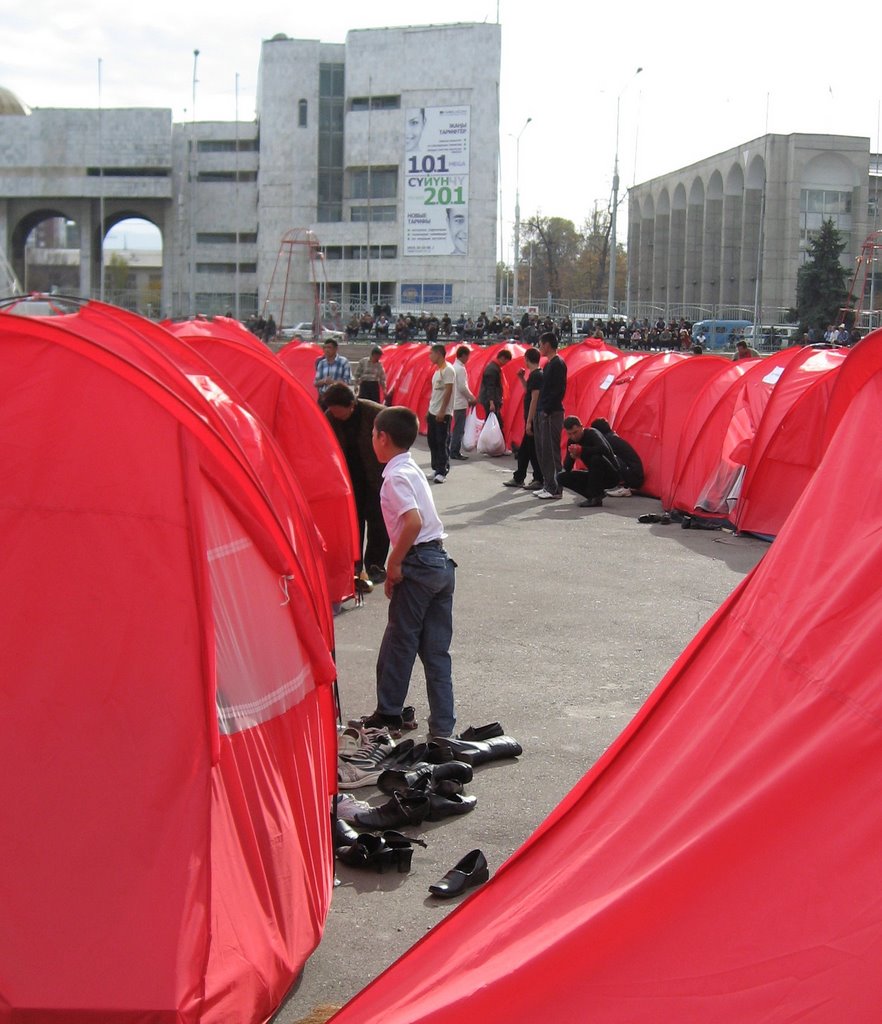
boy putting on shoes outside red tent

The Protests Continue Over the Weekend


November 4, 2006

I expected the protests to be at their strongest on Thursday, the first day. So I was surprised when my boss called yesterday afternoon. On vacation, she was at home watching TV.

“It’s getting bad,” she said. “I don’t expect anything good to come of this. Close the office, take the important documents, and make sure everyone gets home safely.”

We stopped a seminar in progress and canceled a scheduled party that evening to say goodbye to a departing colleague. The staff grumbled that the fun, drunken Friday evening they’d imagined wouldn’t take place. They seemed to consider getting together anyway.

“The café is far from the center,” they said. “Nothing will happen there.”

But when we went on the internet and saw headlines that several Parliament members had gone into the national broadcasting building and that protestors had stormed a local government building, they agreed with the closing.

As much as CNN can get on my nerves, with the same stories repeated over and over, and the often emotional, rather than analytical reporting, at that moment I wished for a Kyrgyz version of CNN, someplace where I could see what was going on at the moment. My two TV channels are Russian channels and even they don’t show up well. And news in Kyrgyzstan is slow to get to the Russian or Western web sites.

I was curious to see what was going on, but decided to play it safe. The anxiety in Maria’s voice had transferred itself to me and I found myself afraid to go home alone on my bicycle. My unpleasant experience in Nicaragua lowered my risk acceptability level substantially.

I walked, together with several staff members who lived in the same direction. Again, the activity on the streets wasn’t much different from usual. Autumn leaves swirled down onto people selling grapes, strawberries, apples, flowers, carrots, eggplant and peppers. Marshrutkas took their passengers home. Cars with little yellow taxi signs atop waiting along the roadsides for passengers.

After arriving home, I began to feel more tranquil, as I was again completely cut off from news. And in my immediate environment, everything appeared normal.

I decided to go out to the internet café. I felt more comfortable being out on the street when I had nothing worth stealing on me. I expected the internet café might be closed, but clients were there as usual, gambling at the numbers tables, making internet-based telephone calls. Two young girls next to me compared notes on pictures of young men they were looking at online. Every entrepreneur had to make the decision for themselves – to close shop and lose profit, or to stay open and take the risk.

Possibly, being there was a good form of protection. At least they could take some action or try to talk looters out of doing something should such activities begin.

“You’re staying here tonight,” I heard a man tell the man who sold me vegetables at the market on my way home.

“Why?” the man asked.

“For security. What do you think?”


This morning I spoke to my friend Zhenya and she told me she’d gone to visit the square yesterday afternoon.

“The people who are in the tents are such simple, poor people,” she said. “There is no way they are part of an opposition party. I went up to one tent and asked a woman who she wanted to be President. She said she didn’t know, just not Bakiyev.”

I decided this afternoon I’d go take a look for myself. When I approached, I saw people crowded around a truck. When I looked in, I saw it was filled with individual portions of food in white plastic containers. They were being distributed to the protestors, people who don’t have enough money to feed themselves – people for whom a free meal is an inducement to join a political movement.

On the stage, men made speeches, first in Kyrgyz, then translated into Russian. Most attendees were men, and almost all were Kyrgyz. These type of activities seem to lead the Russians to emigrate rather than earn their support.

The atmosphere was relaxed. Police officers sat together in the grass. Protestors, appearing poor and rural as Zhenya had said, sat on ledges, eating the food that had been distributed to them. They didn’t look too energized or as though they had a cause.

A few yurts were lined up next to the stage. Several rows of tents spread out on either side, toward the main road, which was open. On one side, all the tents were red, the opposition’s colors. And some protestors wore red fabric tied around their necks.

I watched a young boy emerge from a red tent and put on his shoes. A collection of shoes lay outside the tent’s door. Even when living in a tent on the central square, the Kyrgyz maintain their politeness and hygiene. I wondered about this boy’s life circumstances, what kind of family he has that brought him out to live in the chilly autumn on the central square. He was dressed pretty well. I wonder whether the people in the red tents are those connected to the opposition politicians and those in the varied tents are the poor who are living out there for money.

Near the square, several small vendors were doing good business selling sour milk balls, drinks, chips and rolls. And the traffic flowed by as always, including the beribboned and honking entourages of post-Ramadan wedding parties. One car belonging to a wedding party broke down, directly across from the protests.

Another block or two away, children played at the playground and adults strolled down the leaf-strewn paths of the central park. People live and wait and hope that everything will end calmly.

Friday, November 03, 2006

Protests and Thanks

November 2, 2006

Today the promised protests against the President took place. And they had another complaint to add to their list. President Bakiyev promised to present a new version of the Constitution to Parliament, this morning, then failed to do so. Bakiyev said he had no obligation to listen to the opposition groups and that they couldn’t pressure him to hurry with Constitutional reforms.

The day was pretty quiet. I was happy to see that most businesses were open and most people went about their daily activities as usual. We worked, but like many others, ended our day a few hours early, so that people could be sure to get home before dark and before any problems started.

The protesters organized meetings in five places around town at 1 p.m., then walked toward the central square. According to the Russian evening news, about 30,000 people gathered and they are planning to stay on the square – in yurts and in tents – until the President keeps his promises.

When I walked home shortly before five, I could see very few differences in the activities on the street. The market nearest my home had been closed all day, but the vendors on the street were there. The elderly woman I bought flowers from told me she hadn’t had any problems. I saw a pair of foreigners going out for a run, the children outside playing as always. But those not involved in the protests probably avoided going out in the evening.

My colleagues showed no interest at all in participating in the protests. They thought that even thought the President has not gained the faith of the people, it would cause more instability if he were to be removed.

“People have just start to get used to the new system and start working again,” our office manager, Kasiet, said.

They said the payment for people to join the protest was 500 som ($12.50). When people headed home after work, they jokingly asked if they were going to the square to earn some extra money.

For me, my most memorable moment of the day was the kiss my adopted babushka, Natalya Vasielievna, planted on my cheek. It had been months since I’d been to see Natalya and I stopped by to give her the paper I’d saved for her (which she uses in fires for her home and banya). I asked how she was preparing for the winter. She’d told me before that last year her inability to buy enough firewood meant she’d almost frozen to death.

When she told me she hoped to reconnect her gas, which she’d stopped using five years ago, I offered her $25 and asked if it would be enough to get it running again. I think it’s enough not only to restart it, but to pay for several months of heat.

A smile crossed her wrinkled face, and in a burst of emotion, she grasped my shoulders, hugged me and kissed my cheek.

It makes me feel good to know that one elderly woman won’t be cold this winter. But it’s also sad that people live in such poor conditions that $25 can make such a difference. If you’d like to help out an elderly person in Kyrgyzstan, you can adopt a grandmother or grandfather for $150 a year. I can vouch that Babushka Adoption is a reliable, quality charity and that their recipients truly need the assistance.

Glimpses of Bishkek

October 31, 2006

It’s been a busy week or so. My boss has been on vacation, so I’ve been taking over her work. But even with a double workload, the quality of life is so much better here than in Nicaragua and I treasure and enjoy all the small moments.

One afternoon I met my friend Zhenya at Bishkek’s first modern shopping center – called Vefa. Seeing a chocolatier, Gap, Benetton and Levi’s stores, and a supermarket in Bishkek shocked me. Zhenya’s son Algubek loved the transparent elevator and Zhenya marveled at the lights that hung three stories down from the ceiling. A children’s play area on the top floor looked like a Chuck E Cheese, but only cost 50 cents per hour. There was a movie theater (playing cheap, discarded Western movies – we saw the Perfumier and walked out after 45 minutes) and a fast food court. But the so-called fast food didn’t include any Western giants. Most of the stands had a Turkish influence and several sold English tea in glazed ceramic Turkish mugs.

I was pretty amazed to realize there are enough affluent people in Bishkek to support such a venture. The local population seems to have embraced it. I saw several people I knew there – locals who are professionals, but not especially wealthy. Like teenagers hanging out at the shopping mall, Vefa provides a place to casually meet and see something new.

I feel very at home in my neighborhood, comfortably leaving and entering at all times of the day and night. The young boys greet me, making me feel like I’ve become enough of a neighborhood fixture. Old women sit on benches, wearing thick socks and scarves around their heads, talking or people-watching for hours at a time. I watched a family walk across a busy street – the patriarch wearing a tall, white felt kalpak. And here, that doesn’t attract any attention.

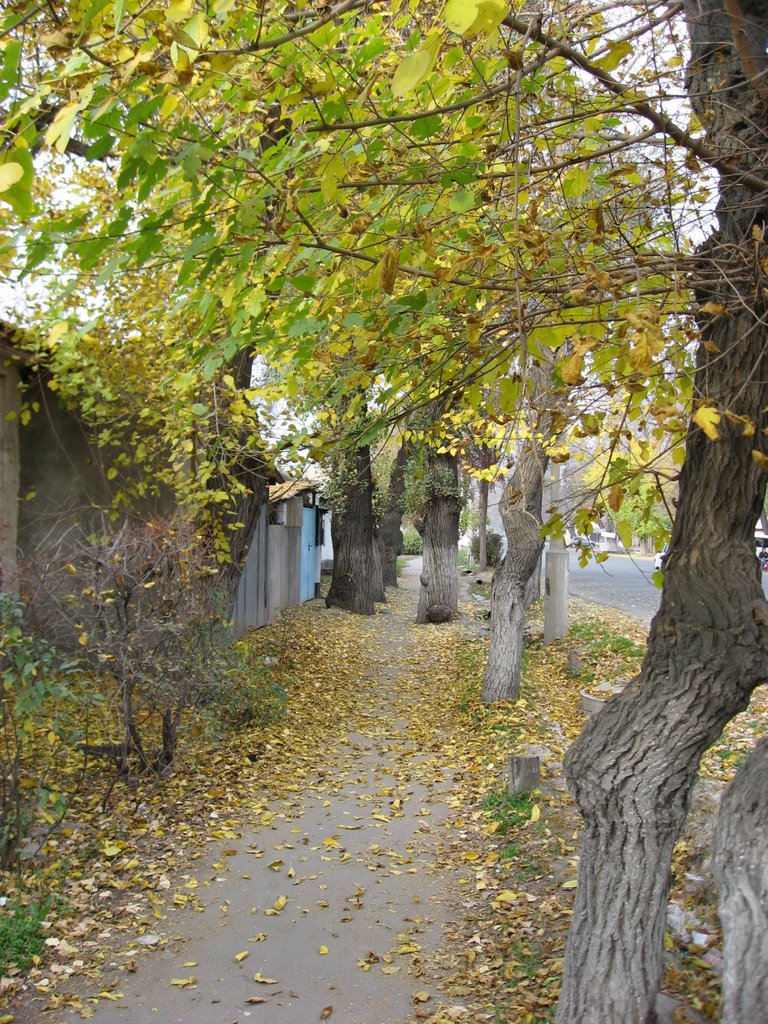
Sunday was a beautiful fall day, the bright yellow and crinkled brown leaves falling down like a constant, light rainshower. Outside my window, I watched children in mismatched clothing playing on the slide – the one toy that the metal thieves didn’t take apart. They would bunch together at the bottom of the slide, hitting one another like carts of a train joining together, laughing hysterically at the pretended accidental crash. They repeated this over and over. I think they just wanted to be part of a group hug.

Today, upon coming home from work, I stopped when I saw two soldiers in the road, holding glow in the dark red batons. They were holding up traffic to allow a troop to cross the street. The soldiers (all male) came out of one building, in formation, dressed in green khaki, and proudly singing a song in Kyrgyz. They marched into the other building, still singing. I know my friend Gulnara’s brother serves there – that the soldiers are mostly just kids for whom studies didn’t work out. But it was nice to see them proud and professional, even when crossing a street in the dark of night.

The day after tomorrow, massive protests are planned against the President. The same opposition leaders who put Bakiyev in power are now regretting it. And it is they who are protesting. The government is issuing statements that criticism should be constructive, that major disruptions won’t be allowed, while at the same time preparing empty hospital beds in Bishkek.

Neighborhood Changes

October 23, 2006

I notice two main changes in my neighborhood during my absence. One, most unfortunately, is that the nice playground that went up with the new building across the street, has been destroyed. Only the slide still stands.

When the toys appeared, they drew the neighborhood children out until 10 p.m., flying in circles on the spinning chairs, swinging, sliding. It made me smile to see their joy. But now, they seem to have been dismantled, only the skeletal frames remaining.

I asked our driver, Sergei, what might have happened.

“Someone probably stole the metal and sold it as scrap to China,” he said.

That’s a very depressing thought.

The second change is that the mosque seems to have installed more powerful speakers. Or they are turning them up for Ramadan. I can now hear the evening call to prayer in my apartment, when I never could before. This brings back memories from Osh, where the call to prayer would float through the air over dinnertime, a lulling, mystical melody.

The mosque has a new sign on its fence advertising an SMS Islam service. Given the veils and traditional dress I see in that area, I find it funny to also see the mosque embracing cell phone modernity. I commented on it to Sergei.

“Islam is gaining more and more followers throughout the world,” he said. “We white people are a bad race. We’re always fighting with each other. But the Muslims support each other. For that reason, they grow strong.”

Sunday, October 22, 2006

Bride Kidnapping Again

October 22, 2006

Yesterday, seated with a group of local colleagues, I read an article about bride kidnapping in the local English-language newspaper. Human Rights Watch recently released a report condemning Kyrgyzstan’s inaction on bride kidnapping and domestic violence.

The article related the story of a 17-year-old, Feruza, who was kidnapped by a stranger on the night she was supposed to wed someone else.

“He forced me to have sex with him the first night,” she is quoted in the article. “A woman came to say that they’d prepared my bed; I thought I’d be alone. I lay down to sleep, then he came in and he forced himself on me and raped me. I was saying no and he still did it. I cried and screamed…There were other times, too, when he raped me. I didn’t ever want to go to sleep.”

I commented to two of my co-workers on the article. “How awful,” I said, “someone was kidnapped on her wedding night.” I couldn’t imagine all of the preparations and thoughts of a voluntary life together suddenly replaced by a life with a stranger, a stranger willing to use force and violence.

“That happens all the time,” Aizhana, a 33-year-old single mother said with a smile. “When a guy realizes he’s about to lose her to someone else, he reacts quickly.”

Nasikat, an unmarried woman in her twenties also laughed.

“That probably happened in the south,” Aizhana said.

“It happens here too,” Nasikat said. “In the villages around Bishkek. I have a friend who was stolen and taken back two times.”

They both giggled as I remained silent, but shocked at their light treatment of the matter.

A little later, while walking down the street with Aizhana, I told her that the article continued to bother me. One of the first cases of forced kidnapping I came across in Osh, a case I’ve written about in this blog, took place when the man made arrangements with a taxi driver to help him kidnap her. Being taken hostage in a taxi or car seems to occur relatively frequently.

“After my experience in Nicaragua,” I told Aizhana, “I know what it feels like to suddenly be a prisoner in a car. It’s a shocking and traumatic experience. And for me, it was just one day. But for them, it’s the rest of their lives.”

“I know,” said Aizhana, with uncharacteristic gravity. “I think it’s because it happens all the time here that we just get used to it and treat it so lightly.”

At the same time, when I tell staff about what happened in Nicaragua, they look at me in disbelief.

“Is it such a dangerous place?” one woman in her early 20s asked me. “That would never happen here.”

And she’s right. I’ve heard of some cases of taxi drivers being victims – killed for their cars. But I’ve never heard of a driver himself being involved in harming his passengers.

I’ve been more cautious when taking taxis here, less willing to argue over price as long as I get to my destination safely. When I take a marshrutka, the public mini-buses, I’m amazed that I don’t need to worry about knife-bearing teenagers who could stick me up in public, while the rest of the bus would sit passively. That happens in Nicaragua, but not here.

Of course, this is a sign the society somehow functions better here – perhaps the closeness of the family is responsible. At the same time, violence against women is not uncommon. And women under the age of 25 are at constant risk of kidnapping, rape, and an entire life with someone they may not love.

Just because I’m not in the risk group, I feel safe here. But I wonder, does the localization of violence within the family unit, does the targeting of a rather helpless group (women aged 15-25), thus reduce the incidence of randomized violence? Do the young women in Kyrgyzstan bear the brunt for the rest of us? Is that why so many of them would like to get out?

Wednesday, October 18, 2006

I Love Kyrgyzstan

October 15, 2006

Today I arrived back in Bishkek, my beautiful, happy home. I felt at peace even while driving through Kazakhstan from the Almaty airport. We had to stop for cows on the major Almaty-Bishkek road, I saw the wide, gray sky, the empty, rolling, golden hills, the blue and white gingerbread box houses. I felt the calm of the land, the ability to be alone and be safe, to trust people more, to venture out and explore without fear of one’s neighbors.

I loved the romantic graves with moons on the corners of the fences, and how my driver, Sergei, a Russian, crosses himself when passing them. I loved the holy snow-peaked mountains – stark, clean, fresh and cool.

I feel like here, people are able to sense themselves as significant under the vast sky. They are part of the world, rather than locked behind bars where they can burn in flames or sweating out their troubles in the humid, stifling air.

Again, I’m silent. After six weeks without a word of Russian, the language has moved down in my head. I was too tired to struggle, so I spent most of the three-hour car ride in silence. It can be strange and frustrating to lose my voice, but it’s also a nice opportunity to be a silent observer. In a short trip out to buy basic supplies, I realized I still had the basics. And I still understand. It will probably just take me a few days to readapt.

It’s very cold here compared to Kyrgyzstan, a chill, fall windy air that portends sniffly noses and tightly pulled jackets, dreams of afternoons with a cup of hot tea and a book by the heater. It’s that time of year when it’s already cold but the central heat hasn’t yet been turned on.

So after several hours of jetlagged sleep, I spent the rest of my waking day in front of my portable heater, with a cup of hot tea, a book and a laptop. It’s great to be home.

Indo-Maiz Reserve


October 4, 2006


One good thing about an 8:30 bedtime is that it makes it easier to get up at 5:30. We met our tour guide at the docks at 6 a.m. and set off for the Indo-Maiz Reserve, a 43,000 hectare swath of tropical humid forest, spread out from 8 kilometers east of El Castillo all the way to the Caribbean.

We motored slowly through the rapids and downriver, the forest growing ever more dense as we traveled. We moved slowly over the glass-smooth water, the mist sometimes so thick we could barely see ahead. Egret, heron and the black anhinga flapped their wings upon our approach. The jungle – thick, dark, impenetrable – stood shrouded in the misty smoke.

Our tour included the rental of knee-high mud boots, which we needed for the muddy trail. We got off at a small dock on the edge of the reserve and waked up to the park ranger’s house to sign in. A many walked out, next to a large, tabby cat.

The cat walked with strong steps and looked at us with a menacing gaze. As soon as I commented on the strange cat, it began to hiss and head toward us. Turns out it was a baby ocelet. It approached each of us individually, hissing, and reached its paws around Mark’s leg. The ranger had a domestic cat as well, who didn’t seem too please with its new wild feline neighbor.

We entered the darkness and magic of secondary forest within minutes, following a muddy, but well-maintained two kilometer trail through the forest. An opaque stream ran through a green fantasy world of trees, flowers, vines, ferns birds, insects and animals. The sounds of the jungle inhabitants rang out around us, the coo of the paloma, the ribbet of the poisonous blue jeans dart frog, the fingernails over a washboard sound of the cigarra, whose singing increased in strength as the sun rose.

Walking through this world, I felt as though I were gliding through a secret world. It seemed the environment was ready to pull us down, eat us, make us succumb to natural forces and become a part of it.

We spotted the blue jean dart frog, a bright red miniature frog with a dark blue behind It’s so poisonous that just by touching it, the poison can seep in through a cut or wound. The native peoples used these frogs to poison their spears. We came across a small, poisonous vibora snakes, lodged in the corner of a step. Best of all, we saw lots of white-faced monkeys (called cappuccino monkeys), with white furry faces and brown behinds. They looked at us menacingly from the tree boughs and approached us in an attempt to intimidate us. But they never left their high perches.

We also saw some of the bounteous plant life lodged in the jungle – the 300 year old mountain almendro, that both feeds the great green macaw with its fruit and produces an oil that the bird uses to comb its wings. The ceiba, worshipped by the Indians for purifying the land. The site of bloody rituals to help its further growth and purification. The moving leaves, carried by the leaf-cutting ant, the only insect that can carry 2-3 times its weight.

During a short boat ride down the River Bartola, the water that separates the reserve from non-reserve land, we watched turtles sunning themselves on logs, herons standing delicately at the water’s edge, chocolate spider monkeys crossing the river via tree boughs, and balete fish, with piranha-like teeth, used for eating fruit seeds that fall into the river, jumping up from the water.

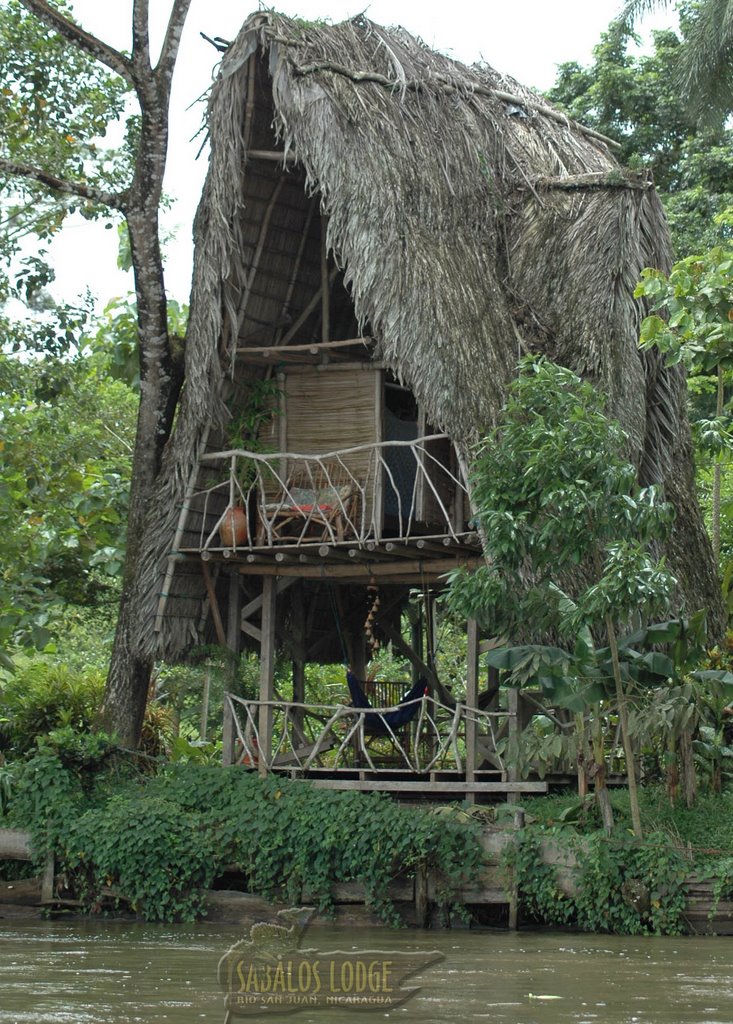
After a lunch of large river shrimps in garlic, we took the public boat back upstream to Sabalos Lodge. It is a series of cabanas on the riverbank, two kilometers away from Sabalos.

We are staying in the Tarzan cabana, a t-frame thatch hut located on the riverbank. We arrived to the sound of howler monkeys and entered a world of hummingbirds, salamanders, caimans and another assortment of forest life. On the upper level of our hut, we have a bedroom, bathroom and a balcony with a bench that look out right over the water. Downstairs, we have a pair of hammocks, where we can rock from side to side while taking in a bird’s eye view of the river and the green forested shore beyond.

The friendly local owner, a former Sandinistan general, treated us to juice made with small oranges upon our arrival, and later to sangria made from grapefruit, orange, lemon and jackfruit grown on his own farm.

Again, sleep with come early tonight. With no multimedia and light attracting bugs, it makes more sense to go to bed early and rise at dawn for a new set of activities.

I’ll walk back to our hut along a path lit by lemon-scented torches, listening to the music of cicadas and the croaking of frogs.

**the photos are of the blue jean dart frog, a caiman, and our riverside Tarzan cabana (which, by the way, is where Mark proposed)

El Castillo


October 3, 2006

El Castillo, a remote outpost, population 1800, on the San Juan River, is my favorite place in Nicaragua so far, and one of my favorite places ever. WE have only one night here. But I’d love to return, spend days reading and writing on the balconies overlooking the river, listening to the hum of insects and rumble of rapids, and eat fresh fish and coconut bread daily.

It required a long journey to arrive here. We lined up for boat tickets at Granada’s dock yesterday at 11, then returned to board at 2. Despite a 3 p.m. departure, we were among the last to arrive and first class was nearly full, relegating us to seats on the end of a table for six.

First class passage to San Carlos, which cost $7, meant a spot in the overcrowded upper deck. Five sets of benches, divided by a table, plus two straight benches were in a small, air-conditioned room.

The experienced passengers not only saved themselves room on a bench, but they brought a hammock or comfy chair to string up on deck, or a mattress to claim corner sleeping space.

We pushed off from Granada and I watched it recede, a view of yellow and pink colonial arches and building, a shore lined with palms and coconut trees. In all directions, a thick green forest spread away from Granada, rising up to the cloud-covered volcanoes, shadowed by rain in the distance.

People passed the time reading, playing games, watching TV, trying various ingenious positions to sleep or eating. I ventured down to second class, where a woman served cold sodas, chips and chicken with rice and fried plaintains through a window. She could look out at the second class passengers packed into hard wooden benches, the floor below wet and grimy.

We made a stop at Ometepe, an island with two volcanoes in the middle of Lake Nicaragua (Cocibolca). There, men carried aboard large baskets of plantains and watermelon for shipment.

At a 3:30 a.m. stop at San Miguelito, on the opposite coast, children came through the boat selling coffee with milk, tortilla with cheese, bread, as though being on the docks, selling in the middle of the night, was a natural activity for them.

The floor in first class was more or less clean. So as it got later, more people dipped onto it. I went down to the cold and hard floor first. Mark later switched places with me. I wished I could have taken a photo of first class, Nicaraguan style, with bodies curled under tables, laid out in aisleways or spread across benches. Those who’d strung their hammocks on the side of the boat had to cover themselves with sheets of plastic as protection from the rain.

I woke up to smooth waters, a calm sky, a pastel world holding the green pearls of the Solentiname islands. We disembarked in San Carlos, a muddy, colorful, decrepit town, surprisingly active at 6:30 in the morning. We found a place to sit at the plastic chairs and tables of a small comedor. There, we could watch the locals eat large, fried breakfasts of gallo pinto – fried eggs, beans and rice, meat or fried cheese, together with sweet iced fruit drinks or cups of coffee – and the bus attendant receiving one after another large bundle of squawking chickens from the top of the bus and dropping them gently in the mud for passengers to claim.

We boarded a 50-passenger covered longboat for the 2.5 hour trip down the San Juan river to El Castillo, the end of this route. The San Juan river runs along the border between Nicaragua and Costa Rica and connects the Atlantic Coast with Lake Nicaragua. It used to be an active route for transporting gold and other goods, as well as a popular roaming ground for pirates. At one time, it was considered as the most logical place to create a canal cutting across Central America.

We’d only passed one sizeable settlement on the way, the riverside town of Sabalos. El Castillo lay at a bend in the river about 20 minutes further, just before a series of rapids. Until recently, when San Carlos-San Juan del Norte boat service resumed, El Castillo was the end of the line.

We stayed in the Hotel Albergue El Castillo, a two-story wooden hotel overlooking the water. Owned by the mayor’s office, it had wonderful hammocks and rocking chairs on the balcony, where one can fall asleep to the rush of rapids.

There we learned that the majority of visitors are European. Despite the much closer proximity compared to Europeans, only 8-10% of the hotel guests are Americans.

“I suppose the Americans aren’t as interested in eco-tourism,” the hotel attendant theorized.

After a wonderful lunch of rubalo (a fish that swims upriver from the ocean into Lake Nicaragua) we went to visit the crumbling stone fortress, El Castillo’s hilltop sentinel.

El Castillo de la Inmaculada Concepción de María was built by the Spanish in 1675 to protect Spanish settlements (including Granada, on the lakeshore) from pirate attacks. At the time, it was the largest fortress in Central America, with 32 cannons and 11,000 weapons.

In 1762 it was the site of a major battle between the Spanish and British in the Seven Year War. A 19-year-old woman, Rafaela Herrera, seized command of her father’s troops after he died and succeed in driving the British off.

In 1780, Horatio Nelson successfully captured the fort by arriving on foot. But after nine months there without reinforcements, he and his sick soldiers went home. We then strolled through the streets of El Castillo.

Accessible only by boat, El Castillo had one central street, or rather a walkway, of alternating stone and concrete. Wooden homes, shops and hostels on stilts lined it, painted green, blue, red, yellow, pink and grey. The children played on swings and slides along the riverbank and wore blue and white uniforms to the hillside school, set among palms and tropical foliage.

The place gave me such a feeling of calm and relaxation. It felt removed, safe, beautiful and unique. I dreamed of returning again some day, to spend a whole week reading and writing from a hammock, eating fresh fish daily.

By six, darkness fell. And by 8:30, the entire town had gone to bed. I joined them, closing my eyes to the sound of the nighttime insects, letting my thoughts flow with the water outside.

Granada

October 2, 2006

Mark and I began our adventure in Nicaragua today with a volcano andCanopy tour. I appreciated both getting out of Nicaragua and lettingourselves be led about by professionals. It was the kind of slower pace and care I needed after my nasty incident on Friday night. My black eye is shining nicely today, but there are plenty more compelling things tolook at in this area.

A canopy tour is a series of ziplines and platforms set up in thetropical forest. The first one, which is the one we visited, was setup by a Canadian. The idea came from the man featured in the movie,The Medicine Man. Tired of going up and down trees, looking for theplants that could cure illnesses, he set up some ziplines that wouldallow him to glide among them. And now tourists can enjoy the fun.

We lumbered up an extremely rough and rocky road, past coffeeplantations and farms that raised peliguey – a funny lookingcombination of a sheep and a goat, made in Cuba, and supposedlydelicious barbequed.

The staff at Mombotours was very professional and safety cautious.We had four guides for only four tourists and they basically dideverything for us – outfitted us in harnesses and chains, gave us ashort explanation, and then hooked us and unhooked us at each stage ofthe journey.

All we had to do was let go of fear and slide along the cables, ourfeet brushing through the tropical leaves, our yells sounding like thehowler monkeys we saw upon arrival. It was great fun to slide overdense greenery, to move through it as the animals might, and to viewit from a different angle. Many of the trees we landed on were giant, majestic species - guyavon, ceiba and royal cedar.

We travelled a total of 600 meters on the course, then had a nicerappel at the end. Walking back to the lodge, which looked out overLake Nicaragua (also called Cocibalca), we passed coffee bushes,avocado and grapefruit trees, banana and cocoa plants. We picked red coffee beans and sucked on the sweet seeds. Our guide, Jay, took acocoa pod. At the lodge, he opened it and instructed us to suck onthe sweet white covering on the cocoa beans, which tasted like alittle red spiky fruit I´ve had here.

From there, we drove to the Mombacho volcano, my first volcano visitin Nicaragua. We entered the park and drove up the steep road to theedge of a crater. In the 1980s, this area had been a military base.But funding from the U.S., Britain and France helped turn it into atourist area, which according to Jay, has been very successful.

At 1150 meters, the air was fresh and clean, a light breeze blowing,the cloud forest greenery covered by dew. Jay led us along a patharound the crater, pointing out various plant life. We saw manybromedias, the candlestick-like plants that can hold up to three orfour liters of water. Salamanders sit inside of them waiting to catchtheir prey. Its because of these plants that the forest stays wetcontinually. We saw sleeping plants, that fold up upon touch, the colaliyo, whose leaves are used for hats, and the orange bird ofparadise, on which hummingbirds feed.

We visited the smoke holes, where hot steam continued to rise, eventhough the last eruption was in 1575. And we enjoyed a wonderful viewof Granada, Lake Nicaragua, the isletas (a series of small islands inthe lake) and the nearby volcanic lake, warmed by the underground steam.
In town, I tried the Granada specialty, yucca, fried pig skins andvinegared cabbage served on the leaf of a plant we saw on the Mombachovolcano.

Yellow, pink, ivory and blue colonial buildings fill the town, wherehorse-drawn carriages roll by, as well as a tacky train, filled with local tourists. On the central square, I watched a vendor scoop ahomemade chocolate drink into a plastic bag, put in a straw, tie itinto a knot, and hand it to two little girls, who bent their heads together to eagerly suck.