Friday, April 28, 2006

Leaving Bishkek again in uncertainty


April 28, 2006

I am once again leaving Bishkek during a security warning. I’m planning to spend the three-day weekend continuing my bicycle journey around Issyk-Kul. Today a warning came out from the German embassy, saying they expected tomorrow’s protests to be peaceful, but warning citizens that grocery stores may be closed and they should plan their personal supplies.

When I told our receptionist I’m heading to Issyk-Kul, she told me to be careful.

“I heard from someone in Cholpon-Ata that people are coming to Bishkek and that some of them have guns,” she said.

“Then I suppose it’s you who should be careful in Bishkek,” I said.

All of the political maneuverings and associated criminal elements is pretty ugly. It makes me sad to feel that the stability for the majority of good, peaceful people is threatened by a few. I prefer to be out in the rural areas where such problems seem very far away.

It’s already full-fledged summer. The temperature today is expected to reach 97 degrees (36 Celsius). Poplar seeds float through the air, flying into car windows, into bicyclists faces and skid along the ground in light, white masses.

Thursday, April 27, 2006

Biking Around Issyk-Kul: Tyup to Ananyevo


March 24, 2006

I began my journey in the small town of Tyup, a place infrequently visited by tourists. Located on the northeastern edge of the lake, it allowed to me to finish the most trafficked half before the summer surge in visitors begins, and to take advantage of being able to coast partway downhill.

I spent my first night in the only guesthouse in town. Run by a Kyrgyz couple, Saidelda and Anara, they provided a warm, comfortable soft bed in a room decorated by plants and felt crafts.

I woke up at 8 a.m. to the cackle of turkeys and a shining sun. On the way to the outhouse, I saw frost and a little leftover snow in their backyard. Saidelda poured a kettle of hot water into a washstand while Anara fried eggs for breakfast. But there was no shower, which meant I started my trip dirty.

Saidelda, a German teacher at the university in Karakol and a summertime tour guide, has lived his whole life in Tyup. His father worked as a guard.

“When we moved here, most of the residents were Russian,” he said. “Now, after perestroika, most of the Russians have run away.”

Anara worked for 12 years at a bank in Tyup, but lost her job in a restructuring. “Now I’m used to staying at home,” she says. She manages their guesthouse and in the summer, sells crafts with her daughter at a market a few hours away.

I’d just left Bishkek, where most of the people I spoke with were against marking the one year anniversary of the revolution as an official holiday. I even heard that some people blocked a road in Bishkek in opposition to the official holiday. But this couple thought the revolution was a good thing.

“Something had to be done,” Saidelda said. “They had forgotten about the people.”


Saidelda walked me through town to the main road. We walked under the shadow of the impressive range of white mountains, the small, wooden, rural homes, past a horse tethered to a pole, munching on hay, and past the run-down park where the Lenin statue had been toppled.

I waved goodbye and started on my way, coasting downhill out of Tyup. The tree-lined road was quiet, except for the cawing black ravens, which flew across the road in populations like monkeys in a jungle. Traffic was light, but the few cars that came through, sped by, apparently happier to risk hitting me than to hit a pothole.

My destination was Ananyevo, a Russian village about 70 kilometers away. I rode at a leisurely pace, enjoying the nuances of rural lake life along the way. I had traveled this road by vehicle at least six times before. But I never noticed as much as I did when I was able to breathe, smell and feel the environment as I passed.

In the village of Frunze, I stopped to rest. The village was quiet except for the sound of a rushing spring. I saw an old man pushing an old woman in a wheelchair, ducks, chickens, turkeys, cows, horses and sheep meandering through the streets. A young boy asked if I was selling my bike.

Fast, expensive cars raced through the village, traveling between Bishkek and Karakol. Looking at the quiet, simple people that watched them go by, I could understand how they could feel forgotten.

One of the things I love most about biking this route is the ability to stop anywhere, at any time, to take a closer look at what I’m passing. I visited a bear statue on the roadside. He held a pitcher in his paw from which water ran. I’m traveling only with a daypack on my back. I’m carrying a change of shirts, a sweater, a jacket, something to sleep in, an umbrella, sunglasses, toiletries, a book and notebook. And luckily, I had a few snacks and water. While I passed several small shops, there were almost no cafes working at this time of year.

I have a phobia of dogs and my fear of dogs is the only thing that prevents me from biking into many rural parts of Kyrgyzstan. Although the road around Issyk-Kul is paved and traveled, the local population keeps dogs and lets them run free.

I’d been briefed by another biker before leaving. If a dog comes at you, jump off the bike and put the bike between you and the dog. Bend over and act like you are picking up a rock, even if there aren’t any. If you see a dog, walk, instead of riding the bike.

I spent my first hours on a constant lookout for dogs. And when a dog did chase me, two hours into the ride, it was unexpected, having come after me from behind.

I went through village after village. Every one, no matter how small, had a small mosque – usually a grey brick building with a silver dome backdropped by mountains. I saw an older woman washing her boots in a puddle, watched people gather water from pumps and chop wood, saw cows lounging on a mountaintop, smiled at children playing on decrepit, mosaiced bus-stands (their substitute for playgrounds), looked at the crumbling roadside cemeteries and felt the heat of the sun strengthen throughout the day.

Children called out to me, “Hi athlete!”

It was perfect weather for biking. A little leftover snow kept the air cool, but the sun shone in a blue sky.

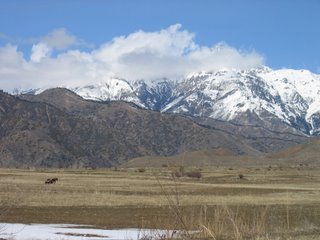
Of course, the main attraction was the lake. When I first saw it, I saw a smooth, pale blue, reflecting the white mountains. As I moved on, it turned a deep, rich, sparkling blue, a constant ribbon to my left.

In the afternoon, during a long, tree-lined stretch between villages, I saw cars and men on horseback gathered in field. I understood that skatchki, or horseback games were underway – probably for a wedding, anniversary, or other celebration. I doubted it was for the anniversary of the revolution.

I got off my bike and sat on a blanket of dry leaves, far removed from the action. I could see the horses galloping from a distance, but all I could see was the dry golden grasses cracking in the breeze and the ravens crowing loudly as they flew between the poplar trees lining the road. Despite the approaching spring, it smelled like fall – a scent of decomposing leaves, peat and warmed grasses. I felt an incredible peace and calm, and safety despite my solitude. I realized that I was able to feel that safety only as a foreigner. If I were a Kyrgyz woman, near so many men on horseback, I’d be in great danger of being stolen.

I saw a couple of horses break from the pack and head toward me. Three young boys were returning home from the races, walloping and yahooing as they galloped across the field. One of them, holding a whip, looked at me and I saw the capacity to steal a bride already in his eyes.

They answered my questions, in barely comprehensible Russian, then galloped off down the empty road, the bare poplar trees arching starkly over them, whooping and hollering in glee at the speed of the chase.


I arrived in Ananyevo, a little before four, exhausted. A stretch of road lined with boxed wooden houses like every other village, I didn’t realize I’d arrived until I’d asked.

Ananyevo is an old Cossack settlement, founded in 1890 and named after a captain, Nikolai Ananyev, who died, along with 700 local conscripts, almost the area’s entire male population, on the Western front during World War II.

I rode a few extra kilometers down to the lake shore, down a beautiful, forested lane. The ground was covered with trees.

At the shore, where the blue waters lapped against the marshy land, I met three men, originally from Ananyevo, who now live in Bishkek. They told me they regretted how their village had fallen apart. They reminisced about the café, tourist base, nice beach and boardwalk that used to exist.

“Now there is no owner,” one of them said. “No one takes care of it and it’s just a swamp.”

They told me that everything was calm in Bishkek. It reassured me to know that I wasn’t biking through a country going through another revolution.

I had made reservations to stay in a Swiss-run guesthouse and I had the entire home to myself. The keeper, a hazel-green eyed Russian, Natasha, met me. She’d prepared me a dinner of fried meat pies with pickles tomatoes and peppers, tea, and chocolate wafers and was in the process of heating up the banya.

As she worked on a pink shawl she was crocheting for an order, she told me that a lot of Russians have already left, but there are still comparatively a lot in Ananyevo.

“In other villages,” she said, “There are only two or three Russian families.”

She told me that there used to be a lot of work in the area, but now the residents have to make a living on agriculture and livestock.

My knees, butt and back were so sore I could barely sit or stand. It was heavenly to enjoy my meal, soak in the steamy banya, and lay on the sofa watching One Flew Over the Cuckoo’s Nest in Russian.

On the evening news, I saw how the holiday was met in Bishkek. Large crowds, mostly Kyrgyz, gathered on the central square. The reporters did no analysis of the holiday, just endlessly asked attendees what they wanted to wish others for the holiday. Only the Russian news provided a little analysis, though it was overall positive. I saw that President Bakiyev had gained weight. He has wide shoulders and is developing a double chin under his round face.

*names in biking around Issyk-Kul posts are real names unless marked otherwise.

Sunday, April 23, 2006

Russian easter


April 23, 2006

Today, one week after the equivalent American holiday, is Russian easter. I’m surprised how widely it seems to be celebrated among the local Russian population. Two Russian colleagues skipped a dinner last night in preparation for the celebrations today. Yesterday, they weren’t supposed to eat meat or fish or drink.

While riding a marshrutka yesterday, I saw someone traveling with a cardboard tray of Easter cakes – round, puffy yeasty cakes topped with a thin layer of frosting and colored sprinkles.

“They are only baked once a year for Easter,” my friend Zhenya told me. “Those who don’t have time to bake those cakes make smaller rolls.”

Another popular tradition is to color hard-boiled eggs a beautiful, deep brown by using onion skins.

At 8:30 this morning, Zhenya called me and asked me to come over for an Easter breakfast.

I had brought two little wicker baskets filled with plastic grass from the U.S. I stopped by a store to get some candy for the baskets, intending to present them to Zhenya and her son.

Sometimes I’m amazed by what little things grab the attention of the people here. The shopkeeper must have asked me twenty questions about what the baskets were, why I was giving them to my friend, how Easter is celebrated in the U.S., etc.

Zhenya had stayed up until midnight last night baking little walnut-shaped pastries. She made them with a waffle-like batter and filled them with condensed milk and chopped walnuts. She showed me the metal mold she used, inherited from her grandmother.

She served me a cold soup made from sour milk, potatoes, cucumbers, eggs and dill, together with the walnut pastries and squares of chocolate. While I was there, her neighbor stopped by and brought her a plate of baked Easter rolls, brown eggs and chocolates.

Zhenya told me that she and four friends had recently visited an oncologist turned laser surgeon to have red and white age spots removed. She had little red scabs around her eyes, neck and hands as a result.

She searched my arms, trying to explain what she was talking about. But she couldn’t find any.

“I guess it’s because you’re active. You don’t have any yet. But if women eat a lot of sweets or fat and they are inactive, their liver gets unhealthy and these spots appear. I was shocked when I first saw them on me and I went in to get them removed.”

“Was it expensive?” I asked.

“No, only 100 som ($2.50). And now I have these scabs. But in a week they will clear up and my skin will be clear.”

She’s also trying to become more active and has starting walking the 40 minutes to and from her store. Just from that, she lost over six pounds in the last two weeks.


Later in the day I visited a modest home, in the neighborhood where the grandmother I adopted lives, and found a man who repairs foreign bicycles. Someone stole the screws that attach my wheels to the frame of my bike. And I had no idea that anyone in Bishkek had such parts, much less someone in an unmarked home. His business largely comes from the expat word-of-mouth network, which luckily for me, seems to work pretty well.

With new screws and a much-needed oiling of the gears, I left riding a new machine.

While I was in the neighborhood, I decided to visit my babushka. I bought an Easter cake from a young boy selling them in front of the Russian orthodox church and brought it to her, along with some money.

I rang her bell and she stepped outside of her green gate to speak with me. I could see small shoots already emerging from her garden. She told me she planted potatoes, beets, onion, cabbage and other vegetables, then asked if I wanted her to cut an onion for me. I’m not sure if that’s a sign of hospitality or not, but I said no thanks.

She did bring out three colored eggs for me. One of them was beautifully done. She’d attached small leaves to the egg before dying it in onion peel, so that it was decorated with leaf patterns. The other eggs were pink and blue from dyes she’d purchased at the market.

I think she considered me less of a threat this time, though she still didn’t invite me in. She complained that she waited several years before she was able to get assistance.

“And my pension was only 250 som ($7) a month,” she said. “I saw people there who had pensions of 800, 900, even 1000 som ($25) a month, and they were getting the assistance of $10 a month.”

It’s a really sad situation when someone living on $25 a month is the object of envy. I guess there are injustices, perceived and real, throughout the spectrum of experience. Ekaterina seemed to consider her bimonthly support transient, as though it could disappear at any time, into the hands of someone with twice her $12 pension. I assured her that she would receive that money regularly, for at least a year, and that I’d try to stop by once a month if she didn’t mind.

“Of course not,” she said, with a smile and a pat on the back.


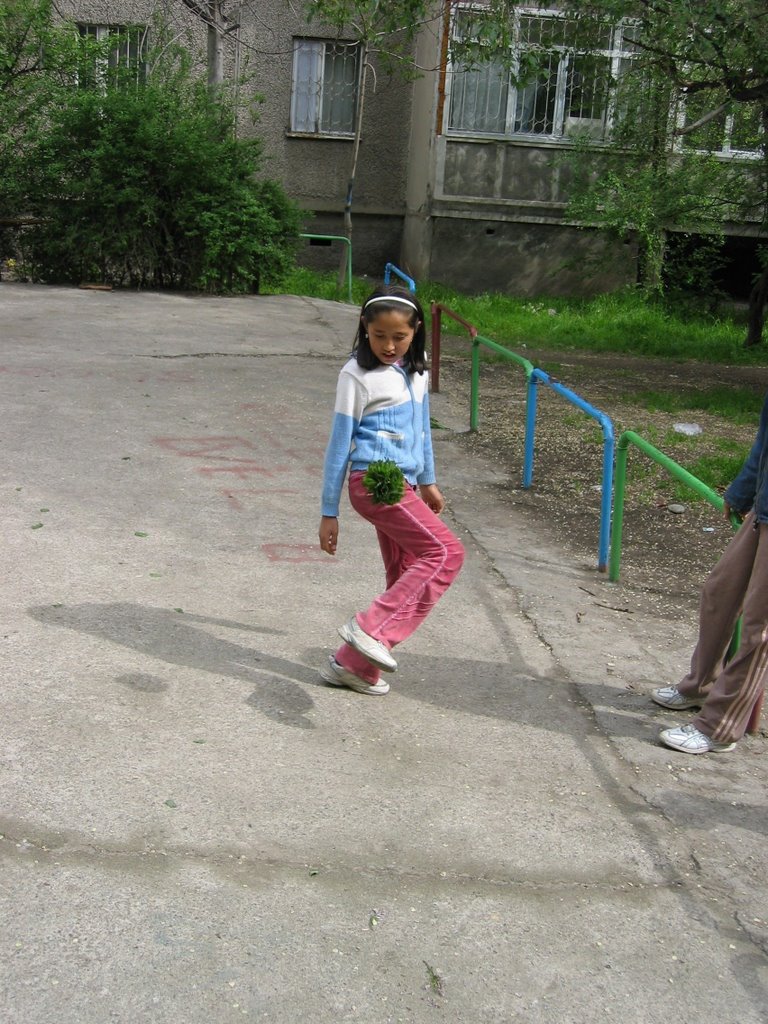
Coming home I passed a little girl playing hackeysack with a ball made out of leaves. It’s the second time I’ve seen that this week. The kids collect leaves from a tree, tie them with string, and are somehow able to make a buoyant ball to bounce on their calves. I’m impressed.

Thursday, March 23, 2006

Anniversary of the revolution

Tomorrow will be the one year anniversary of the Kyrgyz revolution. My housecleaner will not be cleaning any houses.

“I’m staying home all day. I’m scared to go on the streets,” she said.

Zhenya and her two salesgirls are sleeping in her store all night tonight and tomorrow. She says a lot of store owners are doing the same thing.

“Do you have any weapons?” I asked.

“No.”

“Don’t you want at least a club or something?”

“No, what would I do with it? If people come, we’ll just tell them we work there and please move on to another place.”

And the government is considering it a national holiday. Not a lot of residents, at least in Bishkek, seem to consider it a reason for celebration.

“I can’t call it a revolution,” Zhenya said. “It is more like an evolution.”

I’d like to see what kind of festivities the government puts on in the central square, and how well it is received. But I also want to take advantage of the 3-day weekend. So this evening I’m going to travel to the north of Issyk-Kul. I have the goal of riding around the entire lake by bike. I can’t manage it all in one weekend, but three days will give me a good start. I look forward to the adventure, towards working towards accomplishing a goal, towards seeing the land from such a close-up, slow-moving angle, to being far away from the thought of revolutions or evolutions.

Wednesday, March 22, 2006

Trudging Through the Fields

A cold, steady rain fell this morning and continued throughout the day. I went to the home of a man who owns a simple beauty shop at the Osh market. He warned me that the rain had turned the roads to mud and he worried his old Zhiguli wouldn’t make it, but we tried anyway. A little ways short of the house, the mud became too thick and we walked.

We were in one of the regions on the outskirts of Bishkek called Novostroika or new construction. We had completely left the city, passed some fields, then encountered this community of simple brown boxes in various stages of construction. I could see pieces of hay stuck into the mud that formed the walls. Sheets of corrugated metal served as roofs. I tried to imagine someday paved roads, playgrounds and shops. But for now, it seemed naked.

I kept my eyes on my feet, where sticky brown mud mixed with grasses coated my black dress boots and splashed up onto my pants. I could see greenery coming up through the mud, and I felt the ridges we walked over. Despite the fact that we were clearly in a neighborhood, we were definitely walking over a field.

“Is this a field?” I asked.

“Yes.”

“And what about the owner? Was he paid for his property?” I thought back to all the rural squatters who came to Bishkek (and also to Osh) following the revolution, settling onto other people’s fields, and demanding the right to build houses there. Was he one of them? He said he’d come to Bishkek a few years ago from the cattle-raising area of Naryn.

“A squatter took this property, built the walls of a home, and got the land registered. Then he sold it to me for $1000,” the young man said. He wore a waist-length thin black leather jacket and his brown skin was splotched.

I found that pretty disgusting, that someone could squat on another’s land, then sell his right to live there. I doubt the real owner of the field received anything at all. But the guilty party is already gone, probably seeking out the next squatting site.

“Such things happen all the time in this country,” he said. And he was right. I thought back to the swimming pool I’d used on Sunday that had somehow been taken away from the children’s home the previous owner had donated it to.

Among all the houses in the silent, empty neighborhood, his was one of the nicest. We arrived soaked in mud and dirt. But the two rooms inside were clean and carefully decorated, insulated with carpets and shyrdaks (felt rugs). A small green tree wrapped in gold and silver tinsel stood in the windowsill, a sign of the homeowners trying to create beauty.

Every day, this man and his wife walk through that mud to where they can catch a marshrutka. They take the long journey into town, together with the other poor immigrants in their neighborhood. He tries to build his beauty salon, she sews at a clothing factory. Together, they try to build themselves a life, and create hope for their future children.


This evening Zhenya called me to discuss her business’s development. She talks to me a lot about this subject, as she seems to somehow think I can foresee her prospects better than she can.

Her store is located on a riverbank. During the summer, people should stroll nearby and she wants to attract them to her shop with some outdoor tables and chairs and a freezer to sell ice cream.

She heard that Coca Cola provided free tables and chairs with their logo, then found out they’d only give them to cafes in the center of town. She could save the money, but that would mean she’d miss the summer season. So today she went to a bank to look into borrowing $1,000.

“It’s really easy and the price is quite cheap,” she said. “I’d like to do it. But I have a problem. They wanted my husband’s passport. I haven’t talked to my husband in years. I don’t even know where he is.”

I explained how according to the law, each spouse has the right to 50% of the other’s earnings and property.

“But I’m the one building the business,” she said. “I’m the one supporting our son. I figured he wouldn’t have any rights because it’s so clear he does nothing to support us.”

I told her that in her situation, perhaps it was a bit risky to remain married. He could always return and try to lay claim to what she’d built. She has looked into a divorce before. But in order to have it done quickly, she’d need to pay. And she refused to spend any money on the procedure.

“I mainly just stayed married because I thought if I wanted to go overseas someday, I’d have an easier time getting a visa if I was married.”

“They’d know anyway that you weren’t living together,” I said. “And if you leave your son behind while taking an overseas trip, that’s insurance enough that you’ll return.”

“So then what do I need a husband for?” she asked, in a decisive voice. “I just imagine myself searching for him, asking for his passport, telling him I want to take credit. He would be so thrilled, he’d tell me that obviously I can’t do anything without him, he would gloat over my situation.”

So it’s possible Zhenya might get a divorce in order to get a $1,000 loan.

Tuesday, March 21, 2006

Navruz

Zhenya called me this morning, upset. She’s having a hard time getting products from Schwartzkauf, the German maker of shampoos and other personal care products.

“I don’t understand,” she said. “In other countries, manufacturers want to work with stores. But here one has to beg, to placate, and to please them in order for them to come.”

They had agreed to come at lunch time, but instead came in the late morning. They called to see why Zhenya wasn’t there.

“First of all, it’s Navruz,” she said. “And second, we agreed on lunchtime. I can come now if you want.”

“No, we are never going to come to your store again,” they replied.

Before this, they had told her they wouldn’t come again if she didn’t buy a minimum sum every few days.

Of course, she purchases small amounts. But she’s only been working a few months. And if she starts with small purchases, she’s likely to make larger purchases as time goes on. It’s in the interest of the company to help her develop her business.

“The larger companies, Scwartzkauf, Procter and Gamble, they are all like this,” she said. “If you can’t buy at least $25 of products, they are not interested.”

She really wants to sell the Shwartzkauf shampoos. I asked if she could buy them wholesale from another vendor, but she doesn’t like that idea.

“There would be less of a margin and it wouldn’t be worth it. Shampoo is heavy and it would be hard to carry it from the market to my store. Such products are better to have delivered by the manufacturer.”

So for now, her customers will have to live without.


Zhenya and I decided to walk together to the central square to see the Navrus gatherings. I was hoping to spend the holiday with a local and was glad to receive her call.

I’ve met a lot of great expatriates in Bishkek and I appreciate those friendships. But I’m spending more time now with expatriates than ever before and it’s making me wonder if I’m becoming too removed from local life.

Navruz is a shamanistic rite celebrated throughout Central Asia. It marks the beginning of spring and is an Islamic adaptation of shamanist vernal equinox or renewal celebrations. Often banned in Soviet times, it became an official celebratin in 1989 in order to distract attention from Muslim nationalistm. On this day, people celebrating at home have a special meal that should include separate, symbolic items for men and women as well as seven items that being with “sh” in Kyrgyz: wine, milk, sweets, sugar, a peanut sweet, candle and a bud. It’s marked by lots of festivities on Bishkek’s central square and horse races in Talas and elsewhere.

We walked down the main street, Chui Prospect. Already at Tsum, the central department store, the streets filled with people. Outside of Tsum, a crowd formed a semi-circle around a woman playing a traditional instrument.

As we walked further into town, closer to the central square and the White House, the crowds thickened.

“Russians usually stay home on this day,” Zhenya said. “The Kyrgyz all come from the villages, together with their children, and the Russians are afraid because they get wild. Especially at night, when they get drunk.”

Herself a mix of nationalities, she considers herself a Russian. And as she said, there were very few non-Kyrgyz.

But except for throwing their garbage wherever they happened to sit, the people we saw were very well-behaved. A festive spirit ran through the air. I never see so many small children and it was pleasant to watch entire families saunter through an afternoon.

“Did you notice how many small children there are?” Zhenya asked. “Even in these times, when everything is unstable, people continue to have kids.”

Zhenya told me she recently received bad news from her son. He received his third quarter grades.

“I opened up his notebook that had the grades and it was horrible!” she said. He had a 2 (the equivalent of an F) in reading, math and Russian. “I told him OK, math is hard and Russian is hard, so I can understand. But reading? What’s so hard about reading?”

She found out that they had to read a text and were expected to read 70 or 80 words a minute. He read only 35. He explained that he didn’t feel like reading fast, so he purposely read slowly.

Zhenya told me that intellect doesn’t run in her family. Neither she nor her mother studied well. “My mother’s brother was smart,” she said. “And I thought maybe Bagdan would be that way as well. When he was a year and half old, he already knew his alphabet. And he could read at three. But it stopped there.”

The central square was decorated with a large concert stage, giant banners announcing Navrus 2006 and Kyrgyz flags. Photographers worked feverishly. The Kyrgyz seem to like photos with background sets. So all along the road we passed stuffed elephants and tigers, plastic chairs and plastic flowers, and felt covered boards announcing Navrus among flowers and balloons.

Zhenya spoke of her friend Sveta and how much she misses Bishkek. She’s currently living in Almaty. “The people here are so much simpler,” Zhenya said. “You’d never see things like those dirty plastic chairs, that people here are willing to pay to be photographed on.” For the rest of the day, she made a point of pointing out all the things that would only happen in Kyrgyzstan. Many of them – like the cheap games of luck people thought up to make money, and the people sitting and eating in the grass – didn’t phase me at all. I wouldn’t have paid any special notice.

But others were definitely unique to Kyrgyzstan. “Look at those people gathering used glass bottles, right in front of the White House,” she said, laughing. And she was right. Just a few feet away from the most powerful office in the country, people collected and lined up brown, green and white bottles.

I told her I respected that. In America they’d probably just go in the trash. “It’s ecologically clean,” I told her.

“Yes, and look at this ecologically clean,” she said, pointing at the trash already littered across the lawn. “By tomorrow it will be a mess here.” She had a point.

We walked along the art gallery row, where vendors sell paintings under awnings, watch, saw people playing a game throwing large bones (from which animal, no one seemed to know) into the center of a circle, clapped for young dancers, enjoyed a lunch purchased from a grocery store on an outdoor bench, and appreciated the beautiful, sunny, spring weather. The willow trees already hung in green threads and the small apricots already bloomed pink. We heard the sound of popping balloons, of laughing children, and smelled all the national dishes offered for sale – various animal innards, steamed meat-filled dumplings, fried rice with carrot and beef, meat kebabs, and the special holiday treat – sumalak – a brown sweet made from wheat germ sold in small plastic cups for 10 som. Salima had told me so much about it – how difficult it is to make, how long it takes, how it’s only made for Navruz. Only women can make it and the many steps include soaking the wheat for three days until it sprouts, grinding it, mixing it with oil, sugar and flour, and cooking it for 24 hours. So I had to try it. But it wasn’t as good or as sweet as she’d led me to expect.

“They probably have one version they make at home and another version for sale,” Zhenya said.

A bicycle taxi pedaled past us, on the street closed to traffic, and huge stands of balloons puffed up with offerings of Ronald McDonald, Spiderman and Donald Duck.

Our last stop was at the ferris wheel. Zhenya was reluctant to stand in line, but I convinced her it would be worth it. It was a slow, steadily moving wheel, with red, blue, green and yellow carriages that sat four people each. At the base, an old Russian woman renting binoculars sucked on a chocolate ice cream stick. We paid the 35 som fare and climbed aboard. They allowed us to ride alone.

As we rose higher, we could see all the festivities going on below – the children twirling around on the ancient rides, the families seated in the grass, the activities on the central square, the golden domes of a central square building.

On the way home, we passed a place where a carpet of violets bloomed under white-trunked trees. “Spring is really here,” Zhenya said. And by participating in this holiday, we’d officially marked it.

Sunday, March 19, 2006

Issyk-Ata

The construction season is beginning. With the arrival of spring, the construction material market on a March weekend is jam-packed with action.

Preparations are underway for Navruz, the Muslim festival celebrating the spring equinox, which will take place on Tuesday. Colored flag are appearing around the city and the central road near the White House has been closed to traffic for the past several days.

Preparations may also be underway for the one-year anniversary of the revolution, now declared an official holiday. One of my co-workers heard that the owner of the Dordoi Plaza, a large shopping center looted during the last revolution, urges it’s renters to have their goods ready in boxes in case of an attack.

“I don’t expect any major revolution,” my colleague said. “If anything, it will just be some bandits and hooligans acting up. But if they do, they are going to have a tough time. All the shopkeepers have bought guns by now and they are ready to fight to protect their property, after they’ve seen what can happen.”


Today I took a day trip with the hiking group to Issyk-Ata, a sanatorium about an hour and 20 minutes from Bishkek. With the unfortunate early end to the ski season, Sunday hikes are starting up again.

We piled into an old green and white bus with green hubcaps. On the way, our leader, Boris, told us some of the local history.

As we went through Kant, a city of 65,000 on the edge of Bishkek, he told us about Kyrgyzstan’s first sugar industry, located there, and the Russian military base.

We traveled along a flat, tree-lined road toward the mountains. The village people stood and watched the bus go by as though it was the most interesting thing they’d seen all day I alternated my attention between watching the scrub-filled land turn a hesitant green and watching Boris’s videos of previous hikes – filled with waterfalls, flowers, canyons and mountains. Several people had picked up hot, fresh lepushkas (round, flat loaves of white bread) at our stop in a village. Steam rose from my neighbor’s lepushka, like a gaseous sun.

Due to the snow, even at low levels, we couldn’t take our usual long, intensive hike. That allowed us to move at a slower pace, to be more like tourists for once. Boris showed us a rock that, if you put your bare leg into its depression, guarantees either a wedding or the birth of a child within a year.

From there, we moved to a holy Buddhist rock that emanates energy. A carving of Buddha in the lotus position and a Tibetan text were covered in bronze.

“See, this is from the 2nd century and it’s still here,” Boris told us. Whereas a carving of Lenin on the opposite side of the rock, done within the past few decades, had almost been erased by the elements.

We drank from curative waters that smelled like rotten eggs and washed our eyes in a fountain where the water is used only to cure eyes.

Then we took a walk along a snowy path to a frozen waterfall hidden in the mountains. Much of the water had frozen on the way down, forming an ice cave through which the rest of the water flowed.

Before leaving, we paid a dollar each and took a swim in the thermal pools. The 52 degree Celsius water comes out right from the mountains into the swimming pool. Despite the lack of indoor changing rooms, which makes for a frigid entry and exit, it is such a fantastic experience to jump into the steaming waters on a cool day, to vibrate as the massaging waters pour out of tubes onto your back, and to look up and out at snow peaked mountains and a wide, wild sky. I can’t imagine more amazing scenery for a swim anywhere in the world.

Tuesday, March 14, 2006

A steamy profession

Near the intersection where my office is located is a large, square hole, right in the middle of the road. Maybe once there was a metal covering, but someone probably stole it and sold it to China for scrap metal.

This afternoon, I watched one car almost get stuck. It’s wheel fell into the hole and the car, stopped at a stoplight, had just enough momentum to get out.

The car behind it wasn’t so lucky. A beautiful, shiny silver Mercedes, it crawled forward, oblivious of the trap. The wheel approached the edge, then slid right down into the hole. It held the bottom of the wheel like a vice.

I watched the driver get out and look in dismay – his shimmering piece of metal caught like a desperate animal in a trip. A while later, I saw them trying to raise the car, trying to release it from its trap. Once they got out, I knew it would only be a matter of time until another vehicle got caught.


Today was my first, and hopefully last visit to a “sauna.” I see signs for saunas all over the place and didn’t give them much thought. I assumed they were bathhouses, the steam and the clean enjoyed in the typical Russian tradition.

So when someone offered to show me his sauna, I accepted. It was located at a cheap hotel I’d stayed at before, near the bus station. He asked why I hadn’t visited his sauna when I stayed at the hotel.

“I didn’t know it was here,” I said. “And I didn’t really need a bath at that time.”

We went in and he showed me a steam room, a billiard table, and an attractive swimming pool, where people could jump in after steaming up. He also showed me a small, dark bedroom with a double bed.

“What is that for?” I asked. The owner looked at me strangely.

“You know, people get tired after taking a sauna,” my colleague, a male in his early 20s said to me. “It’s so they can take a rest.”

Seemed a bit fishy to me, with a hotel next door, but whatever. The staff, an administrator and an assistant, were busy cutting up sausage, cheese and bread, and laying out salads for several male patrons who’d come to use the sauna.

“You’re no cook!” the administrator, a disheveled blond in her early 30s said to the older administrator.

“And you are?” the middle-aged woman with frizzy brown hair asked.

They told me the men had brought the food themselves.

“Do you charge extra to prepare it for them?” I asked.

“No,” the blond replied. “But I suppose we should – like a service.”

The atmosphere in the cramped administrative office was tense and somewhat unpleasant.

When I went out to find my colleague, he told me he’d see three prostitutes come through the door. “I didn’t want to tell you,” he said.

The owner explained. “We are all adults here, so I’ll be honest. I offer services – erotic massage as well as medicinal massage.” He told me about the $500-800 profit he makes each month on erotic services alone, though he himself does nothing except provide a place for it to happen. We got onto a discussion of pimps and the division of money. I was disgusted to see how much money men would claim for a service being provided by women alone.

I was already struggling to conceal my disdain for this man’s new business. But my colleague remained interested. So we went to his apartment. And upon opening the door, in mid-afternoon, we found three young girls. Two of them were lying in bed, holding each other. It was clear they were all prostitutes and that this older middle-aged man, just back from Russia, was a pimp himself.

We got out of there pretty quickly.

“Nice to meet you,” I said, trying hard to retain civility for a man who used poor, vulnerable local women.

“You too. And happy belated women’s day!” he said, as he left us at the bus stop and walked across the street. I could only wonder what that holiday could possibly mean to him and how he celebrated it with his staff.

Monday, March 13, 2006

All bent up

Today I visited Kugaibergen, the auto parts market. A tremendously male enclave, the market is made up of old, rusting iron trailers. Random auto parts fill up the trailers and line the ground in front of them. The smell of diesel, oil and metal is overpowering.

Nearby, old, beat-up, crashed-up cars stand in a line, an honor guard of metal, waiting for the vendors to take them apart. One would never believe that someone could make their living from these pieces of crushed metal.

I went to the home of a man who has been selling used auto parts from this market for the past eight years. Mirlan has a successful, though small business, and earns enough to support his wife, two children and mother.

We walked through the gate and into the yard of his new home, built on the very edge of town where many recent immigrants try to establish themselves. His mother, a hunchbacked old woman, bent over a sheepskin she was curing, spreading a white paste with a knife and gathering it again at the center of the skin.

“We have very white sheep in Naryn, where I’m from,” Mirlan said.

Across from this grandmother was a beat-up car frame. Clearly, another vehicle had slammed into it on the passenger side. The formerly straight edge was u-shaped. The passenger seat was folded in half like an omelette, the back jerked away perpendicularly. If anyone was sitting there at the time of the crash, they surely must have died.

How strange it was to think that a living being might once have spent his or her last moments on that twisted piece of metal. And even stranger to regularly bring sites of death into one’s new home, to use them to bring food, shelter, clothing and a future to a family of the living.


Later that afternoon, I heard about the death of two brothers I knew in Osh. They were six brothers, all short, squat, deep-voiced and muscular. Despite their bandit-like appearance, they were religious, devoted to their family and hard-working. When they spoke of their mother’s death, shortly after returning from Mecca, tears appeared in their tough eyes.

The six of them worked together, selling cars and car parts, running a car wash. Their goal was to build a beautiful, luxurious new home for each brother in turn.

When I drove in Osh with one of the brothers, he drove so fast I was frightened. My companion asked him to slow down and he did so reluctantly.

I knew they were crazy drivers. And they died the way I imagined it would happen – they got into a car accident in Russia as they were bringing cars back to Kyrgyzstan.

I imagine it was probably their fault. I regretted they couldn’t slow down in order to live another several decades. And I hoped they didn’t take any innocent travelers with them, though I know it’s possible.

One of the six brothers used to sell used car parts from his home. I wondered if he was one of the two who died. I wondered who would deconstruct the metal where they spent their last moments and line it up on display, for sale. I wondered who would buy it and carry it with them, part of another machine traveling the post-Soviet roads.

Saturday, March 11, 2006

I called Shavkat in Osh this evening. He hadn’t been in when I’d called two nights before because it was men’s night at the teahouse.

He’s still formally unemployed but has found a way to earn some extra income by sewing tents. He makes them at home and people buy them to use on the jailoo, the summer pastures. Every weekend he drives to Nookat, a town about 40 minutes away, to sell them.

I asked why he couldn’t sell them in Osh. He said that more people in Nookat deal with cattle – which is probably true. But I think it also gives him an excuse to drive one of his beloved cars.


Construction is moving rapidly on the new building across the walkway from me. Jumping white light shoots through my curtains late at night and early in the morning, the sparks of welders looking like off-season firecrackers. Last night a couple sat on the steps at the entrance to the building, drinking beer and watching a new building rise.

Friday, March 10, 2006

Cell phone thieves

Abdurakhman is a taxi driver who I call with some regularity. He also charges me fair rates without having to barter about the price. For the past several days, his cell phone was turned off. This was hard to explain, given that he works every day.

Today I tried once again and a woman answered.

“Is Abdurakhman there?” I asked.

“Call XX-XX-XX,” she said.

I called and he picked me up.

“Did you change your cell phone number?” I asked, after I slid into the back seat.

“No, I lost my cell phone and had to get a new one. Did a woman tell you the new number?”

“Yes.”

He told me that he’d plugged it into his car to recharge and a female passenger stole the $100 phone.

“So I called her and I told her she could keep the phone, but could she please make sure to give my new number to anyone who called.”

“Why didn’t you tell her to give you the phone back?” The thought of calling the thief and asking for a favor somehow didn’t seem right to me.

“Because I wouldn’t get it back in any case. But I can lose a lot of business from clients who can’t get through to me.”

True. He lost several trips with me alone. I try to imagine what kind of woman could afford to take a taxi (which costs 10 times as much as a marshrutka), yet would stoop to stealing his phone, and calmly answer his call. I guess there are all kinds of people in Bishkek.


I think I’m a magnet for unprofitable taxis. The next taxi I took, one hour later, is another driver I use with some regularity. As we headed toward the office along Chui Prospect, he got stopped by the police.

He pulled his documents out of the glove compartment and went out. I felt uncomfortable sitting alone in the car. I wondered if he worried that I’d find something like a cell phone and steal it.

A few minutes later he returned, opened a drawer and pulled out his money. Obviously, he had to pay the cop off.

When he came back again and we took off, I asked him why he had to pay.

“I don’t have a license,” he said.

At first I thought he meant a driving license and that worried me a little. Then I realized he didn’t have a license to drive a taxi.

“Why don’t you have a license?” I asked.

“I have another job.” He told me that on the weekends he practices arbitrage in the car market, buying cars at low prices and reselling the same vehicle (without doing any repairs) at a slightly higher price. With Bishkek taxi drivers making something like $10-15 a day, he wouldn’t need to add much to the car price to equal a day’s wages.

He had to pay 100 som, twice the price of my fare. He would have been better off refusing to take me, continuing to read his newspaper in the line of taxis waiting for customers.

“Oh,” I realized. “You have the taxi sign on the top of your car.” Many drivers take it off as soon as a passenger gets in. I saw why.

He also realized his mistake. He pursued his lips and stared ahead in the concentration of shock. Lost in his thoughts, he missed my street.

Not wanting to subject any more drivers to problems, I rode my bike home in the evening.

Thursday, March 09, 2006

Nigora's Women's Day

I called Nigora in Osh today to wish her a happy belated holiday. Her husband and sons gathered money to buy her some cosmetics and cooked her shashlik (grilled meat) and plov.

I asked her about her business. She said it’s finally starting to pick up. She has increased her stock from 14,000 som when she started to over 20,000 (just over $500). She found an Osh contact who makes wholesale purchases in Uzbekistan.

“So now, people can order things from me and I just go to her and buy them. It’s a little more expensive than what I paid in Uzbekistan, but given that I don’t have the transportation expenses and don’t lose my time, it’s good for me.” She told me that three people ordered items from her today.

I asked how she liked being in the working world. “I think I was getting bored at home,” she said. “I’m now a delavaya zhenshina (working woman),” she said with a proud chuckle.

Habib grabbed the phone in excitement to talk to me and update me on his university life. I could even hear reticent Faruh smiling on the other end.

I missed my Osh family and I missed Osh.

Wednesday, March 08, 2006

International Women's Day

The big day arrived – the day that women are appreciated, valued, and treated well.

The celebrations started yesterday. My male colleagues greeted each female upon their arrival at the office with a trio of tulips and an offer of tea or coffee. Later, they gave us all special-ordered mousepads and keychains and treated us to cake and champagne. Some employees later invited me for cake and Fanta and gave me a wooden holder for incense sticks.

I went out in the afternoon and found most businesses working as usual. But many people, both men and women, seemed to make an effort to be extra kind. Yesterday, a marshrutka driver refused to let me pay. Today my favorite cafĂ© gave me a small bunch of freesias. When I bought a DVD, the female clerk gave me a five percent discount. And the Chinese-speaking owner of a new Chinese supermarket threw in a little packet of Chinese snacks for free. She called out to the young Russian employed there as a translator and shopper’s helper.

“S pradznikom (Happy holiday),” she then said to me, in heavily slurred Russian. That was OK, because she’d just commented that my Russian sounded like English.

Several people called or SMSed me greetings. Zhenya called in excitement about her sales yesterday.

“I took in 9,000 som!” she said. “Everyone was buying presents.” Her usual income is about 1,500 som, her previous record under 3,000.

The nicest call of all came from an employee I worked with in Osh, Erlist. When someone was going to unjustly fire him, I fought on his behalf. He was later rehired in an even higher position in Jalalabat. I hadn’t spoken to him in almost five months and I appreciated that he thought of me on the holiday and even made a rather expensive long-distance cell phone call to offer his congratulations.

I also received an emailed congratulations from my Osh friend Kairagul. After encountering difficulties with her management in Osh, she quit in December and relocated with her new husband to Russia, leaving her son in Osh until she got resettled. I recommended her as a good employee to a colleague there. But due to variance in the recommendations she received, Kairagul almost didn’t get hired. In the end, my colleague decided to trust her own positive impressions of Kairagul, as well as the recommendations given by me and another. She hired her in a position that pays over twice what she earned in Osh.

I spent most of the afternoon visiting the babushka I adopted through Adopt a Babushka (www.adoptababushka.org) back in December. I had been meaning for a long time to visit her. I wanted to meet her in person, to see if the promised assistance was reaching her, and to find out how else I might be able to help her.

I bought her a cake, flowers, raisins, pastries, tea, oranges, sausage and a four-piece kitchen storage set, then set out to find her house. Adopt a Babushka offered to take me to her house. “It’s so tiny, you can miss it,” they told me. But they were closed on the holiday and I wanted to visit her on the day off. Also, I worried that no one else would congratulate her and I thought a visit on this day in particular would mean something to her.

So after walking for well over an hour, I found her house. I paused at the door, worried about dogs. A little girl quickly emerged from the neighboring house, intrigued by the sight of a foreign-looking person carrying a cake and flowers.

“Does Natalya Vasilievna live here?” I asked her.

“Yes.”

“Does she have a dog?”

“No, she lives alone. With just a cat. Ring the bell there on the door.”

I rang the bell and the little girl shouted to Natalya to come out.

She came to the door, a wrinkled, square-faced 78-year old wrapped in several layers of clothes. I introduced myself as her sponsor. She told me that someone from Adopt a Babushka had come to visit her last February and promised to send her 400 som a month. “But I didn’t start getting anything until December,” she said. Unfortunately, that was how long it took them to find her a sponsor.

“I have to say, that extra assistance really helps a lot,” she said. “And when she came back she brought such wonderful presents – even a Christmas tree!” she said. I was happy to hear she liked them.

The little girl stood by the entire time, eagerly eavesdropping.

“You can go away,” Natalya told her and she scampered back into her fenced yard.

I had brought everything needed for tea and thought Natalya might invite me in. But she didn’t.

“Could I see how you live?” I asked.

She agreed. I walked past a gaggle of chickens and saw her orderly garden, ready for planting. Her house was only two rooms – a tiny kitchen and a bedroom/living room. It was neat, clean, and as well maintained as one can on $10 a month.

She sat me down in the kitchen, near the door. It was clear she didn’t expect me, or want me, to stay long. I later understood her hesitation.

Her pension of 487 som a month ($12) was recently increased by 35 som (less than a dollar) and she was happy about that. “I sell eggs to the neighbors, which covers my milk and bread, and now I get an extra 700 som (from Adopt a Babushka) every two months. I will pick up my next payment on March 14th.” She seemed to be counting the days.

She told me that no one had given her anything for the holiday and she seemed pleased to be congratulated.

“Even a cake!” she said, with some excitement. But she didn’t touch the gifts in my presence, leaving them on a chair across the room.

She pointed to her stove. “In the late 90s someone came and installed a gas line for heat free of charge,” she said. “So I used that for a while. But then the cost of gas went up to 200 som a month. At the time, my pension was only 250. So that left only 50 som ($1.25) a month for my food and expenses. So since 2000, I shut off the gas and only use wood.”

She told me that she had to borrow money from the neighbors to buy wood. And this year she didn’t have enough. “I thought I was going to freeze this winter,” she said. “I don’t know how I made it through.”

I asked if she needed paper to burn. Crazy as it sounds, I’ve been collecting my used paper ever since I moved here in October. I knew there were people in Bishkek who needed it, I just didn’t know how to find them.

“Definitely,” she said. “There is a teacher in the neighborhood who brings me her used notebooks. But if you have extra paper, that would help. My banya is also heated by fire.”

So now I’ll make an effort to collect more paper that would be otherwise thrown away, perhaps seeing if I can collect it at work.

She told me she was born in 1928. “I lived with my husband for 20 years, then he found another woman and left me. I don’t know where he is. Now I live all alone.”

Living alone as an elderly woman seems to be difficult. She told me that five years ago she took in someone for a month. When she arrived home one afternoon, she found everything gone.

“She’d taken everything,” she said, looking traumatized at the memory. “The neighbors were surprised, because they saw a taxi pull up and usually no one comes here. She just took everything out and left.”

Then, she was deceived again, just last August. “Two beautiful gypsy women came to my door, together with their children. They told me that a neighbor had put a spell on me. They asked me to bring out an egg and a scarf. I did so. They broke the egg in the scarf and found a blue hair in the yolk. That was a sign of the spell, they said. They told me there was a snake in my house that was out to get me and they could help me find it. So they came in and got on their hands and knees, looking everywhere. Of course, they didn’t find anything. What they were really looking for was money.” She frowned.

“Then someone called at the door. They were sitting where you are now. When I walked out, they lifted up the tablecloth and found my money. There was 600 som ($15 there). I’d just gotten my pension, plus I had 100 som a neighbor had given me for eggs. They took everything, didn’t even leave me 10 kopecks. As soon as I realized it, I ran outside and told everyone they’d stolen my money. But there had been a car waiting there and they got away in the car.”

She had a heart attack after that. “I just didn’t know what to do. I didn’t know how I could possibly live.”

I found the thought of someone having a heart attack over losing $15 really pitiable.

“Luckily, I have good relations with my neighbors. I’ve been living here for 46 years. The neighbors took up a collection and came up with 470 som ($12), which was enough to get me to my next pension.”

Only six months after this latest theft, of course she felt nervous allowing strangers into her house. Of course she didn’t want me to enter the inner area.

I asked if there was anything she needed besides paper and she said no. I asked if she’d mind my coming by once a month or so to bring her some groceries and visit. She agreed. I left her my phone numbers, hoping if she knew who I was, she could have more trust that I wouldn’t run away with her belongings.

“I don’t have a phone,” she said.

“You can call from your neighbors, can’t you?”

“Yes. What should I call you for?”

“If you need anything.”

“OK.”

I walked another hour home, finding a new Chinese supermarket on the way. After a cloudy, cool morning, the afternoon was sunny, blue, and spring-like. I saw many couples and families strolling, enjoying the holiday, spending time together. Many women made a special effort to dress up. When my friend went to the beauty salon, the stylist told her they were out of hair dye until March 9th. Everyone wanted to be beautiful for the holiday.

I hadn’t done anything special. I wore jeans and tennis shoes, no make-up, and my hair needed a cut (I decided to wait until after the holiday, when demand would decrease). But I didn’t regret not having any big plans, or anyone to take me out. It felt much nicer to do something for someone else.

Tuesday, March 07, 2006

The sounds of the early morning

I woke up at 6 a.m. this morning. Few lights illuminated my neighboring apartment windows, but plenty of activity was going on nonetheless.

From the back of my apartment, I could hear the call of the nearby mosque, a sound I hear infrequently in Bishkek and miss from my time in Osh.

Bright lights shone through my front window. Due to the construction of the new building across from me, the lights atop the crane now light up my street 24 hours a day.

Looking through the curtains, I saw the bright, pulsating white light of welding. I heard the clink of tools against concrete. I heard the calls of the workers, probably Kyrgyz or Chinese, to each other.

They must be in a hurry to have the construction work going on throughout the night.

Monday, March 06, 2006

A new holiday?

President Bakiyev wants to make March 24th, the anniversary of the revolution, a national holiday. For those who just want an extra day off work, it’s a nice proposal, especially as it falls on a Friday this year. But many, including the association of looted businesses, are against making it a holiday. Russians and business owners seem to be most opposed. But one student interviewed on TV said, “Many people don’t have such good memories of that day. And the status of our government is not very good, compared to where it was before March 24th.”

My friend Shakir, a Kyrgyz, is unhappy with the new government. “Bakiyev has not created good politics,” he said. “He says one thing and does another.

“Akaev,” he continued, “was really smart. He could hold his own with any world leaders. He just had intrusive family and relatives that took a lot of benefits for themselves. But he himself was very impressive.”

I don’t hear any praise for Bakiyev these days, but of course, I’m in the north now and his support base is in the south.

Sunday, March 05, 2006

A visit to Zhenya's store

Today, as promised, I went to see Zhenya’s store. I took a marshrutka to another part of the city, walked along the banks of a river, and found it, as she described, along the riverbank.

It’s called Cosmos and used to be a Soviet store. Until Zhenya and her Turkish friend opened store, it stood vacant. Her Turkish partner rents half the store and sells groceries there. In Zhenya’s half, she sells drugstore type goods – socks and nylons, hair dye, shampoo, makeup, Turkish dishes and small gifts.

She’d had her hair done in a new style that would last a week – taking her through the March 8th holiday. Her short, straight bangs lay in a row across her forehead. The rest of her hair rose from her scalp in puffy black curls, as though she was wearing a headband. She wore a maroon and yellow Alokozay Tea smock (donated by the tea company) over her zip-up fleece sweater. She stood in front of a colorful assortment of razors, air fresheners, laundry soap, and bottles of shampoo and lotion she’d wrapped in cellophane and tied with a bow for the holiday.

She was very disappointed to find the nylons she’d picked up with me at the market were not good quality. She usually sells them for 40, but had to reduce the price to 25.

“Boy, he really got me,” she said, referring to the Chinese vendor. “I couldn’t believe that they cost only 10.”

“You yourself said that if a price is too cheap, it should be obvious to buyers that it’s Chinese quality,” I said, laughing, and she agreed. It should be obvious to her buyers, but it wasn’t always obvious to her as a buyer.

I saw the hair ties, mascara and nail polish we’d purchased together at the market, integrated into her stock. She showed me small clown figures her son Algubek makes from plaster molds and paints herself. She sells them for 15 som.

She paused near the paper, which she sells by the sheet. “This is really profitable,” she said. “It costs me half a som per piece and I sell it for one som per piece. I make several dollars on the packet of paper. Unlike sugar, where it’s heavy and you have to weight it and can only add a som or two per kilogram. With paper, no one complains about the price and they even thank me.”

She gave me a present for Women’s Day. Inside a box was a cheap, silver-colored ring with a place for a stone. Inside a peel-open can was a live clam. I was supposed to open it, take the clam out of the murky water, pry it open, and find a pearl inside. The color of the pearl would have a certain meaning.

“The Chinese really think of everything, don’t they?” she asked.

“Yes, they sure do,” I replied, as I thanked her, then stuck the live clam in my backpack and wondered how I could get out of tearing it open.

Saturday, March 04, 2006

A visit to Dordoi

This morning my friend Zhenya invited me over for home-baked pizza. Her 9:30 a.m. call pulled me out of bed on a Saturday morning.

“Come on over!” she said. “I’m already starting to cook.”

“Could we keep our original 11 a.m. agreement?” I asked. “I just got up.”

When I arrived shortly after 11, the pizza was almost done. She’d topped the thick, pastry-like dough with mushrooms, tomatoes, cheese, pineapple, black olives and ham.

“Our country is kind of unstable these days, isn’t it?” she asked me.

“Why?” I asked.

She told me that two deputies had been shot recently. One was shot not far from my apartment building, at noon as he got into his car. “It happened in front of everyone,” she said. But I hadn’t heard about it, nor was the killer caught.

Construction is apace on the future deputy apartment building. I thought it would bring security to my neighborhood. But maybe it will just bring more shootouts.

“People are on edge,” Zhenya said. “The other day, a balloon popped in my store. A man became frightened, thought it was someone shooting. He momentarily cowered, raising his arm over his head.”

Over slices of pizza, she told me about her new store, now in operation for four months. She’s been asking me to come visit it for ages and I think I’ll do so tomorrow. She hired two salesgirls, sisters.

She complained that one is illiterate and she wants to replace her. She pulled out the accounts to show me. She’d corrected all the salesgirls mistakes with green pen. She’d written moloko (milk), malako. She’d written spasm instead of jigsaw puzzle. She made all kinds of mistakes that even I, as a non-native Russian speaker, could probably avoid.

“If she was Kyrgyz, I could understand,” Zhenya said. “But she’s Russian. I asked her if she went to school and she says yes, but I can’t believe it. She’s illiterate.”

Zhenya herself controls the store – opening and closing it and taking a minibus almost daily to the Dordoi market to buy whatever products they are running out of.

“I need to go there after lunch to stock up on things for the March 8th holiday,” she said. She expected there to be demand for cosmetics and perfume before International Women’s Day. When I told her I needed to buy a tinkling wrap around skirt for my eastern dance class, she invited me to accompany her.

We set off for the market in gorgeous, sunny, spring-like weather. People seemed to walk with a lighter step, as if the newly green branches of the willow extended its new life to the city residents. We boarded a marshrutka and stayed on until the last stop. Dordoi, a huge mass of giant, iron containers, is located on the edge of the city.

We first sought out my bellydancing gear. I know that lots of people make their living at Dordoi, from low-income small entrepreneurs to incredibly wealthy traders. A metal container can sell for as much as $40,000. The boxes, freezing cold in winter and burning hot in summer, provide many with a path to security and/or wealth.

On the last weekend before March 8th, considered one of the biggest holidays of the year, buyers packed the market.

“My God, look at the dishes row,” Zhenya said. People thronged the rows like ants around a fresh crumb. When Zhenya stopped momentarily, we were bumped into by buyers, by a baby cart filled with round loaves of lepushka, by a young boy pushing a cart he’d fill with goods, by a man selling meat-filled samsi out of plastic bags. There was no room for stopping.

I found what I needed, then we went to purchase items for Zhenya’s store. It was my first time shopping with a vendor. I knew that thousands of people did the same thing as Zhenya every day – came to Dordoi to find items they could sell at a higher margin in the city center. I enjoyed seeing how she went about it.

“Let’s get out of here,” she said, referring to the area of the market we were in. “It’s too expensive. The cheapest place is where the Chinese vendors sell their things. Not that many people know about it yet.”

We went to another part of the market, where indeed, almost all the vendors were Chinese. They spoke broken, barely comprehensible Russian. But they were friendly, helpful, and sold cheap goods for rock-bottom prices.

“How much are these wholesale?” Zhenya asked, pointing at some nylons.

“Ten som,” a short Chinese man said. That was 25 cents.

“I’ll take 120,” Zhenya said.

She leaned over to me. “I can sell them for 40 som,” she said.

Behind the counter, I saw some plastic bags with the Dollar Store logo. The market was like a giant dollar store, but with most of the goods under a quarter instead of a dollar.

Next she bought 30 bottles of nail polish for 30 cents each, followed by imitation Nivea and L’oreal mascara, glittering Chinese eyeshadow, flowered hair ties for 20 cents each, bracelets for mere pennies, ribbons and perfume.

The Chinese imitations of the famous perfumes and brand-name cosmetics were extremely convincing by the packaging. The only way I could tell they were fact was by the grammatical mistakes in the English text. But a local would never notice that.

Zhenya told me about a Kyrgyz man who recently came in to buy perfume for the holiday.

“He was looking at the different bottles and trying to decide which to buy. He asked me where it was from. I told him Poland.”

“You lied?” I asked. I frequently ask where the goods I’m buying are from and hoped I received honest answers.

“I can’t say China. If I say China, nobody will buy my goods. Everyone is afraid of China. They are afraid it’s poor quality and will break. It’s not like Chinese goods in the West. However, it should be obvious to him that it’s a Chinese product. If it was original perfume, Chanel or Christian Dior, it wouldn’t cost $1.25 and it wouldn’t be packaged in a plastic container inside the box.”

I frowned. How would a Kyrgyz who has never seen an original Chanel know?

“So he bought all five perfumes,” she continued, “saying he’d let his women choose which one they liked best. He bought one for his mother, wife, daughters. It was good for both of us. He thought he got a Polish product and I sold my goods with a 100% markup.” She smiled. The first few months involved some trial and error as she figured out what people wanted and how much they’d pay. But with time she was gaining confidence and seemed to be having fun.

As long as I was in the cheapest part of the market and with an expert buyer, I bought a four-piece stacking set for the babushka I adopted. I plan to fill the containers with candies, cookies, fruits and nuts and give them to her for the holiday.

Thursday, March 02, 2006

In remembrance of a grandmother

I’ve been surprised at how few life events have been marked among my co-workers. I’ve been to weddings and funerals of employees, but not of colleagues. In the last year and a half, three colleagues have become pregnant, but none have gotten married. Today I attended my first event, a pominka, or 90-day remembrance gathering for my colleague’s grandmother.

Ninety days ago, she died of cancer, in her 70s. In accordance with the Muslim tradition, Almaz’s family gathered friends, family and acquaintances for a lunch in her honor.

They held the ceremony at the Dostuk hotel, a formerly Soviet establishment that seems to have been remodeled to acceptable standards.

We were among the last to arrive and the 300-plus guests packed the reception hall. At the front of the room sat several men in kalpaks. More men than women attended the lunch and many wore dark colors, though I was told that among Muslims, white is the color of mourning.

I came in a group of 15 and we were seated in a small room separated from the main hall by a latticed wall. The other people at our table, four young men, didn’t speak to us. When they left early, one of my co-workers said it was because they were intimidated to be surrounded by women.

We ate plov, platters of meat, cabbage salad, Russian salad, oranges, apples, lepushka, bobi, sweet rolls, cookies and candies. Shortly after we sat down, I could hear Shavkat, a religious co-worker from the south, saying a prayer at the neighboring table.

About a half hour into the gathering, everyone quieted while someone read a general prayer. After that, everyone stood up as one. They took the plastic bags that had been placed under their plates and began to fill them with the leftover food.

“You should take a little of everything,” Kasiet told me and my other non-Muslim co-workers. “Take some bread, some fruit, some meat, some candies. There shouldn’t be anything left on the table when we leave.”

Kasiet told me that men used to be embarrassed to take food with them. Only the women did so. “But in these times, they take as much as anyone else,” Kasiet said.

Holding our blue and white plastic bags, filled with food, we walked through the condolence line, our bags crinkling as we walked. Almaz’s mother stood with a scarf wrapped around her head, her hand repeatedly wiping a handkerchief over her red, tear-stained face. I shook her head and offered her my condolences. Kasiet gave an envelope to the family, in which she’d placed money collected from all of us. It’s a Kyrgyz tradition to give money, rather than gifts, for weddings, funerals and feasts. This helps to recoup the expenses incurred in holding the event.

Except for Almaz’s mother, all the others in the condolence line were men and Kasiet told me to pass them by. Only men shook hands with the men.

On the way back to the office, Kasiet told me about the Muslim practice of burying people within three days. In the south of Kyrgyzstan, they bury on the day of death. My colleague Damir told me it was because of the heat.

“But the speedy burials mean that there have been quite a few cases in which people were buried who weren’t really dead. I’ve heard of funerals at which there were signs of people trying to get out of the grave.”


March 8th, International Women’s Day, is coming up next Wednesday and the city is preparing. The Altyn jewelry store glitters with lights and a giant, illuminated 8. They also show commercials on TV of a man waking up from a nightmare in which he couldn’t think of what to give his wife for the holiday, until he found out about the 40-50% discounts on gold earrings at Altyn.

Everything from crystal shops to flower stores are reminding people of this holiday. It’s not as if they need reminding. The millions of women in Kyrgyzstan wouldn’t let them forget. The upcoming holiday, together with the change in seasons makes for active trade. Spring is in the air, with temperatures already in the 60s and people seem eager for the return of good weather.

At the same time, a certain nervousness remains regarding the anniversary of the revolution, which takes place on November 24th. Today, on the way to the pominka, we saw a group of people gathered on the street.

“I see these groups scattered around and I feel like something is underway,” Kasiet said.

Thursday, the 23rd, is the Muslim holiday Navruz. It’s a national holiday and a day off work. The next day, Friday, is the one year anniversary of the revolution, which should make for an interesting weekend.

Tuesday, February 28, 2006

The difference in the news

On a recent afternoon, I sat at a table across from a Dutch colleague. We both simultaneously read the news from our respective countries.

“Listen to this,” I said. “The owner of Domino’s pizza franchise wants to create a new town in Florida basic on Catholic fundamentalism. There will be no access to abortion, contraception or pornography. He calls it God’s will.”

He proceeded to tell me the big news from his country. He told me that cafes are legally allowed to sell pot, but they are not allowed to legally buy it. So this creates complications for them to buy in bulk.

“The mayor of Maastricht wants to remove this inconsistency,” Marcus said. “So together with a famous punk group, he wrote a punk song about the topic. And the Minister of Justice, who is against this measure, replied by writing a rap song.”

We both laughed.

While people in the U.S. are fighting to place restrictions on people’s lives, Holland is fighting to lift theirs.

“I think I like your country better,” I said.

Monday, February 27, 2006

In the woods with a mountain lover

I spent my last half-day in Karakol with Valentin and Cholpon, two local guides I met at the ski base. They teach students studying to become guides and had planned a trip on Sunday for their students. They took a bus in the morning to the outskirts of Ak-Suu village, climbed a mountain with backpacks and cross-country skis on their backs, built a bonfire and had a picnic for a lunchtime rest, then skied down the mountain and back to Karakol.

Because I had to get back to Bishkek that day, I couldn’t join them for the whole adventure. But I did hike an hour or so up the mountain with them, then returned, alone, the way I came.

Valentin took us up into a forest that held 150 varieties of trees, some natural, others planted in a tree-growing institute. He pointed out the tracks of donkeys that pull sleighs filled with downed trees, squirrel tracks, new seedlings and a woolen birch. From the point at which we passed the last home, we walked through silence, the fresh, deep snow packed by the sleighs, the world quieted beneath the blanket.

He told me he and Cholpon each had 11 students, about a quarter of them female. Valentin started with 33 students in the fall and lost 22.

“We have a problem with people thinking tourism is going up to the mountains, eating a good meal, drinking vodka and driving back down,” he said. “So when I tell them they have to climb a mountain, carry skis or carry a heavy bag, they aren’t interested.”

Of his 11 students, only six are willing to go into the mountains, and only three joined us that morning.

“The others refuse,” he said. “So we divided them into two groups – the guide group and the excursion leader group. The excursion leaders will just be able to take people around town, to talk about things. But if they haven’t seen and done things, I don’t know what they’ll talk about. It’s nonsense.”

His love for the nature, for the area, came through so clearly. When he spoke about the different hikes available, when he told me his “big dream” of somehow owning freestyle skis, the white wrinkles emanating from the corners of his eyes danced in his tanned skin.

“We do this because we love it,” he said, “not for dollars. You see that we’d be here anyway, where you were here or not.”

And he was right. When I turned back, he cut a branch off a tree, peeled the bark with a knife he removed from his belt, and sharpened the tip. He gave it to me to fend off dogs. Then they continued on, a motley collection of dark and colorful jackets and backpacks, skis strapped to their backs, heading to the top so they could ski down back to town.