Showing posts with label Mexico. Show all posts

Tuesday, October 31, 2017

Mexico City Highlights

-->
This is brief, because my visit was brief.  But I expect I’ll be return and will update this with future finds.  Here are a few things I particularly enjoyed:

1.              The parks.  In particular, a block along the Paseo de la Reforma that is lined with statues.  

2.              Coyoacan and the market.  Coyoacan is a beautiful, tree-lined area, with colorful older buildings, a historic elegance and a tranquil atmosphere.  The market is fun to walk through and the food stalls in the center of the market looked very appetizing. Unfortunately I didn’t time my visit to align with a meal, but I hope to do so in the future.

3.              The architecture.  There is beautiful architecture to admire in Mexico City.  I particularly enjoyed a red and blue building that looked as though it had been constructed from Legos, a purple building with an orange spiral staircase on an upper floor, and a building with open space built into the translucent structure about two thirds of the way up.


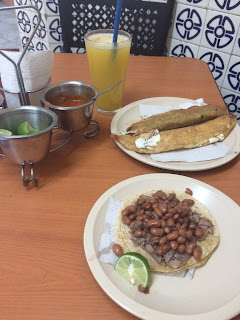
4.              Street food.  Food booths are everywhere, particularly around mass transit stations and markets.  You don’t have to go far to find a good taco, quesadilla or soup.  Look at where the others are going and try a bite of the local culinary scene.  One random find I particularly enjoyed was the Birreria y Taqueria Lupita, where friendly staff pressed fruit into juices and made tacos in full view of customers.  


Friday, March 07, 2008

Walking in a Cloud of Butterflies


Today we made it to the El Rosario sanctuary at the Monarch Butterfly preserve. We took an excellent tour that took us by bus three hours from Morelia, then up to 10,700 feet to see a colony of butterflies. Because it was a warm and clear day, many of the butterflies were flying, looking for water to drink and checking out the mating potential.

It was amazing to look up into the fir trees and see boughs so full of butterflies they seemed like termite mounds. The flying butterflies glided among us, their orange and black wings fluttering in the wind. I loved looking up into the clear slate of the blue sky to watch butterflies fly across my range of vision.

The science of the migration is yet unknown, however the butterflies somehow transmit the information to migrate back to this small region in Mexico through several generations.
The reserve was more touristed than I expected. Even on a Friday we trudged uphill behind groups of schoolchildren and families.

Despite the crowds, the experience of watching a random butterfly turn into more and more and more until the air and ground were ablaze with them, much as the locust storms must have been in the past, was a memorable experience.

Thursday, March 06, 2008

Traffic and Tlaquepaque


Today was our day to look around the city of Guadalajara, including the artisan suburb of Tlaquepaque. Trying to distill a metropolis of over four million people into one day’s worth of sights and experience isn’t possible. But we did our best to try to get a general sense of the sights and atmosphere.

The tour we planned to take didn’t depart because we were the only customers. So we found ourselves instead on the tacky red double-decker buses. We couldn’t have been more obvious tourists if we’d stuck signs onto ourselves. But the upper deck did provide a good view over the city, and especially of the traffic that we seemed to be continually stuck in.

We drove along the bus route, taking in the monuments, the fountains, the old Gothic churches and buildings, the parks where young couples made out and older people strolled, the businesses and the long rows of bright, noisy cars.

We sat in the direct, blazing sun, the force of the heat burning us to a crisp. We covered River with a blanket, as if he wore a burqa to protect his young skin.

We spent most of our time strolling the streets of Tlaquepaque. Compared to the hustle and bustle of Guadalajara, it is peaceful, tranquil, quiet, flowered, marked by artisan shops, beauty salons and fruit stands. We enjoyed an excellent meal of fish stuffed with shrimp and shrimps grilled with garlic and chili peppers, as well as the first margarita we’d had that didn’t skimp on the tequila.

Back in Guadalajara, we made a quick stop at the Cabanas. Our final meal in Guadalajara was an ice cream sundae at a local café. Then it was a long trip back across town to the bus station, back onto a comfortable ETN bus to spend one last day in the Morelia area. Tomorrow is the day I’ve been looking forward to most during this trip – a visit to the monarch butterfly sanctuary.

Wednesday, March 05, 2008

Viva Tequila


Tequila, the birthplace of Mexico’s national drink, is located only 38 miles from Guadalajara.

Upon leaving the city, the land became dry and golden, dotted with squat trees and occasional mountains. Our entry into agave land became clear with the first rows of the blue green plant. They grew in rows in the valley, surrounded by low mountains and extinct volcanoes.

We stopped at a roadside stand, where Tres Mujeres (3 Women) tequila was sold. We were able to walk through the fields, touching the sharp thorns on the spindly leaves. We learned how the plants are planted as babies, cut off from the mother plants and sowed elsewhere. They mature for seven to ten years. Then all the spindly leaves are cut of with a coa and the heart of the plant (called a head or pina, pineapple) is dug up. This weighs between 35 and 150 kilos.

The owners gave us pieces of fiber, what’s left after the juices and sugars are pressed out, to try. It was stringy and looked like beef jerky, but tasted like yam. We also sampled the tequila, made from 100% agave. It was very smooth and while it had the typical afterburn of straight tequila, it was good.

From there we continued on to the town of Tequila, population 35,000. On the way, we passed several distilleries, small and larger. We were going to visit the factory that produces Jose Cuervo tequila, called La Rojena. It is said to be the first tequila distillery and is the most touristed in the area.

There we learned more about the tequila production process and got to see it in action. Unfortunately, no photos were allowed. It was really cool. The giant heads rolled out of trucks and onto the ground, where they were loaded into ovens. Steam hissed out from the oven doors and the smell of agave hearts steaming in hot ovens was overpowering. The building, an original from 1795, had the spirit of colonialism, with the arches and columns at the unloading area, the maize color and the wrought-iron lanterns. We saw the fiber being loaded into a truck like so much hay, on its way to be used for furniture, paper, animal feed and fertilizer. We saw the white oak barrels the tequila ages it, stacked up to the ceiling. And we were allowed to sample each stage of the process – the fiber, the mosto juice, tequila after distilling, white tequila, aged tequila, and at the end, a Jose Cuervo margarita (though with very minimal alcohol content).

I learned about the different types of tequila. And during a visit to the Tequila Museum, also in town, I learned about the cultural relevance of tequila in local life.

We topped off the day with a mariachi concert in a central square, under the backdrop of the illuminated 17th century cathedral. It was great to see so many people out in the center of town on a Wednesday evening – families, couples, friends, al having a nice time.

Then we went to check out a restaurant we’d passed earlier that day, La Chata (Av. Ramon Corona No 126; near Juarez; Tel: 3613-1315 and 3613-0588 and Av. Terranova No. 405; Fracc. Providencia; Tel: 3641-3489) While passing by, I noticed the line of patrons that extended out to the street, and the eight short women, dressed in white, who molded and pressed fresh tortillas, fried meat, and scooped beans, rice and guacamole onto plates. We also stood in line, behind a single woman who like us, was attracted to the hubbub. The people in line appeared upper middle class, well dressed, confident, professional.

The line moved quickly, despite the small size of the restaurant, and we had a table within 30 minutes. The servers and bussers, all men, shook off yellow tablecloths, lay down new ones, took orders and brought food efficiently prepared by the upper middle aged women in white within a matter of minutes. I copied the people around me and ordered a white fruit drink, the water from aquachata (I can’t figure out what this is, if anyone knows, please fill me in). The meal was greasy, but tasty. Most fun of all was the atmosphere, watching how an operation could be so fast-paced, so efficient, and generate such enthusiasm.

Tuesday, March 04, 2008

On to Guadalajara


After spending a day in Morelia working, an interesting chance to see the professional life in the city, early this morning we moved on to Guadalajara. We traveled on the ETN luxury bus line, a route suggested by a colleague of mine. I was very impressed when she sent me a link to their site and I saw I could purchase tickets in advance with a credit card, and even select the seats. The wide seats reclined fully and had a sizeable foot and leg rest. Both shades and curtains covered the windows, helping us to get some sleep after the 6:30 a.m. departure. The staff provided each passenger with a soda, a sandwich and headphones with which to listen to the on-board movies. The driver drove safely and in a little under four hours, we had arrived in the second largest Mexican city.

Approaching Guadalajara, I looked out onto lots of empty land, a sight that always amazes me. There were arid, golden plains filled with short, stubby trees, some bare with twisted branches, others baring green leaves. Hills were striped yellow, brown and rust, like layered cakes. The city appeared suddenly – a gas station, a small enclave of pastel gated residences, and then a vast metropolis.

Guadalajara has a population of 1.6 million in the city and 4.1 million in the metropolitan area. In what I’d read about it before coming, it was said to be the business and technological capital of Mexico, the Mexican Silicon Valley. I read it had many of the positive aspects of Mexico City – the culture, the urbanity, the industry – without the drawbacks of pollution and high crime. In addition, it carried the distinction of being the home of mariachis and tequilas – two things I looked forward to experiencing.

We decided to try to get to our hotel by bus – a decision taken lightly while River was sleeping quietly in his carseat, a decision we later regretted as he began to scream on the crowded bus. During our long ride across the city, I noted the pickup truck with an electric saddle seat in back, a Walmart, a Pizza Hut, a Seven Eleven, narrow, two story houses, usually painted in pastels, with black gates and frequently graffiti sprayed on the walls. I noticed the heavy traffic, the high quality cars and the fact that most people carried their babies and their children simply in their arms, even if they had to lug a backpack and suitcase as well. People were friendly, with both the bus driver and the passengers ensuring that got off at the right place and headed in the right direction for the second bus.

Since River was upset by that point, we took a taxi the remaining distance. Guadalajara is located at 5200 feet, 1300 feet below Morelia. While Morelia is cool in the evenings and warm in the day, Guadalajara is warm in the evenings and hot during the day.

We’d had some trouble finding a hotel at the last minute. We were willing to splurge for our two nights here because we’ve mostly stayed in motels and private homes during this trip and because we were celebrating our anniversary. But all the hotels we called yesterday were booked, apparently due to an expo taking place. We chose a place we found on the internet (Posada San Miguel (Av. Hidalgo 1082; Col. Ladron de Guevara, 2 cuadras de enrique Diaz; tels: 3827-13-27 and 3827-13-17). It’s well located, but seems to have seen better days. While called a bed and breakfast, it doesn’t serve breakfast, the service is unimpressive and the room musty. For $75 it’s overpriced. But the location is good, the beds comfortable, and the cheap chandelier and cherubs painted on the high ceiling are at least amusing.

Everyone was tired from our 5 a.m. wake-up so we took it easy today. Our sole excursion was to visit the Casa Bariachi, a restaurant that hosts regular performances of ballet folklorico and mariachis. I called ahead and was told there would be performances at 3:30 and 4:30. We arrived at four, in time to catch the tail end of the dancers. I wondered who would be there on a weekday afternoon. Then I remembered my colleagues telling me that the Mexicans eat lunch between two and four. Still, there were only four other customers when we arrived, though more had come by the time we left.

The restaurant had a vast seating capacity and I imagined it gets packed on evenings and weekends. The performances were excellent. A twelve member mariachi band came out in purple suits, carrying a collection of instruments. The singers had rich, romantic voices and the musicians played upbeat tunes. Mark and I ordered margaritas, beef stewed in a spicy sauce, and shrimp in a mango sauce. It was our celebratory meal of our one year anniversary. Best of all though, was when the mariachis began to play Time to Say Goodbye by Andrea Bocelli. It was the Mexican version, with a mariachi twang. But the singer delivered the full power and passion of the song. And I was blown away by the coincidence. That was the song we’d walked down the aisle to exactly one year earlier. Our initial wedding plans (which didn’t happen), involved hiring mariachi singers in Nicaragua. So on our anniversary celebration in Mexico, to merge the planned mariachis with the actual opera song we’d chosen was a wonderful celebratory tribute.

We walked back to our hotel, taking a look at the neighborhood on the way. It appeared to be an upscale neighborhood, with offices of integrated psychology, many banks, and a Berlitz language school on the way. Most prominent of all however were the wedding shops. We must have passed at least ten bridal shops within several blocks. Many of them were housed in ornate buildings, painted pink, gold or white, with arches and elaborate rooftop balconies. Large plated glass windows showcased the stylish dresses – white bridal dresses and colored ballgowns. There were also photographer’s, floral shops and fine fabric stores. We seemed to have stumbled upon wedding central.

Life here seems to be quite modern, well developed, and rather expensive. Our meal was almost $50. Mark was thrilled to find his favorite diapers, Pampers Snugglers. A series of brightly lit convenience stores, filled with colored packaged products, Oxxo, appear every couple of blocks. The foreign presence is substantial. As my colleagues yesterday told me, here it is no big deal for a young person to be offered a job with a foreign institution. There are so many of them that it lacks the prestige it carries in other developing countries.

Of course, what is nice about it is seeing that the quality of life for the locals seems pretty high. “It’s great not having to see really depressing destitution all around you,” my colleague Annika said, who has spent years in Central America. “And unlike a place like Nicaragua, where people will always be poor, here you can see people are given a chance, that they can move up.”

I’m really enjoying being back in the mystery and excitement of a different country, and of course, having the opportunity to speak Spanish. I’m also glad for River to be exposed to Spanish, even if he can’t distinguish languages yet. We have two more days in Guadalajara. Having checked out the mariachis, tomorrow we’ll focus on tequila, taking a tour to the town of Tequila, where the beloved beverage is produced. On Thursday we’ll tour Guadalajara itself and try to get a grasp on this large metropolis.


Sunday, March 02, 2008

Morelia, Mexico


Last night we took a direct flight from San Francisco to Morelia, Mexico. Morelia is the most expensive city to fly into Mexico to and our flight on Mexicana Air was only about 1/3 full. The 3.5 hour flight was pleasant though. The flight attendants were courteous, we each had our own row of seats, and we were provided with pillows, blankets, a meal and legroom. Nonetheless, because the flight was in the middle of the night, we arrived at 5 a.m. local time pretty exhausted.

I was impressed at the airport with the modern, clean bathrooms and the presence of a changing table. We made it through immigration and customs with no real hassles, then took a taxi to the homestay where we’d be spending the next two nights. It was a 30-45 minute ride to the city, so I chatted with our driver, Jesus. He was very friendly and polite, framing all of his questions with, “If it’s not an indiscretion,” “If I may ask,” etc. He told us the city is safe and one doesn’t need to fear assaults here. He offered us information on what to see, welcomed us to his city, and told us he’d be happy for us to stay here. I was surprised and pleased to see that he drove carefully and slowly, a sharp contrast from the taxis I’ve taken recently in Central and South America.

We arrived at our host, Renata’s, house, just as the dark sky was lightening. She undid the chains on the three doors leading into her house and welcomed us in. We were given a small but comfortable room with two twin beds and access to a modern bathroom. We slept for several hours, went down for a tasty breakfast, then slept some more.

Renata works at an adult school, which covers post high school material. She doesn’t receive tourists so often, but when she does they come from the U.S. and Canada. She said she usually receives older tourists and young people. She’d never hosted a baby until River showed up though and she really fell for him, even offering to babysit when we went out later in the day.

When we finally got going, around 1 p.m., we walked out to the local bus stop and hopped onto the orange combi (minibus) that would take us into town. We both got seats and it was a pretty easy and comfortable ride. Again, our driver was surprisingly patient and cautious.

As we neared the city center, the streets narrowed and the sounds became more vibrant. Being Sunday, many of the local businesses were shuttered, but many families had still come out for the afternoon.

We arrived at the central square, marked by the city landmark, a cathedral built in 1744. Both the cathedral and the surrounding buildings were built of rose-colored stone, giving it a colonial and Spanish appearance. We walked a few blocks looking for a place to change money. We noted the popularity of ice cream and fruit drinks, with many people either licking a cone or sucking on a straw.

A series of cars drove by with a racket. The occupants waved and shouted out the windows. They held signs that said things like “Live to love,” “treasure the family,” and “Be happy.” We thought it was something political, or maybe a wedding. But when I asked a bystander what was going on, she said they were celebrating The Day of the Family, which is today. I was impressed that among all the activities they could have chosen to do on a Sunday afternoon, they went out to promote love, happiness and family unity.

We took a one hour tour by trolley car of the city, which gave us a nice introduction to the city layout and the truly vast nature of the colonial architecture. After seeing the long stone aqueduct with cupolas that we drove alongside, the numerous fountains, and the stone buildings and churches, many built in the 1500s to 1700s, I understood why Morelia was named a UNESCO World Heritage Site in 1991.

After the tour, we spent the remainder of our afternoon in the Garden of the Roses, a small park with a fountain and stone benches, as well as three cafes with outdoor tables. Enjoying grilled trout and apple crepes, we spent a few hours there, warmed by the nice breeze, enjoying the sound of the tinkling fountain, the low chatter, and the passing guitarists.

The cost of living here seems to be less than in the U.S., but substantially more than in the other countries I’ve worked in recently. Our lunch cost $30 for the two of us and since we barely saw any gringos, the prices seem to be set for locals rather than tourists. We also saw a large selection of consumer goods available, everything from Xboxes to Californian children’s clothing to Allbran cereal bars.

I liked seeing how the families gathered in the parks and squares, especially in the early evening. There, a large crowd surrounded a pair of performing clowns, concerts were underway, and children nudged their parents to buy brightly colored balloons and cotton candy. I had the impression that, in general, people seemed to be content. I certainly enjoyed my first day in central Mexico.

Sunday, February 10, 2008

Recent Stuff


Lessons I’m learning about parenthood:

-The Fisher-Price Papasan swing is the single most useful item we bought.

-Cloth diapering is not as bad as it’s made out to be. We just started about a week ago, using BumGenuiuses. They come in Easter colors, fasten in the same simple method as a disposable, and wash easily in the washing machine. Only drawback is that at River’s size, they make his butt look rather large. But he doesn’t seem to mind.

-Thrush is evil

-Pumping milk is a whole job unto itself

-It’s incredibly rewarding to watch one’s own child develop and interact more and more each day.

-Despite having the wonderful luxury of help, it is still extremely difficult to get anything done, especially when in the house.


Other things happening:

-The Presidential election race is on in full mode here in the United States and I’m heartened to see the level of interest and participation. It seems likely that the next President will be either McCain, Clinton or Obama, any of whom would be likely to reverse some of the horrible policies of the past several years. I myself was unable to vote since I called to register one day after the deadline. Luckily, my chosen candidate won in my state, so I didn’t feel too bad.

-We are preparing to take a long trip down the West Coast and to Mexico and I’m busy packing and preparing for that. It’s going to be a whole different ballgame with a two-month old in tow. But I’m very excited to get on the road, to see friends I haven’t met in a while and to explore new places. The fact that the climates should be nicer is just an added bonus.

-With baby and his added equipment, we need to try harder to pack light. So I bought myself a new little mini-computer, the Fujitsu Lifebook u810. It weighs only 1.5 pounds and functions both as a laptop and a notebook. I love it.

-River and I went to our first post-natal yoga class today. At almost 9 weeks old, he was the youngest one there. The others ranged in age from 3-10 months. It was fascinating to look at the other babies and see what lies ahead for us. Those that sat up and crawled looked so large and developed to me, though I suppose to most people they still look like little babies. I could feel how much each of the mothers in the room loved their babies. I thought about the little boy in foster care one of my relatives is trying to adopt and wished that all children could start off life with such love and devotion. They deserve it.

-I saw a couple good movies lately. The Italian is about a 6-year-old Russian boy, about to be adopted by a loving Italian couple. But he’s determined to try to find his birth mother first. The story is line with the Russian nationalist desire that children not be sent overseas (this belief gained credence after stories of American parents abusing the Russian children they adopted reached the mainstream) but rather retained as part of the narod. But it’s also just a good story about a very determined little boy.

Sicko has already received plenty of media attention. As an employee of a European company, I already know and understand the differences between the American and European social systems. I already benefit from the long vacations and the humane maternity policies. But to see that the United States is surrounded by countries doing so much better in meeting the needs of their citizens – Europe, Canada and Cuba – was very disheartening. I especially found the free childcare and free university education amazing. Right now, in my family, we are spending close to 20% of our take home pay on childcare and savings for college education for just one child. Should we drop from two to one incomes, it would be a third of our income. Should we have more children, even more. So while yes, those countries (esp. Europe and Canada) may have higher taxes, they also have so much more freedom. They don’t have to make decisions at any point in their lives just because they are desperate to retain the insurance or the benefits they need for their children. They are free to make choices of where to live and where to work because it is the right decision for them or their families. They may have reduced incomes throughout their lifecycles (due to the extra taxes) but they still live at a comfortable level and they don’t encounter the serious resource shortages that occur while attending college, while having and raising children, or while entering old age. That income smoothing seems likely to reduce stress, which would improve health and happiness, and yes, they do live longer.

Friday, April 06, 2007

Good Friday


Today is Good Friday, a national holiday in Bolivia. Virtually the entire city shut down. When I went out to try to find some food, the only option I found was a nearby hotel. All the cafes and shops were shut. Very little traffic moved on the streets. Many businesses had dogs sitting in their front windows, ready to bark at any intruders.

I read in the newspaper told about a university student who was attacked in a taxi just a few days ago, and right in my neighborhood. After she got in, the taxi drove a bit, then three others jumped in with her. She was seriously beaten.

It’s definitely been difficult for me to take taxis since my bad experience in Nicaragua. I was told I’d have a car and driver here, but that didn’t emerge. I was told to take radio taxis, as those are linked to a call center and it’s a check on their viability. But even to get a cell phone so I could call a radio taxi was a struggle.

I’ve felt some pressure as if I’m being overcautious, or over demanding. And sometimes it’s a pain to have to wait 10-15 for a radio taxi to come when one is ready to go right away. I’ve been here almost two weeks and haven’t had any bad experiences yet. That leads me to relax and feel like everything is OK.

It’s tempting to try to ignore the signs that danger is present, even though the gates and grills in front of every store and home, the guard dogs, and the 24-hour guards on the street give another picture. But this article reminded me that it only takes one incident, and that it can happen, even in the place that everyone is telling me is so safe. So I’ll continue taking precautions.

I’m currently reading The Plumed Serpent, by DH Lawrence. In it, Kate, an Irish woman, is in Mexico, during the Revolutionary times. She often finds it scary and doesn’t like living with fear. Her friend Cipriano tells her, “..there must be a bit of fear, and a bit of horror in your life…The bit of horror is like the sesame seed in the nougat, it gives the sharp wild flavour. It is good to have it there.”

I feel that little fear, the little horror, in the back of my mind here. I suppose it does give life a more sharp, wild flavor. But if I had a choice, I think I’d prefer to live without it. It causes people to construct prisons around themselves – to lock themselves into their secure homes, secure vehicles, and secure gathering places. It keeps them from interacting, from walking, from mixing with the full array of life around them.

I moved from my hotel into a condominium today. It’s a really cute, furnished place, in a Mexican style, that looks out onto a swimming pool. I like it a lot and despite the fact that it’s on the first floor, the security seems to be pretty good. Yet, it’s still a little scary to be alone. And it’s also strange to get used to having a whole three rooms to myself when I’ve spent the last two weeks in a single room.