
 Posts
Posts


Friday, August 14, 2009
Things to pack for Iceland


Thursday, August 13, 2009
The best museums in Iceland


Monday, August 10, 2009
The festival I must go to someday


Friday, August 07, 2009
Favorite food in Iceland


Thursday, August 06, 2009
Favorite accommodations in Iceland

Wednesday, August 05, 2009
Sleeping bag accommodation

I came across another good idea here in Iceland. It’s called sleeping bag accommodation. When you book a room, you ask for either a prepared bed or sleeping bag accommodation. A prepared bed is what you get in a standard hotel room. In sleeping bed accommodation, the room is the same as usual, but without bed-linens. The guest is expected to bring their own sleeping bag. As a result of not having to clean and replace the linens, the innkeeper charges the guest less.
Sleeping bag accommodations can come in two types – either a dorm room shared with other guests, or standard singles and doubles, identical to typical hotel stays but without linens.
We booked our first sleeping bag accommodation last night at the Hotel Framtid in Djupivogur. We had the option of a prepared room for 10,100 kroners, or a two-person sleeping bag accommodation for 6,800 kroners. Both had shared bath. For the 3,300kr savings (about $28), we were ready to ditch the sheets. We ended up with a cozy room with a nice heater and a view of the harbor. I’m a new fan of Icelandic sleeping bag accommodation.
Tuesday, August 04, 2009
Real Icelandic Weather
In this kind of weather, in which you are wet and feel almost powerless against the strength of the wind, the temperature doesn’t matter too much. It’s cold no matter what.
As a result, we spent much of the day driving. At times, the wind was so strong we could barely keep our little Suzuki on the road. Our back window vibrated so hard I worried it would implode. Giant mountain ranges disappeared under a layer of fog.
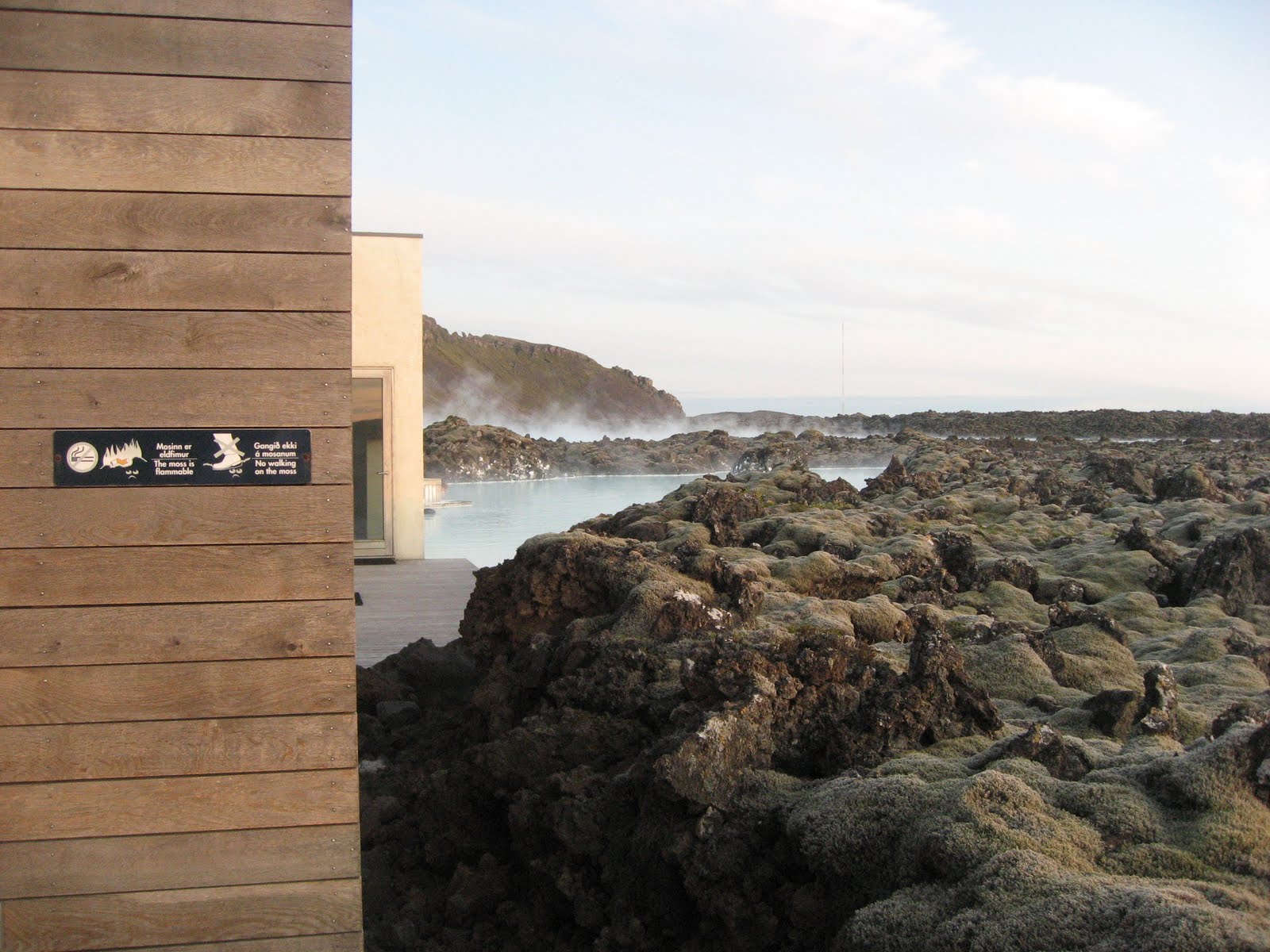
We were lucky to have a clear patch for long enough to take a one hour hike in Skaftafell National Park. We ventured out for a short walk across moss covered lava blobs in a drizzle and I wished for mittens, my wool hat and long underwear when we went out on an amphibious boat to see icebergs fallen from a glacier. Most of the time we just drove, happy to have a warm vehicle to shelter us, even as we lamented the views we missed due to the obstructed scenery.
Worst off were the poor bikers. Just yesterday, I envied the cyclists I saw traveling the Ring Road. It’s a beautiful road for biking, flat, endless scenery, not too much traffic, easy to follow, plenty of space to camp. It reminded me of the wonderful experience of cycling Lake Issyk-Kul in Kyrgyzstan and I wished I could join them. However, today I saw the downside – bikers hiding between rocks to seek shelter from the wind, bikers pedaling slowly, or walking their bikes in winds so fierce they could barely stand up, bikers soaked to the skin, with no signs of civilization for miles and miles in either direction. For anyone thinking of biking the Ring Road, you should know that it offers great possibilities. However, when the weather gets bad, it’s really, really bad and changes occur quickly. I’d advise bikers to either have some kind of back-up plan or be prepared to endure potentially miserable conditions for many hours.
In the evening, we reached the pretty and welcoming harbor village of Djupivogur. The Framtid hotel is warm and inviting, with beautiful views of the harbor and it has a nice restaurant. There, we were told that with the exception of a break in the weather yesterday, it has been raining for the last week. Rain is forecast here for the next nine days.
Due to how quickly the weather patterns change, it’s hard to make plans based upon the weather. We had been hoping to go horseback riding tomorrow, perhaps a boat trip, perhaps some hiking. Now we’ve learned to play it by ear. At the very least, we are experiencing real, Icelandic weather.
The video is from a roadside stop. The mangled metal is a former bridge that was ruined by the weather.
Monday, August 03, 2009
The Faces of Icelanders
We’re enjoying our visit to Iceland very much and I’m spoiled daily by so many striking sites and interesting things to learn about. However, Iceland is one of those places that is great to visit, but I wouldn’t want to live here. Why? It’s cold. Even now, at the height of summer, with beautiful sunny days and little rain, I dress in three layers and carry around a wool hat. Also, the winters are dark. And the land is far from other places.
Reading books, such as the recent novel, The Tricking of Freya, and the opus by Nobel Prize winning Icelandic author Haldor Laxness, Independent People, gives me further understanding of what life was life in earlier decades and centuries. They had to contend with volcanic eruptions, with limited diets and high infant mortality.
Those who endured the hardships to build their life and their families here strike me as noble and courageous. Today I visited the Skogar Folk Museum, where I was able to take a closer look at how life was lived. This is a top-notch folk museum, with extensive collections of implements and excellent creations of dwellings and other buildings, including sod houses. For those who visit the southeastern part of Iceland, this is well-worth seeing. A bonus is that it’s located right next to a stunning waterfall.
More than anything else, the faces that peered out from the old photographs struck me. Here are a few of them, faces of Icelanders:


Saturday, August 01, 2009
The Golden Circle

We took the Golden Circle classic tour offered by Iceland Excursions. This tour stopped first at the geothermal power station. I had expected that we’d go into the power station and see how it worked. Instead, it was just a view from afar. But it was still worth seeing. The surrounding landscape was stunning and filled with hiking trails. The sight of steam rising up from amidst mountains and the long tube that follows the road, carrying warm water to the city, is worth seeing.
The tour included only transportation and the guide in the 60 euro charge. There were plenty of opportunities to buy food along the way. I think if I had it to do over again, I would have brought a picnic and eaten besides the Gulfoss waterfall. The best food was at the cafeteria on the site of the Catholic church headquarters. The final stop, supposedly a religion museum but really just a big gift shop, is best used to try the creamy Icelandic soft serve, at a very reasonable 100 kroners per cone.
Friday, July 31, 2009
Initial Impressions of Iceland

I’ve been in Iceland for two days now and like it a lot so far. There is much to explore and our days are full. Some of my first impressions are:
- It’s cold. Even in late July, one can wear a long-sleeved shirt, a sweater and a jacket. The temperature varies throughout the day, so layering is a must.
- It’s cheaper than it used to be, but still expensive. Many of the prices, especially for tourist-related services, have been raised accordingly to pre-devaluation of the kroner levels. Nevertheless, it’s still cheaper for tourists than it was a year or two ago and will probably remain that way for a while
- It’s spacious. The land is vast and the population small.
- I like the people. Not only are they beautiful, they are proud, individualistic and quite egalitarian. Sixty percent of Parliamentarians are female and they have the world’s first openly gay prime minister.
- Reykjavik is a very walkable city. I’m putting on well over 10,000 steps per day without a problem.
- Reykjavik is surprisingly loud. Frequent airplanes plus traffic, harbor noises, skateboarders and blaring music make one suspect that there aren’t many noise ordinances here.
- It’s light in summer. It’s hard to feel as though as it’s late at 10 p.m. when the sky is still fully light. This takes some adjustment.
Climbing Mount Esja

It’s an easy drive from the capital. Or you can go by bus, taking bus 15 from the main bus station and transferring to bus 57. Check the schedule ahead of time though because there can be a delay of an hour or two between buses.
The trail goes up from the parking lot where the bus drops you off. It’s at a consistent incline. Dress in layers and bring water, a snack and a hat. Walking sticks are helpful if you have them.
The trail is well-mapped and there are six points along the trail, followed by a rocky peak that is a difficult climb. Each point offers increasingly wide views over the capital, the water and the harbors.
Enjoy the panaromic views, the sound of mountain waters rushing down the rocks, the various wildflowers growing amidst the rocks and the long-haired sheep grazing nearby.
At the base of the mountain, a small café offers delicious health shakes, as well as snacks and modern toilets. There are port-o-pottys in the parking lot. When waiting for the bus, stand out at the road so that the bus driver can see to make a stop. She will then pull into the stop in the parking lot.
Tuesday, July 28, 2009
Local Minnesota

Service is excellent, despite the bar atmosphere, it’s very kid friendly, and the menu (most of which is fried) has almost nothing over $5.
Fancy, no. But a good deal? You betcha.
Sunday, June 28, 2009
A trip to Wilmington, Delaware


Saturday, June 27, 2009
Bucks County camping


Saturday, February 21, 2009
Chita

A nice American acquaintance (who has lived here an unbelievable 13 years) met me at the airport and after getting me settled at a nice and reasonably priced hotel, dropped me off at the central market. This used to be my favorite place, where Central Asian traders smiled over stacks of bright fruit and vegetables. The market had changed, with booths for clothing and goods replacing much of the vast open market space. The Central Asians were still there, although in smaller numbers, and they were still the most friendly.
Only at the central market in Chita can someone ask me, “Are you from the Ukraine? Mongolia?” and expect an affirmative reply.
I hoped to walk through town, back towards my hotel, while picking up some groceries, getting something to eat, and seeing how the city has changed.
Instead, what I found is that, with the exception of a few new buildings – a hotel, a couple of apartment blocks, a couple of shopping centers - the city has remained frozen in time. The exact same restaurants and shops stood in the exact same places and in the exact same condition, plus six years of wear. There was very little in the way of renovation, improvement, the flourishing of new businesses. The highlight of the town is the ice palace and slide, located in front of the giant Lenin statue (still standing) and built annually by the Chinese.
Shortly after leaving the market, I realized I’d forgotten my mittens. I wrapped my hands in my scarf and continued on. I was quickly reminded of the power of the Siberian cold. First, the nose hairs stand to attention as they begin to freeze. The hands become uncomfortable cold, and with time, become stiff and lose dexterity. The nose begins to drip and that, plus the frozen nose hairs makes for a cold mess. Then the face begins to stiffen from the cold, making it difficult to speak. The cold seems in through the jeans into the legs and through the collar into the upper chest. The cold air enters the esophagus and the lungs like a thick, chilled drink. I looked for the buses I was told go to the hotel, but couldn’t find nay of them. Nor did I find an easy taxi. So I kept walking.
I moved from the main street, Babushkina, down Chkalova, through the center of town, and up Lenin Street, the main throughway. I hoped that I’d find the buses there, and if nothing else, I could find a café where I could stop to warm up and have something warm to eat. No luck on any counts. I saw one café, Vesta, that I recognized from before. When I went in, I found the tables in disarray, soggy pirozhki in the front case, and no service staff. A few blocks later, I passed Tsyplata Tabaka, a café I remembered that serves nothing but chicken, but the chicken is really good. With some excitement, I approached the front door. But it was locked and there were no hours posted.
I was so cold at this point I could barely move. I went into a shop to warm up and asked the saleswomen where I could find something to eat. This was the main street in the center of town. They named the two places I’d just tried and couldn’t come up with any others.
Finally, near my hotel, I found a little stand selling grilled chicken and shaurma (made with tiny chunks of chicken and lots of mayonnaise and cabbage in a flour wrap). That was enough exploring for the day. I happily entered my warm hotel, made two cups of hot tea and luxuriated in a steaming shower.
In the evening, I visited Lukas and his family. When I told him and his wife Natalia about my difficulties finding anything to eat and my surprise at the lack of cafes or restaurants, Natalia, a Chitan said, “We have a Subway. And a Baskin Robbins!” They mentioned two other cafes, but they are hidden away. Lukas said that one positive change has been that many of the roads have been repaved, saving drivers the cost of replacing their shock absorbers each year. However, even he is considering sending his son to study overseas in order to expose him to a greater variety of people and professions. He said here, the youth want only to study business and law. They don’t see a way to make a living in any other profession.
I’m enjoying the hot water, since I don’t know whether or not I’ll have any in Aginsk. But I’m not at all disappointed to be leaving Chita tomorrow.
Friday, February 20, 2009
getting from Moscow’s Sheremetyevo to Domodedovo airport
1. Take a taxi from one airport to the other. This is likely to cost you several hundred dollars and the traffic can be brutal.
2. Travel by train, which requires three connections – first to Rechnoi Vokzal metro, then Rechnoi Vokzal to Paveletsky, and Paveletsky to Domodedovo. This is the cheapest option, but you’ll need to lug your bags around (and probably can’t avoid stairs entirely). It also takes several hours.
3. Take a taxi to Paveletsky, then take the train to Domodedovo. The taxi to Paveletsky costs 1600 rubles now if you call a taxi to meet you at the airport. This is a good option if you’d have to wait a while at Sheremetyevo for the first train.
At Paveletsky station, for about 300 rubles you can check in for your flight and check in your luggage, allowing you to travel baggage-free to the airport or to spend some time around town.
A few tips to make the transfer easier are:
- Choose a flight that arrives in Moscow in the morning to maximize your time.
- The taxis at the airport are great extortionists. To receive a normal price, call a taxi (232 company (telephone 7 495 232 1111 is reputable) and have it meet you outside customs.
- Pack in a way that allows you to carry your luggage easily.
Arrival at Moscow Sheremetyevo Airport
Upon arrival at Sheremetyevo, you’ll go through immigration, pick up your baggage, then pass through customs. There is an area for people to meet you upon exiting customs. If you order a taxi in advance, this is where you will find the driver.
There are two places to change money in the airport, as well as an ATM machine. The first is just to the right of customs, beyond a door that says Crew Check in. The other is all the way down the hall to the right, just past the bright yellow Evrosite telephone kiosk. The exchange rate is reasonable, currently 34 point something to the dollar, compared to 35 point something you’ll get in the city.
You can buy a local SIM card for your cell phone, or purchase a phone at the bright yellow Evrosite booth. The staff will ask where you plan to call and recommend the cheapest option.
There is a café and several newsstands in the airport.
To get to the city, you can:
1. Take the train.
2. If your luggage is light, you can take a marshrutka (mini-van bus) to Planernaya or Rechnoi Vokzal Metro stations. This the cheapest option. Go out to where the taxis are. Just beyond the taxis, in the third lane from the exit door, the marshrutkas wait.
3. Call a taxi ahead of time, or from the airport, to come meet you. It’s significantly cheaper to do this than to use the airport taxis. One reliable company is 232 (Telephone: 7 495 232 1111).
4. Take a licensed airport taxi. Be prepared to pay a lot.
Friday, February 13, 2009
Things I'm Learning About Planning a Trip to Russia
· It is no easier to get a visa to Russia than it was when I last visited several years ago. If anything, it’s more expensive and complicated. Russia has not yet shown signs of wanting to encourage tourism.
· The cheapest tourist visa for Americans will cost you $181 (for two week processing and an invitation).
· The Way to Russia boards have the most comprehensive and helpful information on visa registration I’ve found. Having been through the process of registration in the Russian hinterlands before, I wonder if they are overly optimistic in their thoughts that local landlords can help register you. My guess is that this would take a substantial amount of time on the part of the landlord and probably some type of bribe. If you are going to ask a landlord to do this, make sure you are paying them enough to compensate them adequately for the hassle.
· For invitation processing, I used a company called Russian American Consulting, which is staffed by former employees of the Russian Foreign Service. What I like about this company is that you send your passport directly to them and they handle all interactions with the embassy. No need for contact with the Russian embassy on your part. They also followed through with what they promised and were professional and courteous. If you will be staying primarily in the Moscow area, they can register the visa for you for 1500 rubles. Otherwise, you have to register with the local authorities, which is a whole adventure in itself. Another, slightly cheaper, option that people recommended to me is Way to Russia.
· The tourist visa application, apparently modeled after the application the U.S. embassy makes Russians fill out, asks questions I’ve never seen on another visa application – such as all the countries you have visited in the last ten years and the dates of visit, full information on your last two places of work, including your supervisor, all educational institutions ever attended after high school, and all professional, civil and charitable organizations you have ever been a member of, contributed to or worked with. I understand they want to make a point that the U.S. visa procedures are cumbersome, expensive and condescending. However, I think they need to keep in mind the numbers of Americans (very few, I imagine) who stay illegally to live and work in Russia. Conversely, the number of Russians who stay in the U.S. illegally is significant and there is a whole network set up to assist them in New York.
· S7 airlines, now the largest domestic airline in Russia, sells tickets online. The customer service is excellent. But watch out for your bank charging you a foreign transaction fee of 2% or more. I was surprised when my debit card, issued by ING Direct (a bank I loved until that moment) added another 2% to my already expensive Moscow to Siberia flight. Capital One credit card doesn’t charge any foreign transaction fees. Also, if you purchase your domestic flight separately from your international flight, you’ll be subject to the 20 kilo free luggage limit.
Monday, February 09, 2009
The Magic of Mullica Hill


Another highlight in town was the Amish market, where we stocked up cheeses, hormone-free milk, canned peaches and three-bean salad and deli meats. Unlike our usual Amish market, this one had a doughnut counter, where you can see the dough being cut, and a counter selling kettle soups with delicate scents. The prepared food section is excellent, with pretzel dogs, roasted duck, fresh fries, sweet potatoes with marshmallows and many other items glistening in the case.
I came across this helpful blog post, which describes the culinary highlights of Mullica Hill and suggests it as an alternate to food courts when traveling between DC and New York. After visiting the above two places, I’d say that’s a very good idea.
Wednesday, February 04, 2009
Super Russian film
Ostrov (The Island) is about a man who commits a terrible sin during the war, then spends the rest of his life in guilt. He lives in a monastic community on a remote island. While I’ve never been to Solovetsky Islands, the movie brought to mind all I’d imagined of this remote northern spiritual community.
The cinematography is stunning, with widescreen panoramas of snow, water and remote isolation captured with a deep sense of beauty. The acting is good, the topic of guilt and repentance thought provoking and the story line unique. An all around excellent film, worth the time spent watching it.